Cuba Grid Operator Forecasts 1,920 MW Blackout Monday

ENERGY · CUBA
Key Facts
- —The country Cuba, a one-party state about 90 miles from Florida, runs its power grid through the state utility Unión Eléctrica (UNE), which relies on ageing oil-fired plants.
- —Why it matters Daily rolling blackouts shape work, food storage, water pumping and migration pressure. The grid has collapsed nationwide eight times in 2026, most recently on 18 September.
- —Why now UNE published its Monday forecast on 5 October, a day after Guiteras, the country’s largest plant, rejoined the grid.
- —What happened UNE forecast 1,260 MW available against 3,150 MW of peak demand on 5 October. It expects to cut 1,920 MW at the evening peak.
- —The numbers Sunday’s actual peak cut was 1,895 MW at 8:10 p.m. Solar parks delivered 5,115 MWh that day, peaking at 795 MW around midday (UNE, 5 October).
- —What it means for you Travellers and families with relatives in Cuba should plan for long evening outages. Charged phones, power banks and flexible call times help.
- —Still open The actual peak cut for Monday night, due in UNE’s Tuesday note, and whether Guiteras holds its output.
Cuba blackouts will deepen tonight: the state grid operator expects to cut 1,920 megawatts at Monday’s evening peak. That is about three-fifths of the demand it expects at the busiest hour.
For Americans with relatives on the island, 90 miles from Florida, that means long evening outages and dropped calls. The forecast comes a day after the Guiteras plant, Cuba’s largest, returned to service.
What the Grid Operator Forecast for Tonight
The Unión Eléctrica (UNE) published its daily note on Monday 5 October, carried in full by the state outlet Cubadebate. It forecasts 1,260 megawatts (MW) of available generation against a peak demand of 3,150 MW.
That leaves a deficit of 1,890 MW. If conditions hold, UNE says the “affectation”, its term for load cut off by scheduled blackouts, could reach 1,920 MW.
The shortfall was already large at dawn. At 6 a.m. UNE counted 1,260 MW available, demand of 2,695 MW and 1,442 MW cut.
For midday it estimated a cut of 1,500 MW. Service, in other words, is rationed through the day, not only in the evening.
Tonight’s forecast is slightly worse than Sunday’s. On 4 October UNE had forecast a 1,840 MW cut, and the actual peak cut was 1,895 MW at 8:10 p.m.
The main reason is demand. UNE expects the evening peak to be 100 MW higher than on Sunday, while available supply rises by only 20 MW.
Which Plants Are Down
UNE lists three broken units: Felton 2 in Holguín, and Renté 3 and 6 in Santiago de Cuba. Three more units are in maintenance: Santa Cruz 3, Nuevitas 5 and Renté 5.
On top of the outages, UNE reports 519 MW of limitations on thermal generation. This is capacity that working plants cannot deliver, on top of the units that are fully out.
Fuel is the other gap. On 18 September, 114 small distributed-generation plants with 926 MW of capacity sat idle for lack of fuel, the Argentine news site Infobae reported.
Monday’s note does not give an updated count for those plants. The pattern of recent weeks, however, has been the same.
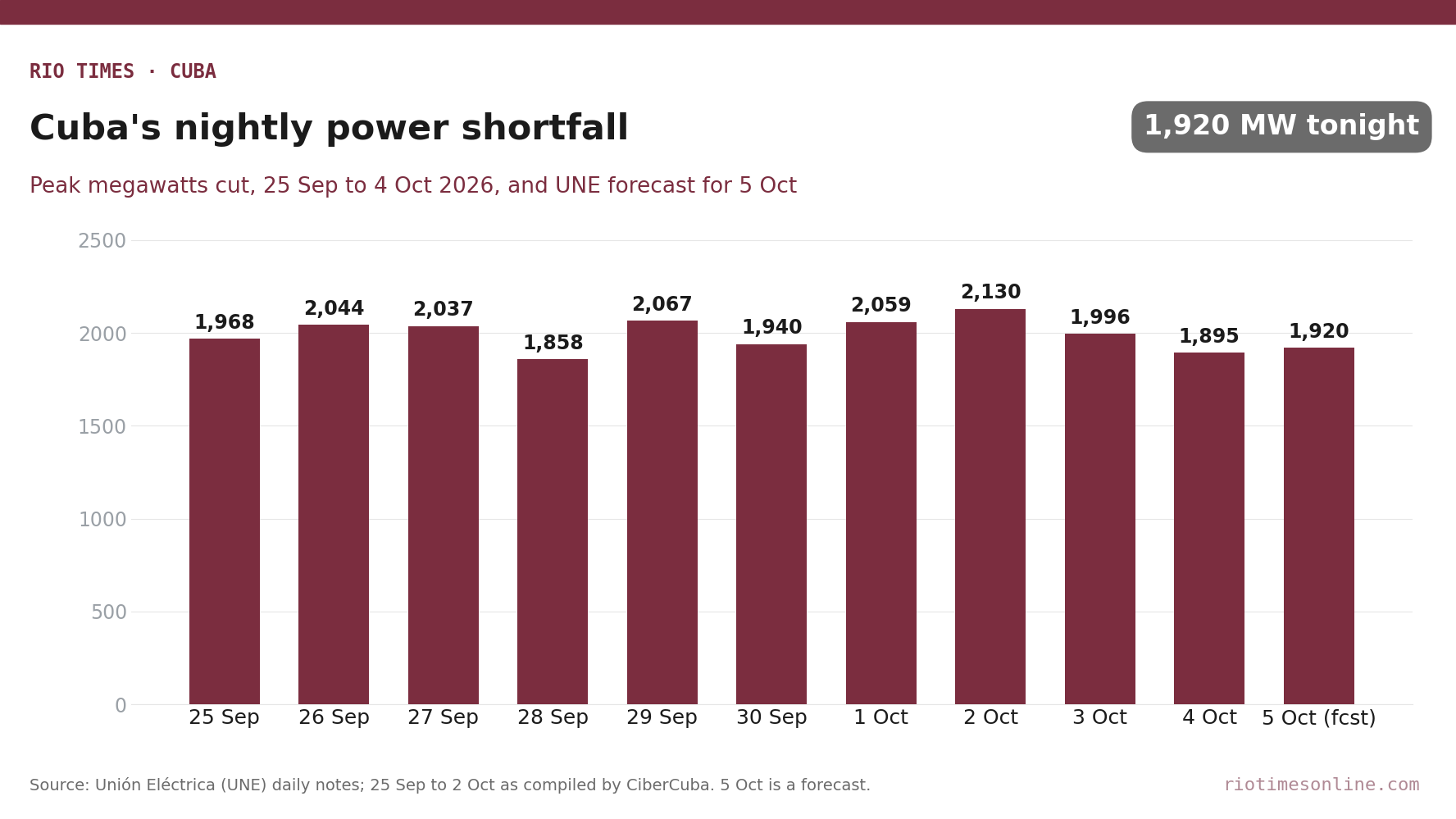
Reviewing UNE’s notes, the independent outlet CiberCuba found that 23 of the 28 comparable days from 3 September to 2 October topped 2,000 MW. The worst day was 5 September, at 2,396 MW.
October began at 2,059 MW on the 1st and 2,130 MW on the 2nd. Saturday 3 October peaked at 1,996 MW, according to UNE.
What Is Keeping the Lights Partly On
The steadier news is solar. Cuba’s photovoltaic parks delivered 5,115 megawatt-hours on Sunday, with a peak of 795 MW around midday, UNE said.
That output helps in daylight but fades by the evening peak. It explains why the midday cut is smaller than the night-time one.
The second support is the Antonio Guiteras plant in Matanzas. It resynchronised at 9:33 a.m. on Sunday, as we reported in Cuba’s Guiteras Power Plant Rejoins Grid After Repair.
Guiteras is not listed among the broken units in Monday’s note. CiberCuba counts at least 17 unplanned outages at the plant this year, so its stability is the key variable.
Cuba blackouts near 2,000 MW are serious but are not the same as a total collapse. The last nationwide failure came on 18 September, as reported in Cuba Grid Failure: Line Trips, Not Gunfire, Caused 8th Blackout of 2026.
What It Means for You
For American travellers, the practical effect is long evening outages in many neighbourhoods. Lodging with its own generator copes far better than lodging without one.
Families calling relatives should expect phones to die and internet to drop when local circuits go dark. Agreeing call times in advance helps.
Cuba blackouts also affect water pumping, refrigeration and small private businesses. That pressure feeds the wider economic strain described in Cuba Explained 2026: The Economy, the Exodus, the System and What to Watch.
Any relief would show up first in UNE’s daily availability figure. New fuel deliveries or more plants returning from repair would both lift it.
What Is Not Known
The actual peak cut in Monday night’s Cuba blackouts will only appear in UNE’s note on Tuesday morning. Sunday’s result came in 55 MW above its forecast.
UNE has not said when the three broken units at Felton and Renté will return. It has also not published a date for new fuel shipments.
How big are the Cuba blackouts tonight?
The state grid operator UNE forecasts a cut of 1,920 megawatts at the evening peak on 5 October. That is about three-fifths of the 3,150 MW of demand it expects.
Why is Cuba short of electricity?
Several ageing oil-fired units are broken or in maintenance, others run below capacity, and many small distributed-generation plants lack fuel. Solar parks help during the day but not at night.
Is it safe to travel to Cuba during the blackouts?
The outages disrupt lighting, water, internet and some services for visitors. Travellers should carry power banks, confirm whether their lodging has a generator and keep plans flexible.
Sources: Unión Eléctrica daily note of 5 October 2026 via Cubadebate; UNE note of 4 October 2026 via Cubainformación; CiberCuba analysis of UNE data, 4 October 2026, and its blackout tracker; Infobae, 4 October 2026; CiberCuba on Guiteras, 5 October 2026.
This article was drafted with automated assistance and reviewed before publication. How we use AI · Report an error · Editorial responsibility: Matthias Camenzind, Editor-in-Chief