Costa Rica Chief Prosecutor Carlo Díaz Seeks Second Term, With Court Vote on 19 October
POLITICS · COSTA RICA
Key Facts
- —The country Costa Rica, a Central American democracy where the Supreme Court, not the president, appoints the chief prosecutor for four years.
- —What happened On 28 September Carlo Díaz formally asked the court for a second term. Its 22-member full bench votes on 19 October; he needs 12 votes.
- —Who is involved Díaz, in office since 31 October 2022; President Laura Fernández; and ex-president Rodrigo Chaves, now finance minister, whose ministry filed the tax plan La Nación counted at six bills on 28 September.
- —What it means for you The vote tests how independent Costa Rica’s prosecutors remain. Separately, residents could face a 15% tax on foreign investment income under bill 25.796, filed in September 2026.
- —Still open Whether Díaz has 12 votes, when his four-year report arrives, and when Congress, where the governing party holds 31 of 57 seats, debates the tax bills.
Costa Rica chief prosecutor Carlo Díaz formally asked the Supreme Court on 28 September for a second four-year term. The court’s full bench will vote on 19 October, and he needs 12 of its 22 votes.
In his letter he promised to stay independent and widen the fight against organised crime, CR Hoy reported. The government’s tax plan, meanwhile, now counts six bills in Congress, La Nación reported.

What the Prosecutor Promised
Díaz wrote that prosecutors must be free to investigate anyone, whatever their position, power or influence. He pledged to defend “the independence of the Public Ministry and of the Judicial Branch”, CR Hoy reported.
The Corte Plena, the full bench of the Supreme Court, appoints the prosecutor. The date avoids a clash with its 26 October vote for a court president, Semanario Universidad reported.
Díaz took office on 31 October 2022 with 15 of 22 votes, Infobae reported.
The vote carries weight because the Public Ministry, the prosecution service, investigates the most powerful officials. In March 2025, then-president Rodrigo Chaves led a protest demanding Díaz’s resignation.
Prosecutors had asked Congress to lift Chaves’s immunity in the BCIE-Cariñitos corruption case. In September 2025 the request fell short of the 38 votes it needed, La Nación and Semanario Universidad reported.
President Laura Fernández has been in office since May 2026. The design limits any government’s reach: the court, not the executive, chooses the prosecutor.
On 28 September the US State Department restricted visas for 27 people from Bolivia, Colombia, Ecuador and Peru, Bloomberg Línea and Bolivia Verifica reported. No Costa Rican official was on that list.
The Tax Bills: Who Pays More and Who Pays Less
La Nación reported on 28 September that the plan now comprises six Finance Ministry bills filed since July. Chaves runs that ministry and the Ministry of the Presidency, El Financiero reported.
Bill 25.797 would scrap many exemptions at once. The Judicial Investigation Agency (OIJ), Costa Rica’s judicial police, would pay 13% value-added tax (VAT) on purchases instead of 0%.
OIJ director Michael Soto warned of a ₡3,969 million (about US$8.7 million) hit to the 2027 budget, Semanario Universidad reported. That uses the rate of ₡454.0 per US dollar on 29 September 2026.
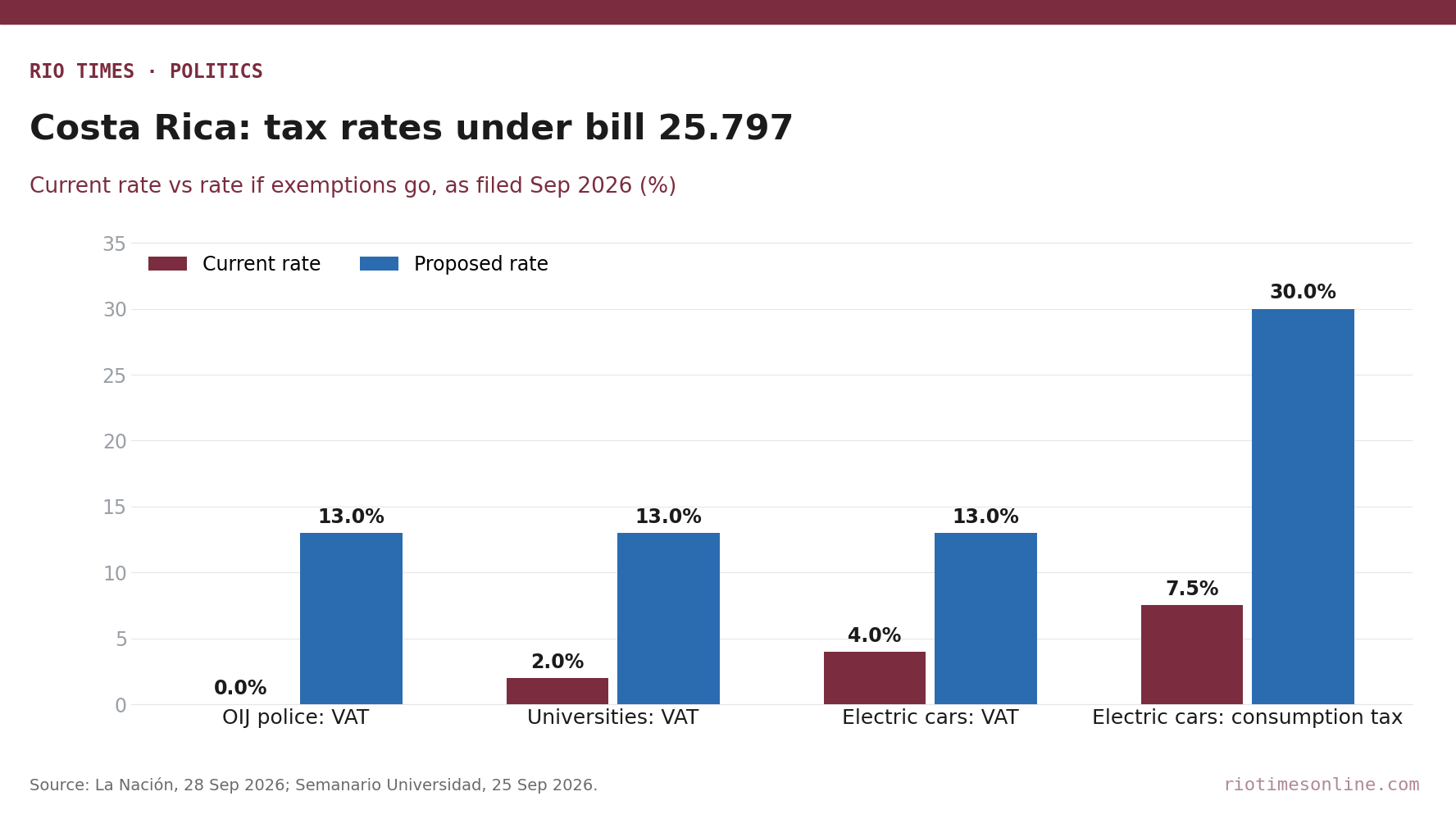
Public universities would move from 2% to 13% VAT on purchases. School boards and rural water systems would also lose exemptions.
Electric-car buyers would lose their breaks at once, not gradually as a 2022 law planned. They now pay 7.5% consumption tax instead of 30%, and 4% VAT instead of 13%.
Bill 25.796 would add a 15% tax on foreign investment income earned by residents. Banks and insurers would instead declare it at the 30% income-tax rate.
Smokers would pay less. Bill 25.668 would set the tax at ₡20 (about US$0.044) per cigarette, down from ₡26.19 (about US$0.058), and drop a 2.5% rural-development levy.
The government says it will not push “new taxes”, El Financiero reported, though some groups would pay more. Chaves has argued on television that “the rich must pay like the rich”.
What It Means for Residents and Investors
For foreign residents, the prosecutor vote bears on how safely contracts and property are protected. Residents with savings abroad are most directly touched by bill 25.796.
The governing Pueblo Soberano party holds 31 of 57 seats, and new taxes need only 29 votes, El Observador noted. La Nación saw no coordinated push yet to put the bills first on the agenda.
What Is Not Yet Known
It is not known whether the Costa Rica chief prosecutor has the 12 votes he needs, or who would run if he fails. His four-year report had not been filed by 28 September.
Nor is it clear when Congress will debate the tax bills or how much revenue they would raise. The court votes on 19 October, twelve days before his term ends.
Frequently Asked Questions
Who chooses the Costa Rica chief prosecutor?
The Corte Plena, the full bench of 22 Supreme Court judges, elects the prosecutor for four years. A candidate needs at least 12 votes.
When will the court decide on Carlo Díaz?
The court set the vote for 19 October 2026. His current term ends on 31 October 2026.
Were Costa Rican officials hit by the new US visa restrictions?
No. The measures announced on 28 September 2026 covered 27 people from Bolivia, Colombia, Ecuador and Peru, and no Costa Rican was named.
Sources: CR Hoy, 28 Sep 2026; Semanario Universidad, 28 Sep 2026; Infobae, 29 Sep 2026; La Nación, 28 Sep 2026; El Financiero, 3 Aug 2026; Semanario Universidad, 25 Sep 2026; El Observador, 1 May 2026; Bloomberg Línea, 28 Sep 2026; Bolivia Verifica, 28 Sep 2026; exchange rate: open.er-api.com, 29 Sep 2026.
Read More from The Rio Times