Comoros UN Speech Presses France on Mayotte and Counts the Cost of War
COMOROS · DIPLOMACY
Key Facts
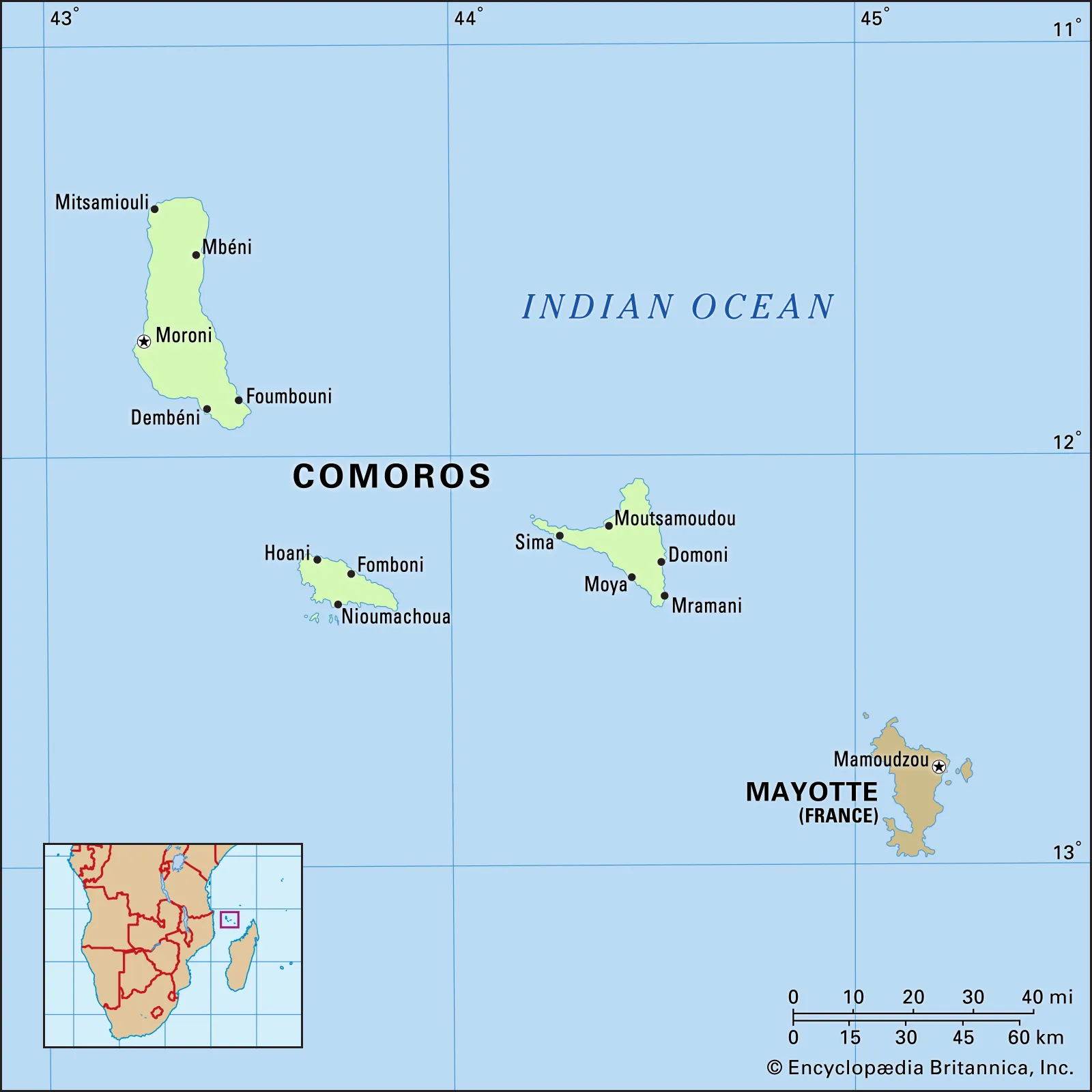
- —The country The Comoros is an Indian Ocean archipelago of about 870,000 people, between Mozambique and Madagascar.
- —What happened President Azali Assoumani addressed the UN General Assembly general debate on 24 September 2026.
- —The claim He restated Comorian sovereignty over Mayotte, which France administers as a department.
- —The cost The country imports all its fuel, and the closure of the Strait of Hormuz has pushed prices up.
- —The catch The UN resolutions he cites date from 1975 and 1976, and nothing has moved since.
The Comoros UN speech had two subjects: a French-administered island the country still claims, and the price of imported fuel.
President Azali Assoumani told the UN General Assembly on 24 September 2026 that Comorians are at home in Mayotte. The Comoros UN speech also argued that distant wars are reaching its food and fuel.
What the Comoros UN speech said about Mayotte
Azali Assoumani is the President of the Union of the Comoros. He addressed the general debate of the 81st session on 24 September 2026.
“Comorians are at home in Mayotte,” he told the Assembly. “Comorian sovereignty over the whole of its archipelago is not for sale.”
Mayotte is the fourth island of the archipelago. It voted to stay French in 1974 and became a French department in 2011.
The Comoros has never accepted that. It cites UN resolutions from 1975 and 1976 that treat the archipelago as one unit.
Why the island question will not close
Mayotte is far richer than the three islands the Comoros governs. That gap drives migration across a short stretch of sea.
Many of those crossings end in death. The route between Anjouan and Mayotte is one of the deadliest in the Indian Ocean.
Assoumani criticised France for tying development aid to migration control. That is the practical form the dispute now takes.
France treats Mayotte as settled French territory. No negotiation is under way, and none has been proposed.
The speech therefore changes nothing on the ground. It keeps a claim on the record, which is its purpose.
The war that reached the fuel pump
The second half of the speech was about distance. A conflict thousands of kilometres away is being felt in Comorian shops.
Assoumani said the Iran conflict had spread to Syria and Lebanon as a result of Israeli military operations. He said it threatens food and energy security.
Allowing the Middle East conflict to continue, he said, “directly weakens the United Nations”. It calls into question its ability to keep the peace.
He used sharper language about Gaza. An entire population, he said, “stands on the brink of extermination”.
He called for the implementation of UN resolutions leading to a two-state solution. That is the standard Comorian position.
What Hormuz did to an island economy
The Strait of Hormuz is the chokepoint for much of the world’s oil. Traffic through it has fallen by roughly 95 percent.
The Comoros imports all of its hydrocarbons. Assoumani said as much in an address at home on 5 May 2026.
The closure, he said then, had triggered a crisis. Brent crude passed US$112 a barrel in late April 2026.
His government answered with measures on fuel supply, food prices and electricity tariffs. That is the domestic context for the speech in New York.
Small importers have no hedge against this. A price set in the Gulf arrives whole at a Comorian petrol station.
Electricity, finally
One thing did improve this month. Three solar plants were inaugurated on 6 September 2026 across the three islands.
Grande Comore takes 12.86 megawatts, Anjouan 4.05 and Moheli 3.1. Battery storage of 16 megawatt hours was installed on the two larger islands.
The Abu Dhabi Fund for Development financed the plants, and Masdar built them. The commitment was about 84 million dirhams, roughly US$23 million.
For a country that has rationed power for years, that is a material change. It also reduces the fuel bill the war has inflated.
The economy behind the rhetoric
The Comorian economy grew about 3.8 percent in 2025, up from 3.3 percent the year before. The African Development Bank credits agriculture, services and construction.
On the demand side it points to private consumption and public investment. Growth is forecast at 3.4 percent for 2026.
Remittances from the Comorian diaspora in France remain central to household income. That is another thread tying the country to the state it is arguing with.
So the Mayotte dispute is not only about territory. It runs through migration, money and family.
That is why it outlasts governments on both sides. Neither the claim nor the crossings have changed in fifty years.
What is not yet known
No negotiation on Mayotte has been announced. France has not responded to the speech.
It is not known whether the Comoros raised the import shock in bilateral meetings in New York. No agreement was announced.
How long the Hormuz disruption lasts is the largest open question. Every projection for the Comorian economy depends on it.
Nor is there a published timetable for further solar capacity. The three plants are a start rather than a programme.
FAQ
When was the Comoros UN speech?
President Azali Assoumani addressed the general debate of the 81st session on 24 September 2026. It was day three of the debate.
What is the dispute over Mayotte?
Mayotte is the fourth island of the Comoros archipelago and is administered by France as a department. The Comoros claims it, citing UN resolutions from 1975 and 1976.
How does a distant war affect the Comoros?
The country imports all of its fuel. Disruption at the Strait of Hormuz raises the price of that fuel and of imported food.
Did anything improve this month?
Yes. Three solar plants totalling about 20 megawatts were inaugurated on 6 September 2026, financed by the Abu Dhabi Fund for Development.
Sources: Arab News report on the address; Habari za Comores on the Mayotte passage; Masdar on the solar inauguration; African Development Bank outlook.
This article was produced by The Rio Times’ automated newsroom system. How we use AI · Report an error
Read More from The Rio Times