BRICS Members Block Venezuela as Thirty Nations Wait at the Door
Geopolitics · BRICS
Key Facts
- —The founders Brazil, Russia, India, and China met in 2009; South Africa joined in 2011.
- —The first wave Egypt, Ethiopia, Iran, and the United Arab Emirates (UAE) joined in January 2024.
- —The second wave Indonesia’s accession in January 2025 made ten full members.
- —The queue Over 30 countries seek membership or partner status; rules are expected in New Delhi in September.
- —The catch Unanimity gives every member a quiet veto, as seen in Venezuela’s blocked bid.
This story is part of our coverage of the Venezuela US tensions. Who runs Venezuela, the US sanctions and oil deals, the Maduro case and the odds are in our dossier.
BRICS is no longer a catchy acronym invented by a bank’s research department. It is a club with a door, a queue outside it, and members who disagree about how wide the door should open.
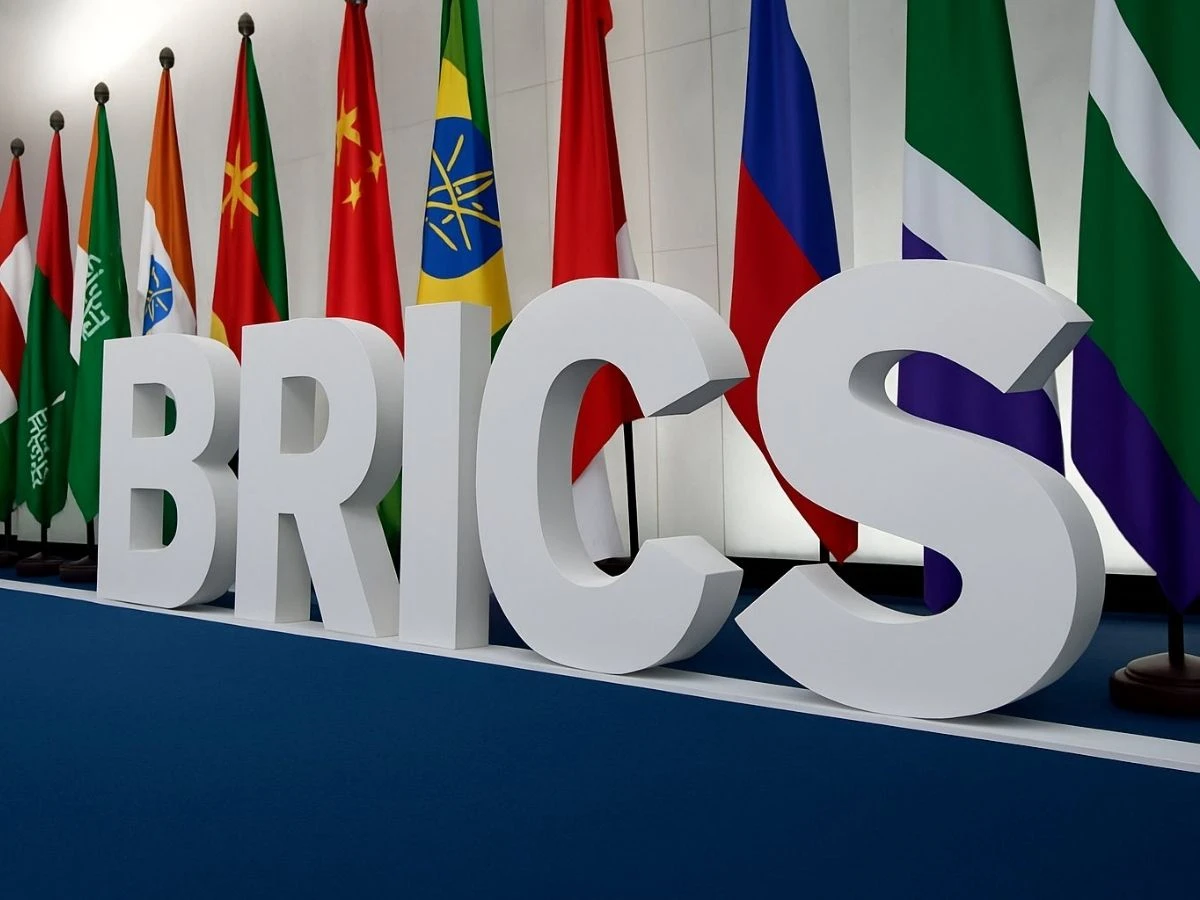
Who is actually in
The founding five remain the core: Brazil, Russia, India, China and South Africa. They built the New Development Bank (NDB) and still hold its largest voting shares.
The January 2024 intake added Egypt, Ethiopia, Iran and the UAE. Indonesia followed a year later, completing ten full members.
Saudi Arabia was invited alongside that first group but has never confirmed it joined. Riyadh still calls itself an “invited country,” so it is not counted among the ten.
Around the core is a looser ring of “partner countries,” a status BRICS created in 2024. It meets outside demand without forcing the unanimity fights that full membership needs.
Who is waiting, and why
The waiting list has middle powers like Serbia and Turkey. It also has several South-East Asian states and economies wanting cheaper bank capital.
For African applicants, the attraction is concrete: the bank has already funded a continental water infrastructure programme. For Latin American applicants, it is about diversifying away from Washington-dominated lenders.
Colombia is a cautionary case. Its government agreed to join the bank in 2025, but the ratification bill still had not passed Congress by September 2026.
The Venezuela test
Every club defines itself by who it refuses. Venezuela applied for membership, but Brazil vetoed the bid at the 2024 Kazan summit, and India has signalled the same reluctance.
Brazil objects for regional reasons. Letting Venezuela in would bring a border and legitimacy dispute into a group Brazil partly built to boost its own diplomacy.
India objects for practical reasons: why argue with Washington over a country that adds little money to the bank?
The lesson for applicants is that geopolitics beats economics. A candidate needs every incumbent’s yes, and some incumbents charge a high price.
What membership is actually worth
BRICS has no free trade agreement, no common tariff, and no freedom of movement.
Its real benefits are the bank and the annual summit photo. It also gives a voice at the United Nations (UN), the International Monetary Fund (IMF) and the G20 club of major economies.
The intangible benefit is insurance. For countries squeezed between Washington and Beijing, BRICS membership is a way to signal options without choosing sides.
That ambiguity is the product. It is also the reason expansion is so hard: every new member makes the club louder and less able to decide anything.
What to watch after New Delhi
If the summit produces written admission criteria — economic size, regional balance, a partner-first pathway — the queue becomes a pipeline. If it produces another statement about “further discussions,” the queue stays the institution’s permanent waiting list.
Either way, the number to remember is ten, not eleven. Saudi Arabia’s unfinished accession is the detail most outside coverage still gets wrong.
How the club decides
BRICS has no founding treaty and no permanent secretariat with authority. Every significant decision requires consensus, which turns every member into a potential veto player.
This is why expansion is slow and why the partner tier exists. It lets the bloc say yes to presence and no to power at the same time.
The partner tier, explained
BRICS created the partner-country tier at its October 2024 summit in Kazan, Russia, with nine countries joining from January 2025. Vietnam became the tenth in June 2025.
The current partners are Belarus, Bolivia, Cuba, Kazakhstan, Malaysia, Nigeria, Thailand, Uganda, Uzbekistan and Vietnam. Partners attend summits and join working groups, and some can seek New Development Bank financing for specific projects.
But none get a vote on membership or governance. For applicants, it is a waiting room with refreshments.
For the incumbents, it is a filter: useful, calm partners can be promoted later. Partners who bring conflicts tend to stay partners.
The weight of the roster
The ten members and ten partners together cover close to half of the world’s population. Their combined economic output, measured by purchasing power, rivals the G7 group of wealthy nations.
But the group lacks coherence. It includes democracies and autocracies, commodity exporters and importers, and rivals sitting at the same table.
Size gives the bloc weight in any negotiation it joins. That lack of coherence limits what the weight can achieve.
Who wants in, region by region
In South-East Asia, applicants seek a hedge between Washington and Beijing. In the Gulf, membership is about diversifying away from oil.
In Africa, the bank’s local-currency loans are the draw. In Latin America, the bloc offers an audience for countries tired of relying only on Washington-based lenders.
Members judge applicants on what they add: votes, markets, minerals, geography. They also weigh what conflicts an applicant might import.
The acronym problem
The name was coined in 2001, when economist Jim O’Neill grouped four countries as “BRIC.” It stopped fitting neatly once the bloc grew past ten members and gained a partner tier.
Members avoid renaming because that would mean admitting what the bloc has become. It is less a category of emerging economies now than a coalition of the unsatisfied.
Such coalitions carry weight at summits but strain in a real crisis. The membership debate is really about which of those two futures the ten are choosing.
The cases that wrote the rules
Argentina was invited in 2023 but declined the offer in December that year after its government changed. This shows entry is voluntary and can be reversed.
Saudi Arabia accepted an invitation in 2023 but has let the process sit unfinished since. This shows even the most courted candidate can move at its own pace.
Each case added an unwritten rule: no member may join while it has a live dispute with another. No applicant is owed an answer, either, and New Delhi is expected to try to write these habits down.
More: Latin America news in English, every day from The Rio Times.
Who pays, and who profits
The founding five still supply the bank’s core capital, and their voting shares stay the largest even as new members join. New arrivals add capital at the margin but gain little control over it.
Borrowers like Egypt and Ethiopia get cheaper infrastructure finance in return. Commodity exporters get a stage, and China gets a group where most institutional questions still orbit its economy.
Applicants outside pay in a different currency: diplomatic attention. Every year in the queue costs bilateral capital, spent courting ten capitals that each set their own price.
New Delhi will not spell out this calculation in any communiqué. The club’s value to its members depends on keeping the door narrow, even as it depends on the queue believing otherwise.
Connected Coverage
30+ Nations Await a BRICS Seat — New Delhi Votes in September
Colombia’s Law to Join the BRICS Bank Died in Congress Without a Single Debate
Iran Says It Will Join the BRICS Bank — Bank Can’t Confirm
The Big Picture
BRICS Expansion — all our coverage of the bloc’s growth and its limits
Latest developments
- Stocks Pause 0.02% Before US Inflation Data — 14 October 2026
- Venezuela Inflation to Hit 467% This Year, IMF Says — 13 October 2026
- Taste of Cape Town Food Festival 2026 Guide — 13 October 2026
- Ironman Cozumel 2026 Triathlon Guide — 13 October 2026
This article was produced by The Rio Times’ automated AI newsroom. Editorial responsibility: Matthias Camenzind, Publisher and Editor-in-Chief. The Rio Times also runs Ask Rio Times, which answers from 100,000+ of our own articles, the daily Latin America Power Map, and prediction-market odds on elections and markets.. How we use AI · Report an error
Venezuela and the United States
- What Is Going On Between Venezuela and the United States?
- What Is Going On Between Venezuela and the United States?
- Venezuela Geopolitics Explained, US Now Runs Its Oil
- Venezuela Politics 2026, Who Holds Power After Maduro