Brazilian Navy kills KC-2 project 12 years later and without receiving any aircraft
By Roberto Caiafa
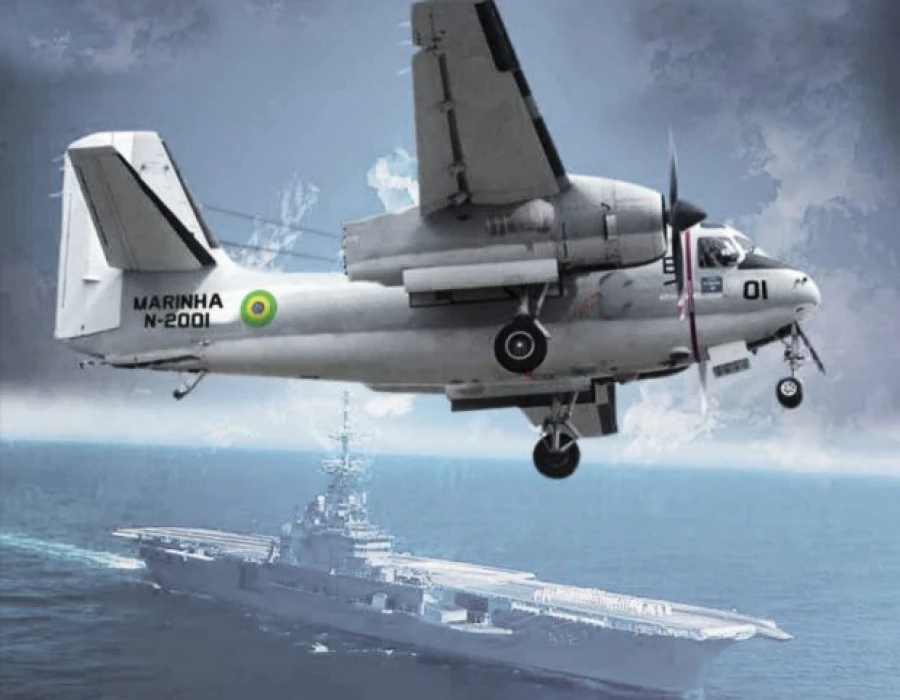
After 12 years of announcements, pauses, delays, cancellations, new announcements, and more breaks, the unfulfilled career of the KC-2 Trader COD aircraft in the Brazilian Navy’s Naval Aviation has finally officially come to an end.
This was reflected in ordinance 21/MB/MD, signed by the head of the naval force, which extinguishes the Aircraft Inspection and Reception Group COD (Carrier On-board Delivery) / AAR (Air-to-Air Refueling).
Planned to be operated as an integral part of the Embarked Air Wing of the aircraft carrier São Paulo, recently sunk somewhere off the Brazilian coast after a legal dispute that dragged on for months, the Turbo Trader aircraft was to perform in-flight refueling (REVO) missions supporting A-4 Skyhawk/AF-1 Falcon fighters and perform a myriad of complementary missions in addition to the COD tasks usually performed by this type of aircraft.
A LOST INVESTMENT?
In 2011, when it was still believed that the São Paulo would sail for another 15 to 20 years, the Navy acquired four old twin-engine eight-cell aircraft purchased for US$32,000 each to replace their radial engines with new Honeywell TPE331-14GR-801Z turboprops, new digital avionics, and a complete structural overhaul.
None of the aircraft ever flew.
The Trader aircraft, chosen from those stored at Mason, Arizona (Marsh Aviation), would, after modifications, be capable of logistical support missions, including transporting material and personnel, paratrooper drops (special forces missions), and, primarily, in-flight refueling of AFI-1B/C aircraft, modernized at Embraer.
Thus it would be contributing to the expanded air defense capability of a naval or Marine Corps force (in the absence of an NAe, and with its fighters operating out of a single naval base, the need for a refueler had become chronic for the Navy to give its jets more range).

In addition, the avionics of this rebuilt twin-engine would be digital and Brazilian-developed, based on those created for the modernization of the Brazilian Air Force’s Embraer C-95 Bandeirantes transport aircraft, but upgraded for the demanding naval operating environment.
This set of claims lasted for 12 years.
While the very ship where the aircraft were to operate disappeared in deep waters, the company contracted to refurbish the aircraft was sued by the US Government for supporting the Venezuelan FANBV’s OV-10 Bronco engines, being debarred, and its president was “forced” to pay US$250,000 in fines to get rid of the US federal charges.
Finally, in 2019, when the turn of an engine on a prototype aircraft (No. 27) and a probable first flight were announced, the program again entered a complete stalemate with the arrival of the Covid-19 pandemic.
Finally, it was officially abandoned at the end of the first quarter of 2023 without delivering any operational aircraft.
The delivery forecast was 2021.
As of today, it is not known what is the status and what will be the destination of the acquired cells, the new engines (if the Navy purchased turboprops), and other actions that were initiated to support the aircraft.
AEL Sistemas, from Porto Alegre, has already had this project’s test benches and avionics integration for some time.
Still, now these resources, with the interruption of the program, must be reused in other company activities.

With information from Infodefensa
Editorial responsibility: Matthias Camenzind, Editor-in-Chief · Editorial standards · Report an error
Read More from The Rio Times