Brazil will manufacture locally the ammunition for the 76/62 SR cannons of the Tamandaré frigates
By Roberto Caiafa
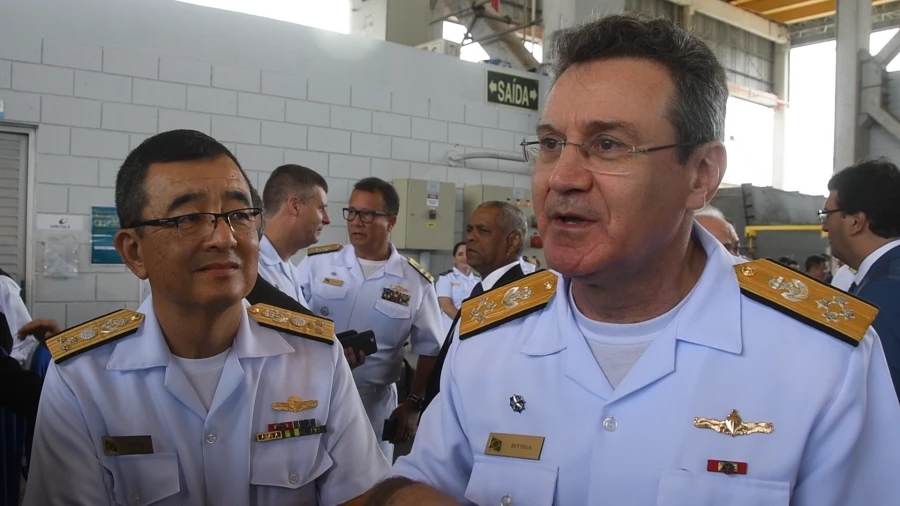
After the end of the keel laying ceremony of the first Tamandaré class frigate, Infodefensa.com interviewed Admirals Arthur Fernando Bettega Corrêa and Celso Mizutani Koga, Director General of Naval Material and Director of Program Management of the Brazilian Navy, respectively.
On occasion, the naval authorities discussed:
- the doctrinal impact that the ships bring with them,
- the issue of the nationalization of the different types of 76 mm ammunition of the Leonardo/Oto Melara 76/62 SR bow gun,
- the MBDA Sea Ceptor surface-to-air missile vertical launching system,
- and issues related to preparing personnel to operate and maintain the ships and their systems.
The arrival of the Tamandaré frigates represents a milestone for the Navy and the Brazilian naval industry. What can we expect from this partnership?
Bettega: The gains in terms of technology and operational capabilities are innumerable.
We are talking about upgrades to weapon systems, to sensors, we are talking about new propulsion systems, and we are entering a new world in terms of combat management and platform management.
All the systems of the Tamandaré are state-of-the-art, so now we have versatile ships whose capacity is nominal; that is, it is a ship that has its parameters very well defined, it is a class that is already in the market with a very respectable and well-known history.

These vessels have excellent characteristics for bluewater operations.
So we are sure these frigates will be a milestone, even doctrinally, for the Brazilian Navy.
Just as the Niteroi Class was, 45 years ago, a turning point in terms of surface, anti-air, and anti-submarine warfare, we expect the same to happen with the arrival of the Tamandaré, especially in terms of doctrine and the use of capabilities we did not have.
To cite one example, the Sea Ceptor anti-aircraft missiles are far superior to the missiles we were operating until then.
That’s why we base our confidence on these ships.

On your visit to La Spezia (Italy), you inspected the first 76/62 gun on the first Tamandaré frigate. What can you tell us about the delivery schedule for these guns and sensors?
Bettega: As Director General of Material, I do not have exact knowledge about the delivery date of these guns; this depends on the shipyard.
Consórcio Águas Azuis, as the integrator, has full control of these systems coming to Brazil, not only of the armament but also of the sensors.
I can guarantee that this gun (76/62) and the ammunition it uses bring significant gains to the Brazilian Navy in high-value aircraft.
For example, we are allocating a part of the Navy Ammunition Factory, upgrading this plant to produce the different 76 mm ammunition for this gun, which is highly technological.
We are working to increase the entire structure of the Ammunition Factory to meet the natural demand, not only from the Navy but also from other countries that operate this weapon system.
The nationalization of 76/62 ammunition is feasible, and we will pursue it vigorously.

What are the next practical steps before the launching of this first ship?
Koga: The ship will still go through several stages, the next being the unification of the different blocks, then the pre-finishing and finishing phase, where the main equipment and systems that equip the frigate are installed, from the diesel generators to the main engines.
All this integration results in the ship’s construction, which is then joined, integrated, and launched at sea.
Then, the testing phase begins, port trials, sea trials, all of this conditioning it for its future delivery to the operational sector of the Brazilian Navy.
The Tamandaré are the first Navy ships equipped with a vertical launch system for its new Sea Ceptor surface-to-air missiles. What new capabilities does this missile system add?
Koga: Whenever new technologies are incorporated, updating our doctrine to use these new types of weapons is important.
Several friendly navies have adopted Meko-class ships, and Brazil joins this club of operators where it is possible to exchange important information and knowledge.
It is always interesting to think not only about the operation, in the case of missiles, but also about maintenance, speaking of the ship as a whole.
These activities involve specific resources and needs, so it is very important to continuously discuss with other Meko operator countries how they are carrying out the different maintenance and operation routines.

With information from Infodefensa
This article was produced by The Rio Times’ automated newsroom system. How we use AI · Report an error · Editorial responsibility: Matthias Camenzind, Editor-in-Chief
Read More from The Rio Times