Brazil Supreme Court Critics Earmarked US$1m by US State Department Fund
POLITICS · BRAZIL
Key Facts
- —The country Brazil, whose Supreme Federal Court (STF) convicted former president Jair Bolsonaro of a coup plot and has clashed with Washington over sanctions and tech platforms.
- —What happened The Guardian reported on 30 September 2026 that the US State Department earmarked US$1 million for a project titled “Countering Lawfare and Censorship in Brazil”.
- —The numbers The Brazil grant is one of 43 worth US$176.9 million from the Human Rights and Democracy Fund, as reported on 30 September 2026.
- —What it means for you Foreign money aimed at a national court is a new source of diplomatic friction, arriving days before Brazil’s first-round election vote.
- —Still open Whether any money has been paid, which Brazilian groups would receive it, and how the court and the foreign ministry will respond.
The US State Department has earmarked US$1 million for a Supreme Court project in Brazil, according to The Guardian. The money would back Brazilian civil-society groups that oppose what the project calls judicial overreach and censorship by the court.
The British newspaper published the report on Wednesday 30 September, citing State Department documents and sources. Brazilian outlets including G1 and the state news agency Agência Brasil relayed it on Thursday.

What the Report Says
The grant is titled “Countering Lawfare and Censorship in Brazil”. G1 said a document seen by The Guardian describes funding for groups opposed to the Supreme Federal Court (STF), Brazil’s highest court.
At the 1 October rate of R$5.20 per US dollar, the sum equals about R$5.2 million. That figure is a currency conversion, not a separate payment.
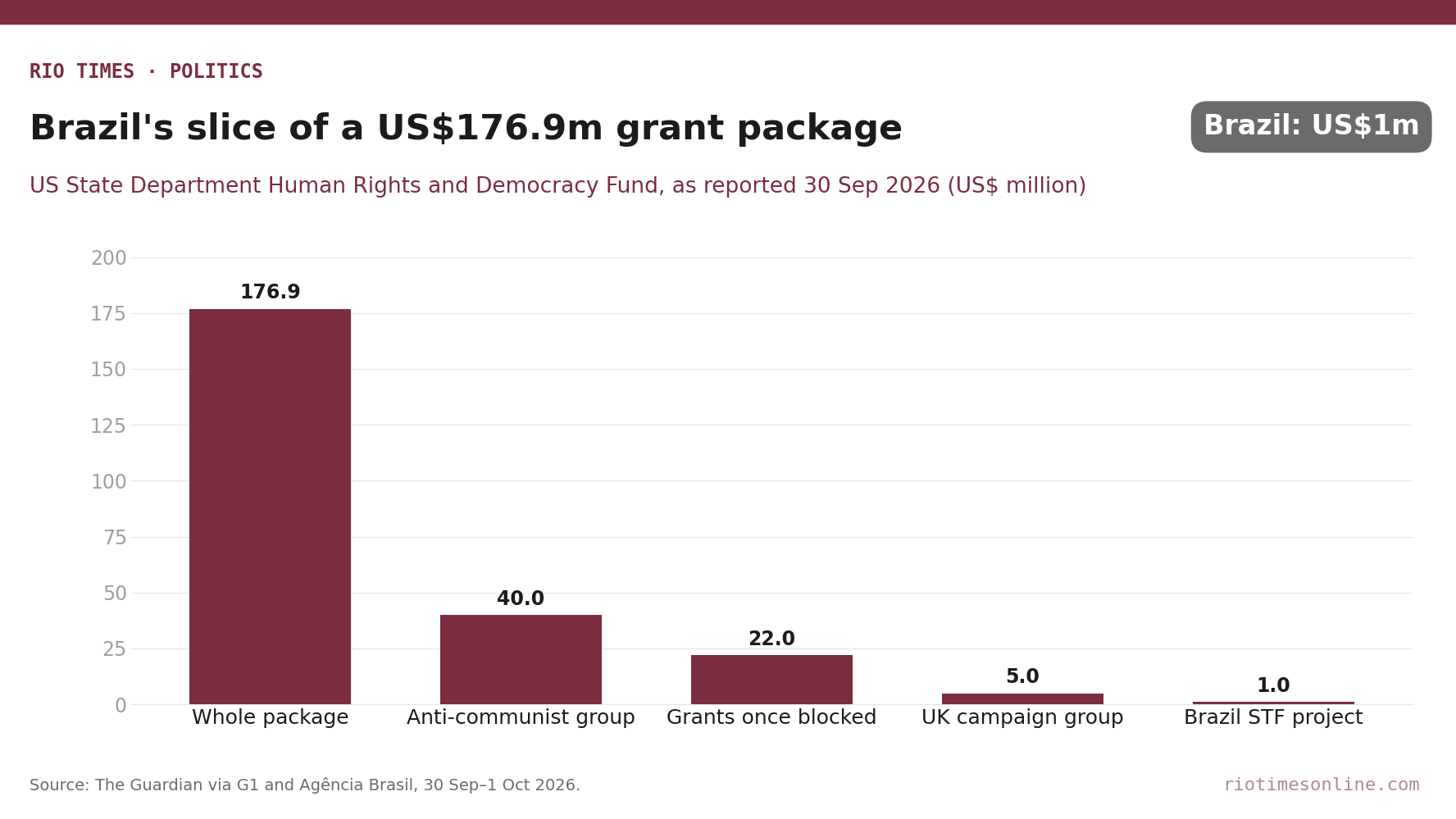
It is one of 43 grants worth US$176.9 million from the Human Rights and Democracy Fund. The US Congress appropriates that fund for democracy and rights work abroad.
The largest award reported is US$40 million for a consortium led by the Victims of Communism Memorial Foundation. A US$5 million grant would support a British group campaigning against online-safety and hate-speech laws.
Who Signed Off on the Money
A Democratic congressional aide told The Guardian that Senator Jeanne Shaheen had placed holds on US$22 million in grants. These included money for Brazil, South Africa, Nigeria and right-wing causes in Britain and Europe.
According to the same aide, Secretary of State Marco Rubio personally signed a memo overriding the holds. That account comes from one source and has not been independently confirmed.
The State Department did not comment on specific grants. It told The Guardian the programmes were still under “active deliberation” and would pass a vetting process.
Recipients would also have to meet the rules for federal grants. Agência Brasil noted there is no information on whether the money was transferred or only committed.
Why the Court Is a Target
The STF convicted Jair Bolsonaro of plotting a coup and sentenced him to 27 years in prison. Washington then made the court a target, Agência Brasil wrote.
In July 2025 Washington sanctioned Justice Alexandre de Moraes after lobbying by Eduardo Bolsonaro, the former president’s son. Rio Times reported the early stage of that push in Eduardo Bolsonaro Calls for U.S. Punishment of Moraes and Brazilian Leaders Using Magnitsky Act.
The sanctions were lifted in December 2025, CNN Brasil noted. Friction continued over STF rulings that restrict American digital platforms, which the court says target online crime.
The Domestic Context
The report lands as the court faces criticism at home as well. Members of Congress have filed dozens of proposals to curb its powers, as covered in Brazil Supreme Court Reform Push Grows as 84 Amendments Await Congress.
Jorge Messias, head of the Attorney General’s Office (AGU), said on 1 October the report was a warning for Brazilian sovereignty. He said foreign political interests must not interfere with Brazil’s institutions or voters’ choices.
Those debates run through Brazilian institutions and elections, not foreign grants. Brazilians vote in the first round of general elections on Sunday 4 October.
The Supreme Court project is small next to the whole package, at well under 1% of the US$176.9 million total. Its significance is political rather than financial.
What Is Not Yet Known
No recipient groups for the Supreme Court project have been named, and no payment has been confirmed. The State Department says the programmes are still being considered.
The STF did not respond to Agência Brasil before publication. Brazil’s foreign ministry had not commented in the reports reviewed, although the AGU has.
Sources: The Guardian (30 Sep 2026), as reported by G1 and Agência Brasil (1 Oct 2026); Jorge Messias statement via Metro1; sanctions timeline via CNN Brasil (1 Oct 2026); exchange rate 1 Oct 2026.
Read More from The Rio Times