Brazil: the challenge to save the last 30 dolphins, symbolic of the seas of Rio de Janeiro
RIO DE JANEIRO, BRAZIL – In a corner of the sea where the tropical paradise of Guanabara Bay is located in the state of Rio de Janeiro, a female Guiana dolphin swims next to a newborn calf.
The only sound is the hiss of the whales’ breath as they rise to the surface. The water looks like a mirror, and time has stopped.

The only movement is the dolphins performing acrobatic feats in the landscape framed by the Serra dos Órgãos (Organ Mountain) – the same landscape that has enchanted generations for centuries. Silence and animals are the last survivors of an almost lost world.
There are no longer 30 dolphins in Guanabara. And they embody the challenges of resilience and survival of the bay itself.
The female is the oldest dolphin and the youngest calf in Guanabara, explain scientists from the Laboratory of Marine Mammals and Bioindicators (Maqua) of the Oceanography Faculty of the State University of Rio de Janeiro (Uerj).
For three decades, Maqua has been involved in the study and rescue of Guiana dolphins (Sotalia guianensis) from Guanabara. There is hope, but the window of opportunity for the porpoises to survive is narrowing as water pollution and noise pollution increase, Maqua scientists warn.
“The waters of Guanabara still hold immense riches, but aggression is increasing and affects us all. At the top of the food chain, the porpoises are their guardians and their greatest symbol. The pollution that affects them also affects us. Saving the oceans is our own salvation, and it is possible,” says José Lailson Brito Junior, oceanographer, doctor of biophysics, and one of the founders and coordinators of Maqua.
The female, nicknamed “Auntie” by scientists, is more than 20 years old and is in the final stages of her life, as her species does not usually live past 30. She has never had offspring, but like the females of her species, she participates in the production of baby groups.
The calf is the firstborn this year, and like most Guanabara dolphins, it has a slim chance of living to six or seven years old, the age at which they begin to reproduce, says Alexandre de Freitas Azevedo, a specialist in cetacean behavior and bioacoustics and also one of the founders and coordinators of Maqua. This early death brings the Guanabara dolphin closer to the end year after year.
The group of the aunt and the baby, not yet “baptized” by the researchers, work together to catch fish in their corner of the sea. They also work together for protection. The baby is permanently attached to the mother and an adult and swims under the adult’s supervision all the time.
But some porpoises exhibit strange behavior in the bay. They seem to enjoy catching plastic trash with their snouts or the tip of their tails and throwing it at other group members. It is a dangerous game in which they may learn to chase shoals, but in doing so, they run the risk of swallowing contaminated pieces and choking on them.
When the first Europeans arrived, there were thousands of dolphins. In the 16th century, the French missionary Jean de Léry (1536-1613), author of “A History of a Journey into the Land of Brazil,” wrote that dolphins “often gathered around us in great numbers as far as the eye could reach. ”
The porpoises were hunted to the brink of extinction, and their habitat was gradually destroyed. Until the beginning of the 20th century, however, they were still relatively common, so much so that they even adorned the coat of arms and flag of the city of Rio de Janeiro.
“The strangest inhabitant of our bay, which until today is considered exclusive to Guanabara, is the dolphin. (…) They are the acrobats of our bay, considered friends by the men of the sea,” wrote naturalist and journalist Armando Magalhães Corrêa (1889-1944) in “Águas Cariocas,” a collection of chronicles about Guanabara in the early 1990s.
In the 1980s, however, there were no more than 400 animals. By 1992, when Maqua was founded, that number had dwindled to just over a hundred. In 2014, Maqua scientists recorded only 40.
This year, they are down to 30, the last. And the eye can barely reach them. Scientists use trained eyes and devices like hydrophones to find them as these whales communicate in the water. Seeing them has become a prize, a privilege.
Unlike dolphins, which stay in the sea and have no inhibitions, coastal bottlenose dolphins are shy and avoid approaching humans. They are practically confined to a bay corner next to the Guanabara Ecological Station and the Guapimirim Environmental Protection Area. There was a time when they accompanied the ferry to Paquetá and arrived in Praia de Ramos.
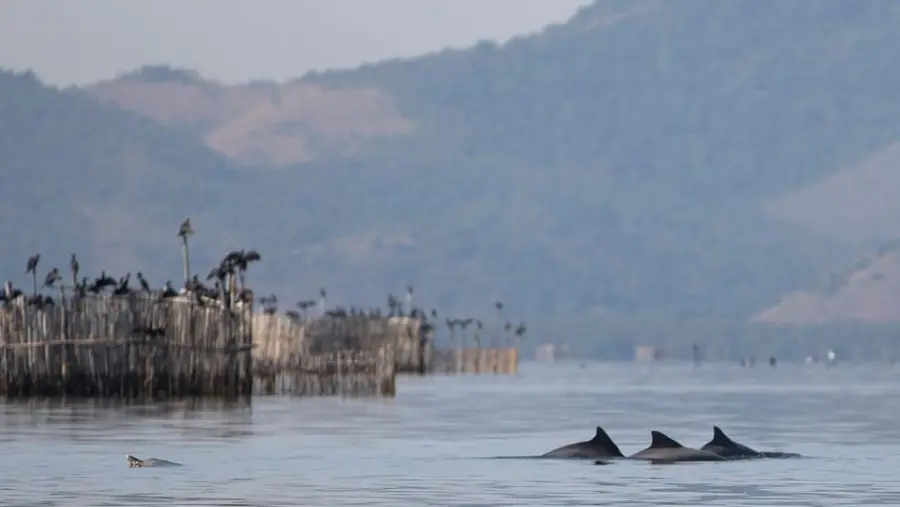
“Today, it is tough for them to leave the protected areas,” notes Azevedo.
The water is a little less dirty in them, and there is less noise. Boats make the seabed louder than Avenida Brasil in the rest of the bay. An unruly cacophony of droning and buzzing, generated by the constantly running boat engines and the constant rocking of the boats. Scientists point out that the bottom of the water is louder than the surface.
For harbor porpoises, the noise pollution is unbearable. They use echolocation to find their food, especially sea bass and shrimp. And they communicate with a variety of sounds, whether hunting in groups, warning of danger, or in a range of complex social interactions.
Magalhães Corrêa was wrong about the species’ geographic distribution, as it occurs in coastal bays from Honduras to Santa Catarina. Still, in his way, he was right about the special status of Guanabara porpoises.
“They are warriors. They resist and insist. And they fascinate us. We’ve never known the species as well as we do now, thanks to years of research, dedication, and technology. But paradoxically, they have never been so rare and threatened,” emphasizes Maqua researcher Rafael Ramos Carvalho.
Guanabara dolphin babies have little chance of reaching adulthood because they are victims of aggression. The first is bycatch; quite a few suffocate when they get caught in trawl nets.
A much greater enemy, however, is pollution. Mammals and porpoises expend immense amounts of energy to survive in the water. Their metabolism is intense, and they need to eat a lot. As a result, they also ingest large amounts of pollutants in the water and the fish and crustaceans they feed.
The pollutants accumulate in the fatty tissues throughout the animals’ lives. Since mothers pass 80-90% of their fat to their young in their energy-rich milk, harbor porpoise pups are contaminated with pollutants from birth. There is also transmission during pregnancy through the placenta.
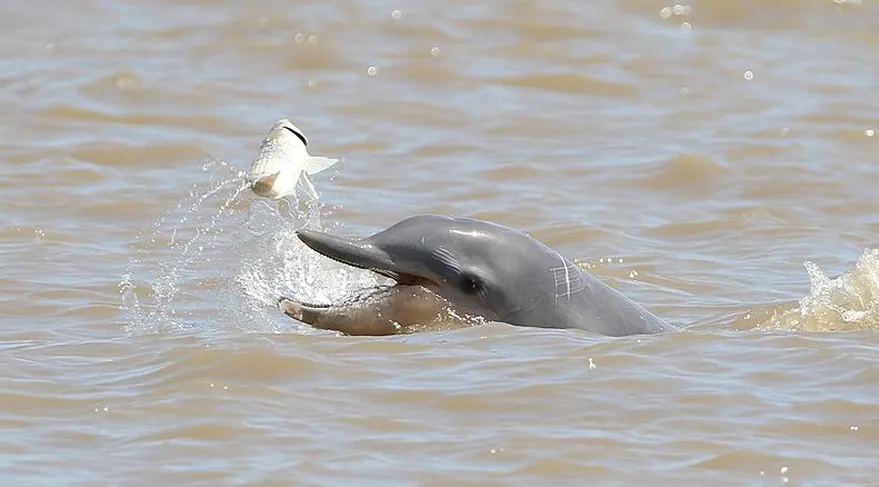
“At six years old, a boto already has a brutal load of contaminants. It’s so bad that females almost always lose their first calf because it’s already born with an immune system weakened by pollution and can’t resist disease,” Brito Junior explains.
At around six years of age, the accumulated pollutants also cause the animals’ defenses to weaken, and most of them die.
In Guanabara, where there are no sanitation facilities, domestic sewage and industrial pollutants are as aggressive and deadly as PCBs, Ascarel, dioxins (from the incineration of domestic and industrial waste), and flame retardants, which are still present years after their release.
“Brazilian whales have the highest contamination rate ever recorded in any animal in the world,” says José Lailson Brito Junior, who stresses that the same pollutants also affect humans exposed to them:
“Everything we see in whales is also happening to us, on a different scale, but it still affects us. The boot warns us,” he adds.
Theoretically, the Guiana dolphin could venture into the sea. However, the species is a resident, living all its life in the bay where it was born. And the Guanabara insists on the bay that Magalhães Corrêa called “a true tropical garden, the largest and most beautiful in the world, where biology is waiting for man to teach it.”
More: Brazil news in English, every day from The Rio Times.
Living in or visiting Rio de Janeiro? See this month's events and our Rio de Janeiro city guide with rents, safety and upcoming concerts.
This article was produced by The Rio Times’ automated AI newsroom. Editorial responsibility: Matthias Camenzind, Publisher and Editor-in-Chief. The Rio Times also runs Ask Rio Times, which answers from 100,000+ of our own articles, the daily Latin America Power Map, and prediction-market odds on elections and markets.. How we use AI · Report an error