Brazil Stocks Fall 1.15% on Election Nerves | Brazil Market Report, Oct 22
Key Facts
- Ibovespa falls 1.15% to 204,120 points with 48 of its 76 members closing lower as investors trimmed risk before Sunday’s presidential run-off.
- The real weakens 0.40% to 5.0443 per US dollar a modest move that shows the currency market is not panicking even as stocks slide.
- Global tech leads the retreat with the Nasdaq down 2.60% and the VIX fear gauge jumping 14.09% as Middle East tensions resurface.
- Datafolha shows a dead heat: 47% for Flávio Bolsonaro and 46% for Lula among all voters, 50% each among valid votes, three days before the runoff.
- Heavy selling in miners and banks as Vale and the big lenders bore the brunt while defensive names like BB Seguridade rallied.
- Prediction markets: Polymarket gives Flávio Bolsonaro 75.8% and Lula 24.5% to win the runoff (US$192 million traded, read 8:30 pm ET, 22 October). Bets, not polls.
Runoff · Sunday, 25 October
Brazil Runoff 2026: Lula vs Flávio
Date, polls, debates, odds and how the runoff works, updated every day.
Read our Brazil election 2026 runoff guide →
Brazil election 2026 · Brazil election polls · Who will win: Brazil election odds · Brazil runoff date and results start · Brazil election results · Brazil election poll data (CSV) · All election stories
Prediction markets · who wins the runoff
Implied chance of winning Brazil’s presidency on 25 October, from traders’ prices.
Polymarket
Flávio Bolsonaro 75.6% · Lula 24.5% (US$192 million traded)
Kalshi (regulated in the US by the CFTC)
Flávio Bolsonaro 76% · Lula 26%
As of 22 October, 8:40 pm ET (01:40 Lisbon), updated every 20 minutes. Prices are bets, not polls, and can move fast.
Why we show this: prediction markets turn real-money bets into a live probability that moves within minutes of the news, which is why investors, campaigns and newsrooms in the United States now follow them closely. We show them next to polls and official results, never instead of them.
Today’s Focus
Brazil’s main stock index, the Ibovespa, fell 1.15% on Thursday to close at 204,120 points. The drop came as investors reduced risk ahead of Sunday’s presidential run-off and a global sell-off in technology shares spread across markets.
The real, Brazil’s currency, weakened only 0.40% to 5.0443 per US dollar (RT data; local desks quoted R$5.038, up 0.22%). That contained move shows currency traders are more focused on the election outcome itself than on the day-to-day polling noise.
Datafolha, published after the market closed on Thursday, showed Flávio Bolsonaro at 47% and Lula at 46% of all voters, or 50% each of valid votes. A Quaest poll the day before had put him at 45% and Lula at 44%, which kept traders cautious about carrying large positions into the weekend.
The Nasdaq fell 2.60% and the VIX volatility gauge jumped 14.09%, adding external pressure to a market already nervous about domestic politics.
What matters today. Brazil’s market is being squeezed between a too-close-to-call election at home and a sharp global rotation out of risk assets abroad.

01 The session in one read
Brazil’s main stock index fell hard on Thursday as global jitters and domestic election nerves collided. The Ibovespa dropped 1.15% to 204,120 points, with 48 of its 76 constituents closing in the red.
The real weakened only modestly, slipping 0.40% to 5.0443 per US dollar. That relatively contained move suggests the currency market is more composed than the equity market about Brazil’s political outlook.
The trigger came from two directions. Overseas, the Nasdaq tumbled 2.60% as investors dumped technology shares, pushing the VIX fear gauge up 14.09%. At home, a Quaest poll on Wednesday had the presidential race statistically tied (Flávio Bolsonaro 45%, Lula 44%) with three days to go.
Traders now face a familiar dilemma ahead of Sunday’s run-off: hold positions through the weekend and risk a sharp opening gap on Monday, or reduce exposure and miss a potential relief rally if the result is clean.
The evidence points to an orderly de-risking rather than a stampede. The Ibovespa’s 1.15% fall was broad but not extreme, and the real’s 0.40% slide was far milder than the equity move. That asymmetry suggests investors are nervous about the election but not terrified.
The variable to watch is whether Sunday’s result produces a clear winner quickly. A contested or delayed outcome would likely trigger a sharper repricing on Monday, while a clean result could see the market recover much of Thursday’s lost ground.
02 The day’s numbers
| Measure | Level | Change | Read |
|---|---|---|---|
| Ibovespa (Brazil’s main stock index) | 204,120 | −1.15% | Broad decline, 48 of 76 members lower |
| USD/BRL (the real) | 5.0443 | +0.40% | Modest currency weakness, contained |
| VIX volatility gauge | 19.03 | +14.09% | Fear jumped on tech rout and Middle East |
The Ibovespa traded between 203,052 and 206,493 points during the session, and 48 of its 76 members closed lower.
The real’s move to 5.0443 per dollar was small. That stability contrasts with the sharper equity sell-off and suggests investors are not betting on a disorderly election outcome. Rio Times · Live Market Intelligence
Live Market IntelligenceBrazil — Live Market Board
Brazil — Live Market Board
Instrument Last Change YoY Prev. High Low Volume
IBOV
204,120.12
-1.15%
+21.85%
206,495.23
168,310
167,142
—
USD/BRL
5.16
+0.01%
-5.13%
5.16
5.18
5.14
—
SELIC
14.00%
—
—
—
—
—
PETR4
41.64
-0.05%
+35.19%
41.66
41.97
41.15
41,499,400
VALE3
72.97
+0.83%
+30.75%
72.37
73.54
72.66
17,658,000
ITUB4
38.60
-1.03%
+4.57%
39.00
39.34
38.39
29,487,800
BBDC4
16.85
+0.36%
+3.50%
16.79
16.90
16.67
19,416,900
BBAS3
19.37
+0.47%
+0.73%
19.28
19.44
19.16
11,069,200
B3SA3
14.26
-0.21%
+12.73%
14.29
14.47
14.11
33,037,800
ABEV3
14.89
-0.80%
+21.91%
15.01
15.07
14.81
16,453,100
WEGE3
47.59
+0.49%
+29.99%
47.36
48.08
47.36
3,364,600
PRIO3
59.14
-0.19%
+50.67%
59.25
59.81
58.74
3,325,600
SUZB3
41.33
+2.35%
-23.55%
40.38
41.48
40.35
3,914,900
RENT3
34.68
-0.09%
+0.84%
34.71
34.96
34.35
7,979,100
AZZA3
15.89
-2.63%
-53.76%
16.32
16.42
15.82
1,330,300
CSNA3
4.30
+0.47%
-42.65%
4.28
4.41
4.26
10,076,100
GGBR4
24.69
+2.19%
+51.38%
24.16
24.85
24.18
7,047,600
ENEV3
24.21
-1.38%
+70.49%
24.55
24.64
23.99
9,297,000
03 Why it moved — election caution and global tech rout
The global backdrop was the first problem. The Nasdaq fell 2.60% and the S&P 500 lost 1.21% as investors rotated out of technology shares, while renewed Middle East tensions pushed oil prices higher but hurt risk appetite everywhere.
Domestically, Wednesday’s Quaest poll showed Flávio Bolsonaro at 45% and Lula at 44%. That statistical tie, three days before Sunday’s run-off, made traders reluctant to hold large positions over the weekend; the Datafolha poll arrived only after the close.
The Ibovespa fell hardest in economically sensitive sectors. Miners and steelmakers led the declines, while banks also fell: Itaú lost 1.84% and Santander Brasil 1.35%. Brazil’s interest-rate futures for January 2028 rose 11 basis points to 12.88%, and Brent crude climbed above US$112 a barrel, its highest since May.
US data added to the caution. Initial jobless claims fell to 194,000 against a forecast of 200,000 (RT economic calendar), a firm labour-market signal that kept bets on higher US interest rates alive. Yet the real’s 0.40% decline was far gentler than the stock market’s fall. That gap suggests currency traders see the election risk as manageable, even if equity investors preferred to trim exposure.
04 The day’s movers
| Driver | Level / Move | Change | Note |
|---|---|---|---|
| CSN (steelmaker) | — | −5.43% | Worst performer, hit by risk-off and commodity pressure |
| Usiminas (steelmaker) | — | −4.81% | Followed CSN lower on demand worries |
| Embraer (aircraft maker) | — | −4.66% | Export-heavy name hurt by global growth jitters |
| Vale (iron-ore miner) | — | −3.97% | Mining heavyweight weighed on index |
| Bradesco (bank) | — | −2.08% | Banks fell on election uncertainty |
| BB Seguridade (insurer) | — | +2.05% | Defensive gainer, best performer |
| Prio (oil producer) | — | +1.85% | Higher oil prices lent support |
The sell-off was broad but not uniform. Commodity-linked and cyclical names bore the brunt of the selling, with CSN, Usiminas, Embraer and Vale all falling between roughly 4% and 5.5%.
On the positive side, defensive and oil-linked names held up. BB Seguridade rose 2.05% and Prio climbed 1.85% as higher crude prices provided a cushion.
05 The regional scoreboard
| Index | Country | Change |
|---|---|---|
| Ibovespa | Brazil | −1.15% |
| IPSA | Chile | −1.88% |
| IPC | Mexico | −1.25% |
| COLCAP | Colombia | −1.25% |
| Merval | Argentina | −1.5% |
Latin America fell in unison on Thursday, with every major regional index closing lower. Chile’s IPSA led the declines at −1.88%, followed by Mexico’s IPC and Colombia’s COLCAP, both down 1.25%.
Argentina’s MSCI Merval fell 1.5% to 97,993.
06 The technical picture
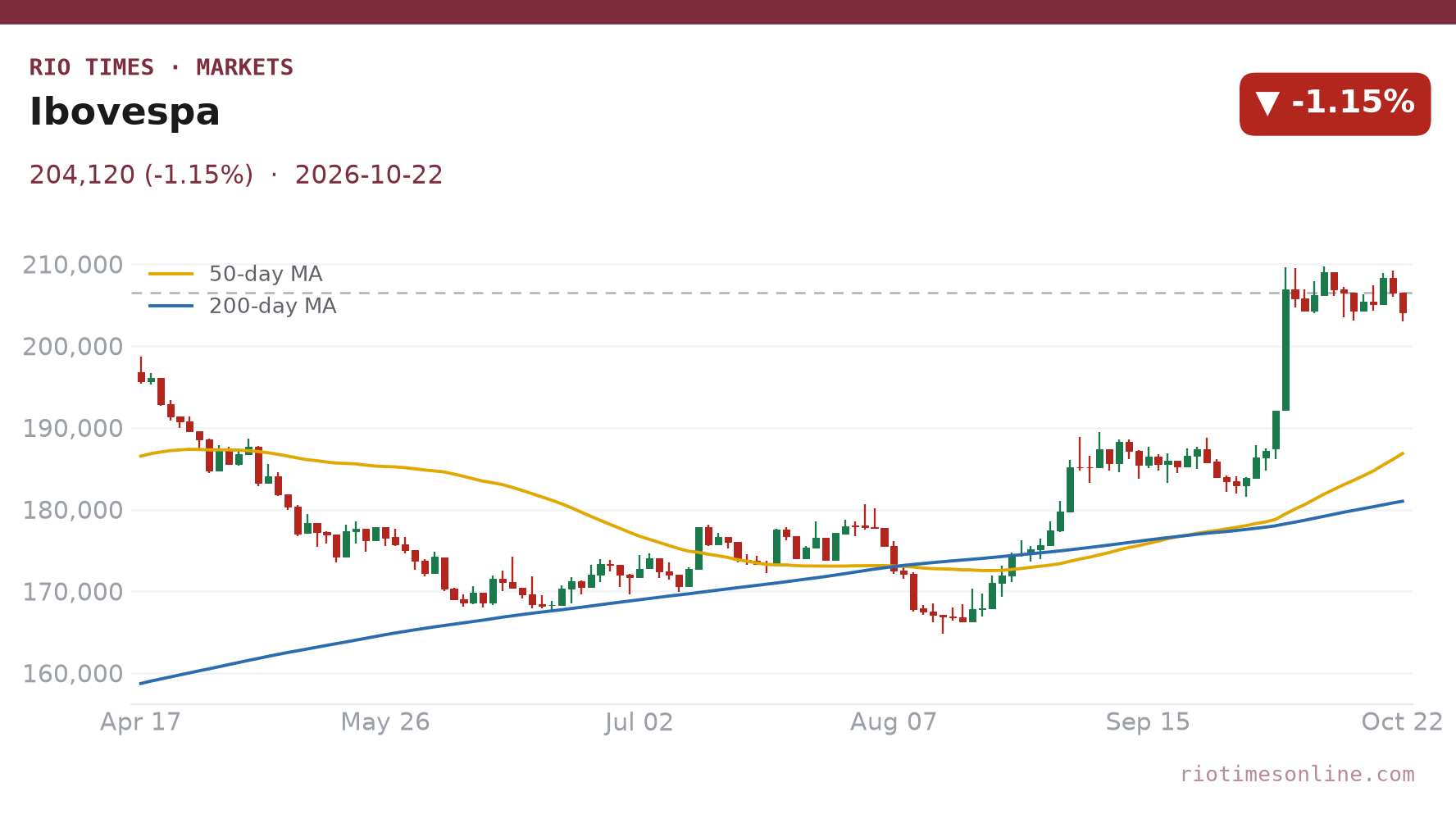
The Ibovespa closed at 204,120.12, near the lower part of the 203,052 to 206,493 range it traded in on Thursday. It had closed at 206,495 on Wednesday and 208,296 on Tuesday, so the index has now lost about 2% in two sessions.
A fall below 203,000 on Friday would mark a new low for the week, while a move back above 206,493 would show buyers returning. The real stayed close to 5.04 per dollar, calmer than shares.
What Prediction Markets Say
Polymarket, a prediction market, priced Flávio Bolsonaro at 75.8% and Lula at 24.5% to win the presidency, with US$192 million traded (read at 8:30 pm ET on 22 October).
These prices are bets, not polls. They can move quickly with each new poll.
Why we show this: prediction markets turn real-money bets into a live probability that moves within minutes of the news, which is why investors, campaigns and newsrooms in the United States now follow them closely. We show them next to polls and official results, never instead of them.
07 What to watch
- Sunday’s election result: A clear winner would likely spark a relief rally on Monday; a contested result would trigger a sharp sell-off in both stocks and the real.
- Global tech sentiment: The Nasdaq’s 2.60% drop on Thursday signals fragile risk appetite. Any further sell-off on Wall Street would pressure Brazilian equities regardless of the election.
- Oil prices and Middle East: Rising crude helped Prio on Thursday. Escalation in the region would support oil plays but hurt overall risk appetite.
- IPCA-15 inflation (Friday 23 October): The monthly inflation reading is due on Friday; we have no verified forecast to report.
Background: Brazil Stocks Fall 0.9% as Poll Tightens.
Background: Brazil Stocks Jump 1.57% on Bank Rally.
Frequently Asked Questions
Why did Brazil’s stock market fall on Thursday?
The Ibovespa fell 1.15% because global investors sold technology shares and Brazilian traders reduced risk ahead of Sunday’s presidential run-off between Flávio Bolsonaro and Lula.
How did the real perform?
The real weakened 0.40% to 5.0443 per US dollar. The move was modest compared with the stock market’s fall, suggesting currency traders are less alarmed by the election than equity investors.
Which stocks fell the most?
CSN led declines at −5.43%, followed by Usiminas at −4.81% and Embraer at −4.66%. Vale also fell 3.97%.
What is the Ibovespa?
The Ibovespa is Brazil’s main stock index, tracking the most heavily traded companies on the B3 exchange in São Paulo. It is a key barometer of Brazilian corporate health and investor sentiment.
Market data: RT; exchange figures from B3
This article was produced by The Rio Times’ automated newsroom system. How we use AI · Report an error · Editorial responsibility: Matthias Camenzind, Editor-in-Chief
LatAm Markets: Live Signals → — real-time movers, turnover leaders and FX across Latin America.
Get The Rio Times delivered to your inbox — market intelligence, daily briefs, and breaking analysis across Latin America.
Start for US$1