Balneário Camboriú Aims for Global Skyline Dominance with 550-Meter Residential Tower
Balneário Camboriú, Brazil’s coastal luxury real estate hub, aims for global skyline dominance with a new 550-meter residential tower set to redefine luxury living.
The city has unveiled plans for the Senna Tower, a 550-meter residential skyscraper set to become the world’s tallest residential building.
The project, announced by local developer FG Empreendimentos and endorsed by the Senna family, features a 14-meter scale model occupying four floors of a downtown building.
The tower’s $545 million construction will break ground in late 2025, targeting completion by 2030.
It surpasses New York’s 472-meter Central Park Tower and Dubai’s 435-meter Marina 101, with 228 units ranging from 300 m² apartments to 903 m² triplex penthouses priced up to $40 million.
FG Empreendimentos claims pre-sales already exceed $1.7 billion, leveraging Balneário’s status as Brazil’s priciest real estate market at $2,600 per square foot. Engineering hurdles dominate the narrative.
The coastal city’s granite bedrock and high winds necessitated innovations like Auger Cast piles-40-meter-deep, fully steel-reinforced foundations-and Latin America’s first Tuned Mass Damper, a 200-ton counterweight system to stabilize the structure.
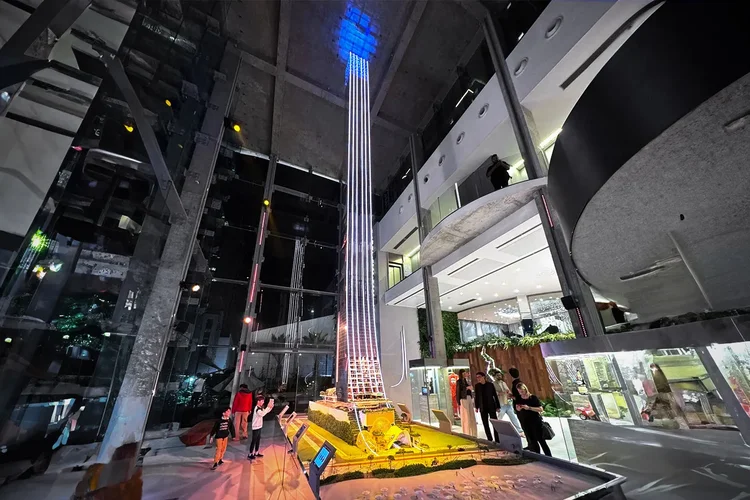
Balneário Camboriú Aims for Global Skyline Dominance with 550-Meter Residential Tower
Harry Poulos, a Burj Khalifa consultant, advised on soil mechanics, while fiber-optic sensors will monitor stress in real time.
Economic stakes are stark. The project’s $3 billion budget includes a dedicated digital bank (FG Bank) to finance future high-rises in Miami and Lisbon.
Local officials tout 12,000 construction jobs and a projected 9% annual tourism boost from the tower’s observatory and leisure floors.
Critics question absorption rates in a city with 18 vacant luxury towers, but developers highlight interest from athletes and investors eyeing Brazil’s tax incentives for coastal developments.
Ayrton Senna’s legacy anchors the design. His niece, artist Lalalli Senna, shaped the tower’s curved silhouette to mirror his racing trajectory, while LED bands on the facade evoke “transition from material to light.”
The Senna Brand’s involvement extends to an on-site museum featuring the driver’s career artifacts, blending real estate with cultural capital.
Environmental concerns linger despite LEED Platinum ambitions. The tower’s glass exterior risks bird collisions, prompting negotiations with wildlife groups, while seawater cooling systems face scrutiny from coastal regulators.
FG Empreendimentos maintains the project will use 30% recycled materials and achieve net-zero energy via solar panel arrays-a claim awaiting third-party verification.
As Balneário Camboriú positions itself as Latin America’s answer to Dubai, the Senna Tower embodies Brazil’s gamble on vertical urbanization.
With 60% of units reportedly reserved, its success or failure will signal whether supertall aspirations can withstand economic gravity.
More: Brazil news in English, every day from The Rio Times.
This article was produced by The Rio Times’ automated newsroom system. How we use AI · Report an error
Read More from The Rio Times