A Closer Look at the Dollar’s Surge Amid Economic Turbulence
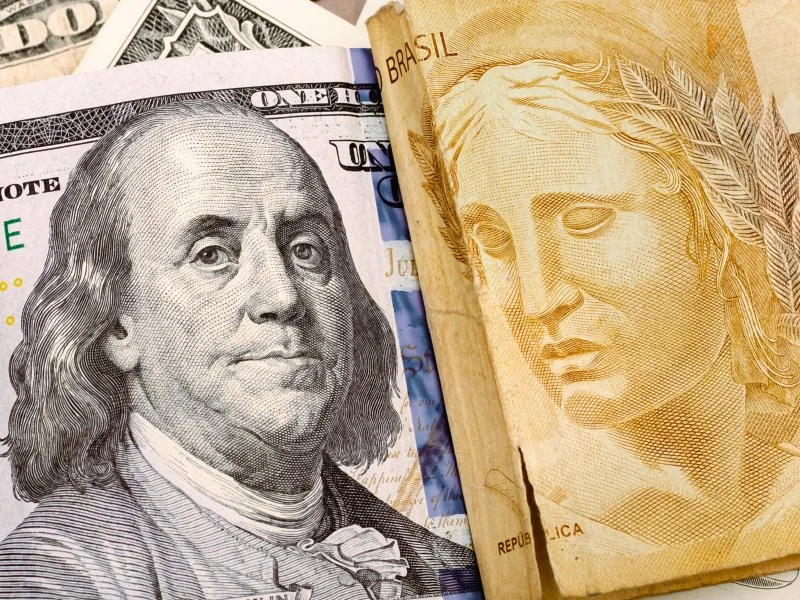
The US dollar has seen a notable increase against the Brazilian real, closing at R$5.6404, marking a 0.46% rise.
This uptick reflects a broader pattern influenced by global economic currents and contrasting national economic performances.
Initially, the dollar softened against the real as Brazil‘s GDP for the second quarter outperformed expectations.
The Brazilian economy expanded by 1.4% from April to June, surpassing the economist consensus of a 0.9% rise.
This 3.3% annual growth spotlighted Brazil’s fiscal expansion, which, despite its boost to the economy, raises concerns about its sustainability due to high interest rates and escalating public debt.
Contrastingly, in the United States, economic indicators tell a different story. The manufacturing PMI, a measure of industrial health, edged up to 47.2 in August from July’s 46.8.
However, it still missed market predictions and continued to signal industrial contraction. This data prompted investors to gravitate towards safer assets, including the US dollar and Treasury securities.
This shift occurred amid renewed anxieties about the US economy and ahead of impending labor market data.
Currency Markets and Global Economic Impact
This movement was mirrored in currency markets, where the dollar‘s strength was evident against other currencies.
This was evidenced by a slight increase in the DXY index, which tracks the dollar against a basket of six global currencies, rising by 0.12%.
Emerging markets felt the ripple effects distinctly. Commodities like Brent crude oil and iron ore, often economic staples for these regions, plunged over 4%.
This decline was due to diminished attractiveness in the face of a strengthening dollar and economic shifts in major economies like Japan, which is considering interest rate hikes.
The fluctuating probabilities of US interest rate cuts further complicate the scenario. Market forecasts now see a 63% chance of a 25 basis-point cut in September, a decrease from the previous day’s 70% likelihood.
Expectations for a more significant rate cut also grew slightly following the PMI report. This economic interplay not only affects currencies but also informs investment strategies and fiscal policy adjustments worldwide.
It highlights the intertwined nature of global markets and the far-reaching impact of economic policies and performances in major economies.
This article was produced by The Rio Times’ automated newsroom system. How we use AI · Report an error
LatAm Markets: Live Signals → — real-time movers, turnover leaders and FX across Latin America.
Read More from The Rio Times