Uganda Says Exports to South Sudan Hit US$700 Million

TRADE · UGANDA
Key Facts
- —The country Uganda is a landlocked East African economy of about 46 million people (2024 census). South Sudan, its northern neighbour, depends heavily on Ugandan food, goods and transport links.
- —Why it matters South Sudan is one of Uganda’s biggest export markets. Steady cross-border trade feeds families on both sides and supports a fragile country heading towards elections.
- —Why now The figure came as a Juba official’s call to keep small retail trade for South Sudanese alarmed Ugandan traders. The commissioner later said he has no mandate to expel them.
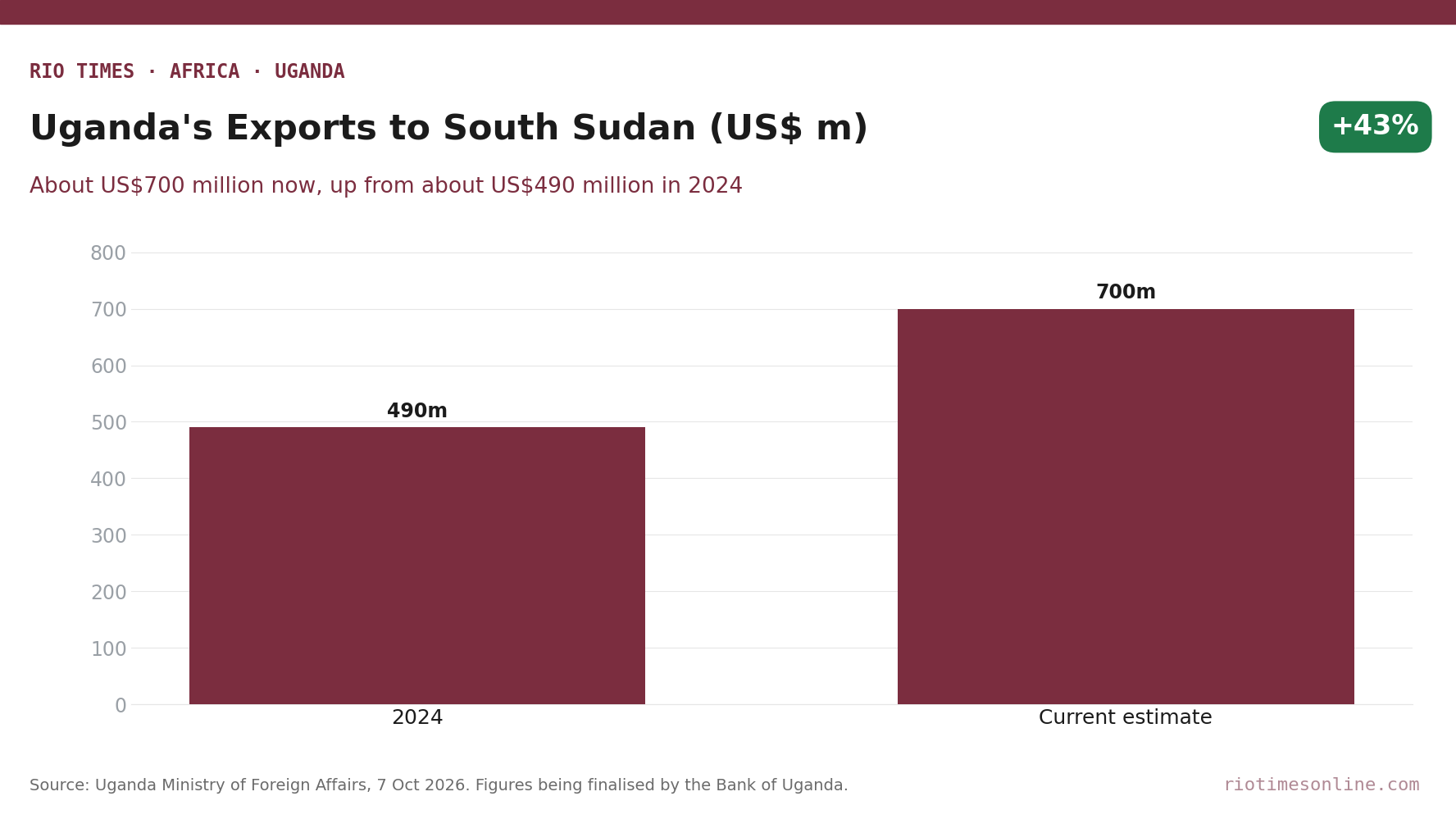
- —What happened On Wednesday 7 October, Uganda’s Foreign Affairs Ministry said exports to South Sudan reached about US$700 million, up from about US$490 million in 2024.
- —The numbers A rise of roughly 43%. The ministry said two-way trade averaged US$700 million to US$800 million a year over the past two years. The Bank of Uganda is still finalising the data.
- —What it means for US readers No direct US trade link. It matters for US investors in East African banks and telecoms, and for aid agencies that rely on the Uganda corridor to supply South Sudan.
- —Still open New trade targets are due at a Kampala business forum from 13 to 15 October. Juba has not published any formal rule on foreign retail traders.
Uganda South Sudan trade has climbed to about US$700 million in Ugandan exports, Uganda’s Ministry of Foreign Affairs said in Kampala on Wednesday 7 October. That is up from about US$490 million in 2024. For foreign investors and aid groups, it shows how much a fragile neighbour still leans on Uganda for food, goods and transport.
Ambassador Charles Ssentongo, Director of Protocol Services at the ministry, gave the figures. He was launching the second Uganda–South Sudan Business Forum, which runs at the Mestil Hotel in Kampala from Tuesday 13 to Thursday 15 October.
“We estimate that right now we are trading at around $700 million in terms of exports to South Sudan, which is a big leap from $495 million by 2024,” Ssentongo said, according to SoftPower News. Another Kampala outlet, ChimpReports, put the 2024 base at about US$490 million.
He stressed that the numbers are not final. The Bank of Uganda, the central bank, is still finalising them. New trade targets will be announced at the end of the forum, he said.
A Big Market Next Door
South Sudan became independent in 2011. It has few factories and imports much of what it eats and uses. Uganda sits on its southern border, linked by the main road from Elegu and Nimule to Juba, the capital.
Brigadier General Bonny Bamwiseki, Uganda’s Defence Attaché and head of mission at its embassy in Juba, said trade now spans agriculture, manufacturing, construction materials and services. Education and healthcare are the main services South Sudanese buy from Uganda.
On the wider measure of Uganda South Sudan trade, Ssentongo said two-way flows had averaged between US$700 million and US$800 million a year over the past two years. He credited cooperation between the Uganda Revenue Authority and South Sudan’s revenue body with cutting smuggling and speeding up customs clearance.
The relationship has had shocks. Bamwiseki said Uganda’s embassy stepped in when Ugandan maize was barred from entering South Sudan, and again in a recent dispute over scrap metal.
Friction Over Small Traders
The upbeat numbers arrived in a tense week. On Monday 5 October, Kalisto Lado, the caretaker Commissioner of Juba County, told foreign traders at Juba’s Kubri Haboba market to focus on wholesale trade and larger investments.
According to Juba-based Eye Radio, he said businesses such as selling charcoal, onions and tomatoes, and motorbike transport, should be left to South Sudanese. Ugandan and Kenyan media reported the remarks as a call to expel foreign traders. Lado has since said a county commissioner has no mandate to expel foreigners.
Rebecca Kadaga, Uganda’s Minister of East African Community Affairs, asked Juba on Ugandan television to respect the bloc’s common market rules. She urged that any measures be applied without discrimination and through legal and diplomatic channels.
Both countries belong to the East African Community, an eight-member regional bloc that is building a customs union and common market. Ssentongo urged traders to respect South Sudan’s “stringent and sovereign regulations” and said Uganda must also remove its own non-tariff barriers.
Akuol Abijok Deng, Chargé d’Affaires at South Sudan’s embassy in Kampala, named high costs, border delays and limited access to finance as the main obstacles. She called for simpler procedures and more transparent rules.
What It Means for US Readers
The figures involve no US trade directly. But the corridor matters to Americans in three ways.
First, US investors hold stakes in East African banks, telecom operators and consumer firms that sell into South Sudan. Smoother trade supports their revenue; new barriers would hurt it.
Second, the United States has long been one of the largest donors to South Sudan. Much humanitarian food and fuel moves along the same road from Uganda, so delays at the border raise costs for aid programmes.
Third, stability in South Sudan, which has a long history of conflict, depends partly on affordable imports. The US State Department has for years told Americans not to travel to South Sudan. Trade growth is a modest stabiliser, not a fix.
For context on Uganda’s wider trade picture, see Uganda Trade Deficit Hits Record US$1.14 Billion. Our earlier report on the Juba dispute is Juba Retail Ban Hits Ugandans, but No 7-Day Expulsion.
What Is Not Known
The US$700 million figure is an estimate. The Bank of Uganda has not yet published final Uganda South Sudan trade numbers, and we could not independently confirm them. The period it covers, a calendar year or the latest twelve months, was not stated.
Reports differed slightly on the 2024 base, at US$490 million or US$495 million. Ssentongo declined to give the new trade targets before the forum ends.
Juba has not issued any written rule on foreign retail traders. It is unclear whether national authorities will set one, or whether the matter ends with the commissioner’s clarification.
Frequently Asked Questions
How much does Uganda export to South Sudan?
Uganda’s Ministry of Foreign Affairs estimates exports at about US$700 million, up from about US$490 million in 2024. The Bank of Uganda is still finalising the figures.
When is the Uganda–South Sudan Business Forum?
The second forum runs from Tuesday 13 to Thursday 15 October 2026 at the Mestil Hotel in Kampala. New trade targets are due at the end.
Is South Sudan banning foreign traders?
No formal ban has been issued. A Juba County official urged foreigners to leave small retail trade to South Sudanese, then said a commissioner has no mandate to expel anyone.
Why does this matter to Americans?
It affects US investors in East African banks and telecoms, and aid programmes that ship food and fuel to South Sudan through Uganda.
Sources: Uganda Ministry of Foreign Affairs statements at the forum launch, Kampala, 7 October 2026, as reported by SoftPower News and ChimpReports; Eye Radio, Juba, 8 October 2026.
Editorial responsibility: Matthias Camenzind, Editor-in-Chief · Editorial standards · Report an error
Part of our ongoing coverage
Africa: The New Scramble — the great-power contest over the continent.
Read More from The Rio Times