The Criminal Police Officer Who Took the Secrets of Rio’s Underworld to His Grave
RIO DE JANEIRO, BRAZIL – In 2005, the jail for state police officers in Rio de Janeiro was awarded the highest decoration in the state. However, the honoree was not a prison guard, but rather an inmate.
An officer charged with murder was awarded the Tiradentes medal – a commendation for providing outstanding services to the state proposed by a twenty-something Carioca deputy, Flávio Bolsonaro. His father, Jair Bolsonaro, then an irrelevant federal deputy who would become the President of Brazil, attended the trial of the decorated prisoner and even dedicated a speech to him in the plenary of the Chamber of Deputies.

He regarded him as a brave man unfairly pursued after killing during a police operation “an element that, despite being involved in drug trafficking, was considered by the press as a mere car watcher”.
On Saturday, Jair Bolsonaro again spoke about the militiaman. “There is no final sentence convicting Captain Adriano for anything, with no intention of defending him. That year he was a hero of the State Police”, he said in a press interview.
Adriano Magalhães da Nóbrega was an exceptional policeman and then an exceptional criminal. An instructor for the corporation that starred in the film Elite Squad, he became a criminal years ago, after being released from prison in 2006. In 2018 he was interrogated for the murder of city councilor Marielle Franco and last Sunday he was shot down in a police operation. He was 43 years old.
The suspicion of destroying evidence was instantaneous. A suspicion that draws a filmlike ending to a life fit for a horror soap opera. Regarded as brave and violent by his coworkers, “Captain Adriano” embodied the dark side of Rio, according to Chico Otavio, a veteran reporter for the newspaper O Globo.
A dense tangle of dark connections between police, organized crime and politics hidden behind the cover of stunning beaches, Carnaval and Caipirinha. “Rio is today like the Chicago of the 1920s or the New York of the 1980s,” says Jacqueline Muniz, a doctor of Police Studies.
Captain Adriano was one of Brazil’s most wanted men. Although he faced the law several times, when he died he was clean, at least in the official records. His criminal record evaporated because although he was convicted of murdering the car watcher, he was later acquitted.
Nor was he prosecuted in the Marielle case (for which another former state police officer is in prison). And despite being suspected of several murders, his connection to senator Flávio Bolsonaro was indirect but recent: up to 2018, the son of the Brazilian president employed in his office the mother and ex-wife of this police officer who was expelled from the corporation in 2014.
Following Adriano’s death, Flávio Bolsonaro only broke his silence to report on Twitter that the former police officer’s body would be cremated. A judge prevented the cremation.
DENUNCIATION! It has just come to my attention that there are people expediting the cremation of Adriano da Nóbrega in order to vanish with the evidence that he was brutally murdered in Bahia. I urge the relevant authorities to prevent this and to clarify what actually happened.
– Flavio Bolsonaro (@FlavioBolsonaro) February 12th, 2020
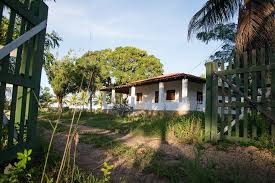
Captain Adriano had been hiding for less than a day in the house where he was shot down by former colleagues. His lawyer says he was nervous, that he was afraid of being murdered. It is unclear whether anyone tipped him off that they were after him. What has been confirmed is that the isolated house he used as his last hiding place belongs to a city councilor from the party through which the head of the Bolsonaro clan won the presidential elections.
For years, this quiet, 1.77 meter tall, muscular police officer, who knew how to assemble an AK47 without looking at instructions, had been working for crime. “He was recruited in the 2000s. And he became head of security for the Garcia family”, explains Otavio in a café, the journalist who, together with a colleague, was the first to write about Adriano.
“He ascended quickly because he was violent and wasn’t afraid,” he adds. Rio’s Prosecutor’s Office charged him a year ago with commanding a group of hitmen called the Escritório do Crime (Crime Bureau) and leading one of the so-called militias that increasingly control more territories -and voters- in the city.
These are groups born in the late 1970s, when the local underworld, which manages the ‘jogo do bicho’ (game of chance) and the slot machines (illegal in Brazil), recruited the police officers who had performed the dirtiest job of repression during the dictatorship. They came to the periphery offering community security and began to extort and monopolize basic services like gas, Internet, cable TV or water in gallons.
In recent years they have expanded their business into illegal construction. The major events that culminated in 2016 with the Olympic Games were the breeding ground for their expansion to control half the city, explains Muniz, who worked for Lula’s government.
The O Globo reporter explains that Captain Adriano’s most lucrative deals in recent times were loans and illegal construction in Rio das Pedras, a favela built to house nannies, gardeners or drivers from the wealthy residents of the Barra da Tijuca condominiums, where Bolsonaro keeps his family home.
Among his condo neighbors was the state police officer charged with firing four shots in the face of city councilor Marielle Franco in a moving car. Called Ronnie Lessa, his trajectory is similar to that of Captain Adriano. The reporter says that the skill required for this attack was the reason why Adriano ended up being questioned regarding the councilor’s murder. The collapse of an illegally built building in Rio das Pedras killed 24 people last year.
Professor José Claudio Alves, who has been studying these militia groups for three decades, believes that Marielle was murdered because, through her work, she was familiar with these groups’ network, because she was more combative than others and because she was a woman. “These groups do not coexist with any woman who intimidates them.”

Marielle’s death had a huge impact that placed the focus on the criminals who were once police officers. Interrogations stirred up a hornet’s nest. Thus was born the Prosecutor’s Office operation named Os Intocáveis (“The Untouchables”), which arrested a dozen of them, although the most valuable one, Adriano, managed to escape. “These groups exist only because they have funding, political support and because they control densely populated areas in a militarized way,” explains Alves, a professor at the Federal Rural University of Rio de Janeiro.
Whoever controls the territory controls the electorate. This is one of the keys, because in this system the money from illegal deals is used to finance political campaigns. “It’s the best money, you don’t have to declare it,” Muniz says. It helps to understand how one of those investigated as a potential intellectual perpetrator of Marielle’s murder is an acting city councilor. A city councilor who, ironically, has the surname Siciliano (“Sicilian”). His name is Marcelo.
“It’s been many years since we witnessed a perverse illegal privatization of public safety in Rio de Janeiro; the police haven’t patrolled for a long time, they’re an operations police: what they do is take criminals out of here,” Muniz says. “A war is being waged in order to increase the price of bribes for rents in the territory,” he concludes. In order not to be pariahs, the masters of these illegal deals head samba schools, which at the end of the month will parade in Carnival before Brazil and the world.
The expert report on the death of Captain Adriano has not yet been released. But the photos published by Veja magazine show that he was shot at least once at close range. What he knew about the dark side of one of the most beautiful cities in the world he took to his grave. None of the arrested militiamen have spoken. Neither did the man accused of killing Marielle.
Source: El Pais
More: Brazil news in English, every day from The Rio Times.
This article was drafted with automated assistance and reviewed before publication. How we use AI · Report an error
Read More from The Rio Times