The Party Elon Musk Backed Just Won a German State by 26 Points
GLOBAL BACKDROP · POLITICS
Key Facts
The result: Alternative for Germany, the anti-immigration party known as the AfD, took 43.8 percent in the eastern state of Saxony-Anhalt on Sunday 6 September, the largest share a populist-right party has won in a German state election since 1945.
The seats: It holds 39 of 83. The four parties that refuse to work with it also hold 39. A majority needs 42.
The hinge: One small left-wing breakaway party, the BSW, has the remaining five seats and has not said what it will do.
Not final: This is the preliminary official count. The state electoral committee certifies the result later this month.
The collapse: The Christian Democrats, Germany’s main conservative party, fell to 17.2 percent from 37.1 percent, losing 25 of their 40 seats.
What comes next: Two more German regions, Mecklenburg-Vorpommern and Berlin, vote on 20 September.
Elon Musk said only this party could save Germany. On Sunday it took 43.8 percent of one German state, a landslide in a system built to prevent them, and 26 points clear of the conservatives who had governed there since 2002. It still cannot govern, because the parties refusing to work with it hold exactly as many seats. Latin America has spent twenty years learning what that kind of arithmetic does to a country.
Nothing Like This Has Happened Since 1945
Saxony-Anhalt, a state of about two million people in the former East Germany, voted on Sunday 6 September. Alternative for Germany, an anti-immigration party usually called the AfD, took 43.8 percent of the preliminary official count.
No party of that kind has won a bigger share in any German state election since 1945. Chatham House makes the same point in the same words.
The raw number is not the record. Eight German state elections have produced 43 percent or more since 2006, two of them as recently as 2022.
What has no precedent is the speed. The party took 20.8 percent here five years ago, so it has added 23 points in a single cycle.
Its own previous best anywhere was 32.8 percent, in Thuringia in 2024. It has just beaten its own ceiling by 11 points.
No party that a German domestic intelligence agency has classified as confirmed right-wing extremist has ever won a share like this. The Saxony-Anhalt branch has carried that classification since November 2023.
And no party in Western Europe since 1945 has crossed 40 percent while every other party in its parliament refused to govern with it. Belgium’s cordon peaked against a party on 24 percent, Austria’s against one on 28.9.
The share converts to 39 of the state parliament’s 83 seats. In 2021 the party took 20.8 percent and 23 seats, in a chamber that then held 97.
The Christian Democrats fell to 17.2 percent from 37.1 percent. The governing party lost more than half its vote in a single election, and 25 of its 40 seats.
The party had governed Saxony-Anhalt since 2002, under Reiner Haseloff from 2011. Sven Schulze only took over as minister-president in January of this year.
And Now Nobody Can Govern
Winning on that scale has not delivered power, and that is the second half of the story. Add the conservative Christian Democrats’ 15 seats to the centre-left Social Democrats’ eight, the Greens’ eight and the left-wing Die Linke’s eight. That is 39.
The AfD also has 39. Neither side can reach the 42 seats a majority needs.
Between them sits the Bundnis Sahra Wagenknecht, or BSW, a breakaway from Die Linke with 5.3 percent and five seats. The Free Democrats took 2.6 percent and lost every seat they had.
The BSW’s federal leadership has ruled out installing either the AfD’s Ulrich Siegmund or Schulze as minister-president. It has floated a candidate from outside the parties instead.
Its regional lead candidate, Thomas Schulze, has left the door open to working with the AfD bill by bill. “This tiny party could now play a decisive role in determining the future of Saxony-Anhalt,” the analyst Volker Resing told the Associated Press.
Four parties that agree on almost nothing must now govern together, or hand the state to the party they exist to exclude. There is no third option that does not involve the five seats in the middle.
Every earlier test of the firewall lasted a week, or covered one district, or turned on a single ballot. This is the first time the arithmetic itself makes the wall unworkable.
Washington Is Cheering
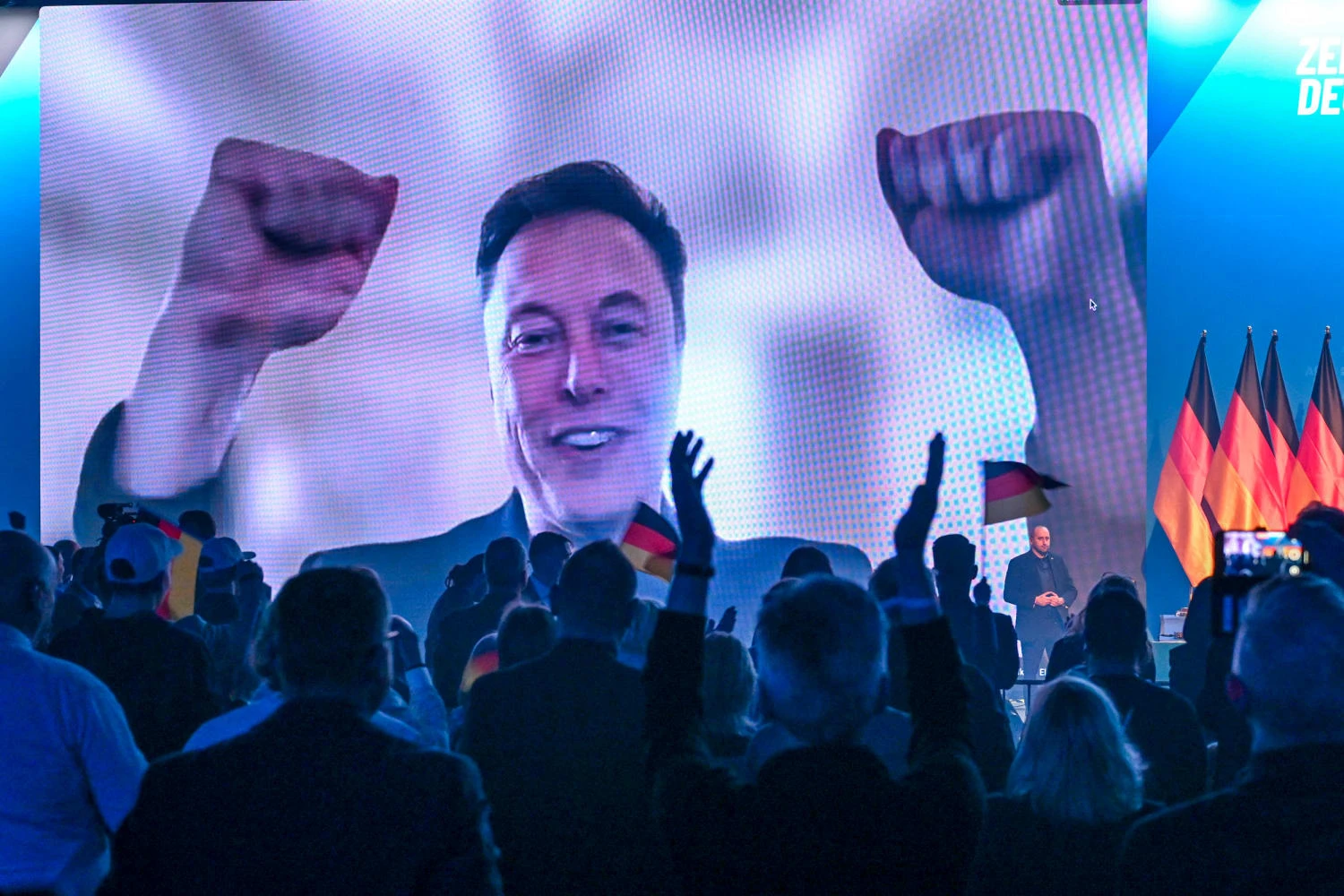
The party has powerful admirers abroad. Elon Musk wrote in December 2024 that only the AfD could save Germany, then hosted its leader Alice Weidel on a livestream.
He posted “Gut gemacht”, German for well done, after Sunday’s result. Richard Grenell, Donald Trump’s envoy and a former US ambassador to Berlin, called it a new day in Germany.
Trump himself shared the result on his own platform without comment. He has never endorsed the party, and in 2025 said he was not disappointed it had lost.
US Secretary of State Marco Rubio went further than his president. After German intelligence upgraded its assessment of the party in May 2025, he called the move tyranny in disguise.
That assessment no longer stands nationally. A Cologne court blocked it in February 2026, and the federal party is again treated only as a suspected case.
The Saxony-Anhalt branch is the exception. The state intelligence service has classified it as confirmed right-wing extremist since November 2023.
The Wall Was Never a Law
The Brandmauer, German for firewall, is an understanding rather than a statute. Germany’s mainstream parties agreed not to govern with the populist right or to accept its decisive votes.
An understanding lasts exactly as long as the people keeping it. This one has cracked before.
In February 2020 the Free Democrat Thomas Kemmerich became Thuringia’s premier on a ballot that passed only because all 22 AfD deputies backed him. Chancellor Angela Merkel called it unforgivable, and he announced his resignation the next day.
In 2023 the AfD’s Robert Sesselmann won the Sonneberg district administration, the first populist-right politician to run a German county since the Nazi era.
The Rosa Luxemburg Foundation counted 121 cases of mainstream parties voting alongside the AfD in eastern councils between 2019 and 2023. Most concerned building, infrastructure and social policy rather than migration, which accounted for only eight.
Every Earlier Crack Was Small
On 29 January 2025 the Bundestag passed a non-binding migration motion by 348 votes to 345. Friedrich Merz brought it as opposition leader; he is now chancellor.
It carried only because AfD votes supplied the margin. It was the first time a Bundestag majority had rested on the populist right.
Between 160,000 and 250,000 people protested in Berlin within days, depending on whether the count comes from the police or the organisers.
Every previous breach was absorbed inside a week, a district or a single ballot. Saxony-Anhalt is different in scale, and scale is what containment was never built to survive.
Where the Vote Came From
The state’s economy supplies the mood. Population is down to 2.12 million since reunification, and unemployment runs at 8.2 percent against 6.5 percent nationally.
Company insolvencies rose about 18 percent in 2025, against 4 percent nationally on the same measure. The pressure sits in the Leuna and Bitterfeld chemical belt the state still treats as its identity.
Voters name migration rather than unemployment as the problem. Foreign nationals are 7.9 percent of the state population, against 14.9 percent nationally.
What changed was belief. Some 36 percent told pollsters in July they trusted the AfD most to fix the state, against 9 percent five years earlier.
Siegmund’s campaign converted that into an estimated 157,000 former non-voters and 83,000 former Christian Democrat voters. Turnout climbed to 77.8 percent from 60.3 percent.
Marcus Boick, a historian of Germany at Cambridge, argues that “voting for right-wing populists is a very rational thing to do in the rural areas” of the east.
A Movement, Not a Swing
Vote shares move all the time. Movements show up in a different number, which is how many people they pull into an election that was not going to have them.
Seventeen and a half points of extra turnout, in a state that has been losing population since reunification, is that number. So is a jump from 9 percent trust to 36 in five years.
The party also beat its own ceiling by 11 points, having never passed 32.8 percent anywhere before. That is not a swing between two established blocs.
The closest comparison anyone reaches for is American. The Washington Post described the winning candidate, Ulrich Siegmund, as a German politician with a MAGA touch, and Make Germany Great Again caps have become common at the party’s rallies.
Almut Moller of the European Policy Centre put it more carefully. There is ideological alignment on key issues, she said, and the party is also learning from the MAGA movement.
The differences are real and worth stating. The party is pro-Moscow in a way the American movement is not, and its leaders have publicly criticised Washington on tariffs, Iran and Greenland.
Berlin Braces, Warsaw Fumes
Merz called Sunday’s result “the most serious election defeat that the CDU has had for years, for decades”. He said his party was “deeply shocked” and that “giving up is not an option for me”.
Schulze, the outgoing minister-president, chose defiance over concession. “Some say this is a dark day for Saxony-Anhalt. I say this is democracy.”
The result travelled. Poland’s prime minister Donald Tusk posted that “in Poland, only idiots or traitors can rejoice at the triumph of the AfD in Germany”, adding that “quite a few of them have gathered in Confederation and PiS”.
The reply was personal. The Confederation MP Konrad Berkowicz told Tusk it was his own camp that should worry about German money drying up, and the AfD member of the European Parliament Tomasz Froelich told the Polish prime minister to eat a Snickers.
The AfD’s roughly 576,000 second votes are about one percent of Germany’s national electorate. The party still leads the Social Democrats 35 to 32 in Mecklenburg-Vorpommern, which votes on 20 September.
What This Means From Latin America
Rio Times readers do not need a German dictionary to recognise this problem. They need only look at their own legislatures.
Peru has removed or forced out six presidents since 2018. The most recent was José Jerí in February 2026, four months after he replaced Dina Boluarte.
That happens inside a Congress split across a dozen shifting blocs. Each vote requires a new coalition, so nobody governs for a term.
Brazil’s answer has a name and a price. President Lula da Silva’s government depends on the Centrão, a bloc with no fixed ideology and a documented appetite for cabinet posts and budget earmarks in exchange for votes.
That is the kingmaker role the BSW has so far declined to play for free. Brazilian politics has priced it in for a generation.
Argentina ran the opposite experiment. Javier Milei took office in December 2023 with a small fraction of Congress and was not walled out but invited in, first through decree powers and then through seat-by-seat deals.
Latin America never wrote a doctrine as explicit as the Brandmauer. Exclusion here has always been improvised, coalition by coalition.
Saxony-Anhalt makes the same point from the other end. Even an explicit doctrine comes down to whichever five seats hold the balance.
More: World news in English, every day from The Rio Times.
Frequently Asked Questions
Did the AfD win control of Saxony-Anhalt?
No. The preliminary official count gives it 39 of 83 seats, three short of a majority. The four parties that exclude it also hold 39, so the BSW’s five seats decide who can reach 42.
Is this the first time a populist-right party has topped a German state election?
No. The AfD topped Thuringia in September 2024 with 32.8 percent. What is new in Saxony-Anhalt is the size of the share, 43.8 percent, the largest since 1945.
Is the result final?
Not yet. This is the preliminary official count. The state electoral committee meets later this month to certify the final result.
What is the Brandmauer?
It is an informal commitment by Germany’s mainstream parties never to govern with the AfD or accept its decisive votes. It has cracked before, in Thuringia in 2020, in Sonneberg in 2023 and in the Bundestag in January 2025.
Does this affect Chancellor Merz?
Not directly, because a state parliament has no say over Berlin. Indirectly it is real: Merz called it his party’s worst defeat in decades, and two more states vote on 20 September.
Connected Coverage
We covered the regional read-through in Global Economy Briefing — September 8, 2026 and the wider European policy picture in Europe Intelligence Brief.
Sources: Saxony-Anhalt state returning officer and election calendar; Federal Agency for Civic Education; Infratest dimap LanderTREND; Rosa Luxemburg Foundation study on the firewall; Destatis and Dun & Bradstreet on insolvencies; Bundesagentur fur Arbeit; Chatham House; Associated Press; NPR; Fortune; Christian Science Monitor; Notes from Poland.
This article was produced by The Rio Times’ automated newsroom system. How we use AI · Report an error · Editorial responsibility: Matthias Camenzind, Editor-in-Chief