Rwanda and Congo Sign US-Brokered Peace Deal, Eye Mineral Wealth and Stability
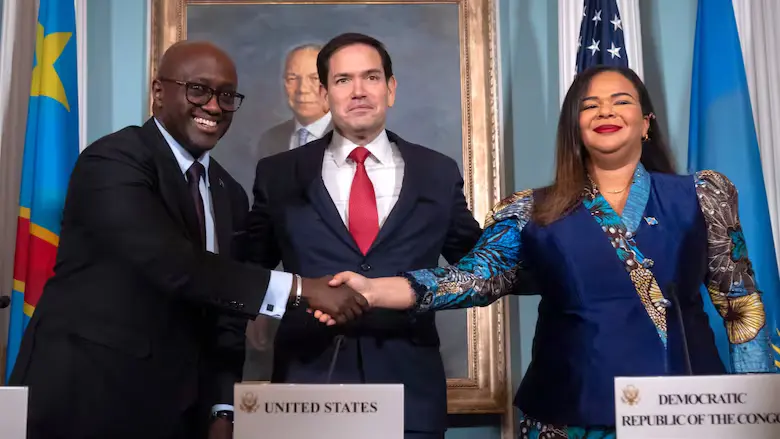
The Democratic Republic of Congo DRC and Rwanda signed a US-brokered peace agreement in Washington on June 27, 2025, aiming to halt three decades of violent conflict in eastern Congo.
Official statements from both governments confirm the deal, which follows three days of negotiations in the US capital.
US Secretary of State Marco Rubio and President Donald Trump attended the signing, highlighting the significance of the event.
The agreement requires both countries to respect each other’s borders, stop supporting armed groups, and disengage military forces within three months.
It establishes a joint security coordination mechanism and outlines the disarmament and conditional integration of non-state armed groups.
The deal builds on previous declarations and includes provisions for regional economic integration. Both sides agreed to monitor troop withdrawals and end support for hostile militias.
The US and Qatar acted as mediators. The US government made clear its interest in securing access to Congo’s vast reserves of cobalt, coltan, gold, and lithium, which are critical for electronics and electric vehicles.
The DRC holds at least 60% of the world’s coltan reserves and produces most of the global cobalt supply. This mineral wealth has fueled the conflict, as various groups have fought for control of mining areas.
Eastern Congo has suffered from violence since the 1990s, with more than 100 armed groups operating in the region.
The M23, a Tutsi-led militia, advanced rapidly in early 2025, capturing Goma and Bukavu.
Rwanda and Congo Sign US-Brokered Peace Deal, Eye Mineral Wealth and Stability
The United Nations and US experts report that Rwanda supports the M23 with troops and weapons, a claim Rwanda denies.
Rwanda cites security threats from Hutu militias linked to the 1994 genocide as justification for its actions. The Congolese government accuses Rwanda of destabilizing the region for economic gain.
The human cost has been immense. Over six million people have died since the 1990s, mostly from preventable causes such as hunger and disease.
Rwanda-South Africa Diplomatic Rift Intensifies as DRC Conflict Escalates
More than seven million people remain displaced. The violence has blocked economic growth, stifled trade, and kept millions in poverty despite the region’s mineral wealth.
The peace agreement aims to attract foreign investment by reducing security risks and improving the business environment. The US seeks to secure mineral supply chains and reduce Chinese dominance in the sector.
The DRC ranks among the lowest in the world for rule of law and governance, and experts warn that only real reforms can ensure long-term benefits from the peace deal.
The M23 did not participate directly in the negotiations. Analysts caution that armed groups may continue fighting, and previous peace deals have failed.
The agreement marks a significant diplomatic step, but its success depends on implementation and ongoing cooperation.
Both countries and their international partners face the challenge of turning this diplomatic breakthrough into real and lasting peace.
More: DR Congo news in English, every day from The Rio Times.
This article was produced by The Rio Times’ automated newsroom system. How we use AI · Report an error · Editorial responsibility: Matthias Camenzind, Editor-in-Chief
Part of our ongoing coverage
Africa: The New Scramble — the great-power contest over the continent.