
FRANCE · PROTESTS
Published Wednesday, 21 October, 3:01 p.m. ET (9:01 p.m. Paris) · Source: Paris Police Prefecture order, franceinfo
Paris police have banned all street gatherings in the centre of the capital on Thursday, after a third night of curfews. The ban runs from 8 a.m. to 8 p.m. Paris time (2 a.m. to 2 p.m. ET) and covers the seat of government and major tourist sites.
Key Facts
- —What happened Paris police banned all gatherings in central sectors on Thursday, 22 October.
- —Who decided The Paris Police Prefecture, the capital’s police authority.
- —What happens next Ban runs 2 a.m. to 2 p.m. ET Thursday (8 a.m. to 8 p.m. Paris).
- —Why it matters for US readers The ban covers the Champs-Élysées and other tourist areas.
- —Prediction markets Polymarket: 57.5% chance the Paris curfew ends by 31 October. As of 3:00 p.m. ET.
This story is part of our coverage of the why France is in crisis. Dates, times and how to follow it are in our guide.
In plain English
Riots followed a cost-of-living protest on 17 October, and parts of France have had night curfews since. Now police say no unapproved march or rally may take place in central Paris on Thursday.
Students had planned a march anyway, and they are challenging the ban in court. The prefect is the state’s police chief for Paris.
The Paris Police Prefecture banned all gatherings and demonstrations in several central sectors of the capital on Thursday 22 October, from 8 a.m. to 8 p.m. Paris time (2 a.m. to 2 p.m. ET). It announced the order on Wednesday as the unrest that explains why France is protesting continues.
Curfews were renewed on Wednesday evening in several cities, including Paris and Lyon, as the France protests continue. Prime Minister Sébastien Lecornu meets the mayors of Paris, Marseille and Lyon at Matignon, his Paris office, on Thursday afternoon.
What the Ban Covers
Undeclared processions, parades and gatherings are barred in the listed sectors, franceinfo reported. They include the Élysée Palace, Place Vendôme, the Champs-Élysées, Châtelet-Les Halles, Bastille, the National Assembly, the Senate and six main railway stations.
The 17 October cost-of-living protest ended in riots and looting in several cities, and the curfews followed. Marseille’s curfew applies only to unaccompanied minors.
Students Challenge the Ban
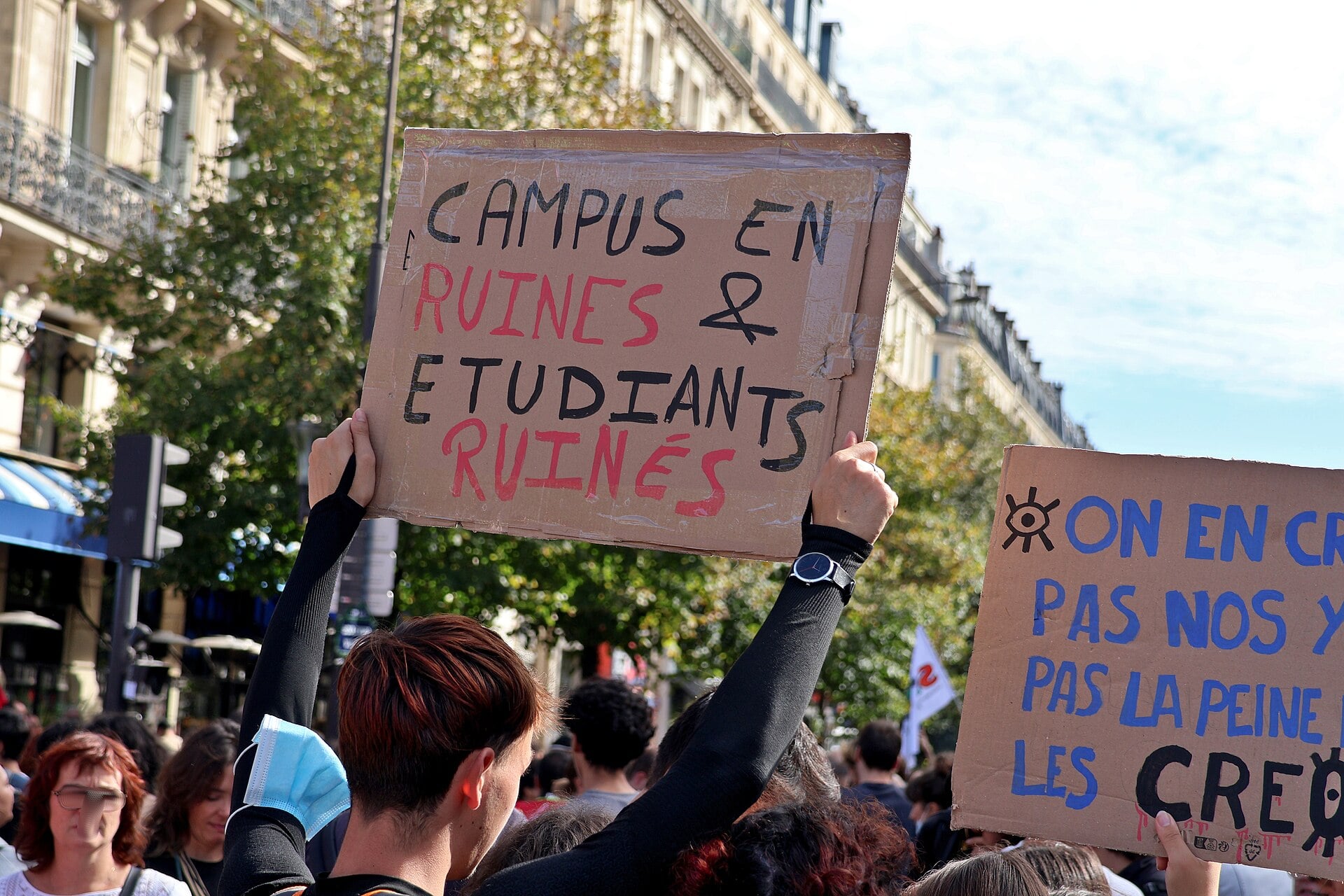
Interfac IDF, a coordination of high-school and university students in the Paris region, had planned a march on Thursday from the Pitié-Salpêtrière hospital to Place de la Bastille. The prefect banned it too, for the area between Boulevard de l’Hôpital and Bastille, citing the organisers’ inability to prevent abuses at gatherings on 13 and 17 October and security risks.
“We will not let this happen,” the group said, adding that it is challenging the ban legally (our translation), France 3 reported. A court ruling had not been reported at the time of writing.
The Paris transport operator will not stop trains at several metro stations from 10 a.m. Paris time (4 a.m. ET) on Thursday, including Bastille and Place d’Italie, Sortir à Paris reported. Line 10 is cut between Gare d’Austerlitz and Jussieu.
What Prediction Markets Say
Traders on Polymarket, a crypto-based platform, put the chance that the Paris curfew is lifted by 31 October at 57.5% and by 30 November at 97.4%, with US$11,817 traded. They see a 7.0% chance of a state of emergency by 31 October, with US$210,814 traded.
On Kalshi, which is regulated in the US by the CFTC (the Commodity Futures Trading Commission), the odds of a state of emergency are 12% before 1 November, with 29,147 contracts traded. Prices are as of 3:00 p.m. ET on 21 October and are bets, not polls. Why we show this: prediction markets turn real-money bets into a live probability that moves within minutes of the news, which is why investors, campaigns and newsrooms in the United States now follow them closely. We show them next to polls and official results, never instead of them.
What It Means for US Readers
Visitors to Paris on Thursday should avoid the banned sectors, which include the Champs-Élysées and the main railway stations. Our guide to travel to France right now lists curfews and strike dates.
What Is Not Known
It is not yet known whether a court will lift the ban or how many people will defy it. The end date of the curfews is also unclear. Unions have called a strike for Thursday 5 November, and Yellow Vest groups have called a further protest day, “Acte II”, for Saturday 24 October.
Frequently Asked Questions
Why did Paris ban demonstrations on Thursday?
Police cite security risks after the riots of 17 October. For the student march, the prefect also cited the organisers’ inability to prevent abuses on 13 and 17 October. The ban covers 8 a.m. to 8 p.m. Paris time (2 a.m. to 2 p.m. ET) in set sectors.
Where in Paris is the ban in force?
The sectors include the Élysée Palace, Place Vendôme, the Champs-Élysées, Châtelet-Les Halles, Bastille, the National Assembly, the Senate and six main railway stations, franceinfo reported. The list is longer than this.
Is there still a curfew in Paris?
Curfews were renewed on Wednesday evening in several French cities, including Paris and Lyon. No state of emergency has been declared.
Is it safe to travel to Paris now?
Most of the city runs normally, but the banned sectors include major tourist areas and some metro stations will not stop on Thursday. Check the US Embassy and the Paris police for updates before you go.
What happens after Thursday?
Prime Minister Sébastien Lecornu meets the mayors of Paris, Marseille and Lyon on Thursday afternoon. Unions plan a strike on Thursday 5 November.
Sources: franceinfo, 21 October 2026; France 3 Paris Île-de-France; Sortir à Paris; Paris Police Prefecture order of 21 October 2026; Polymarket and Kalshi market pages, 21 October 2026.
This article was produced by The Rio Times’ automated newsroom system. How we use AI · Report an error · Editorial responsibility: Matthias Camenzind, Editor-in-Chief
France in Turmoil
- Why France Is in Crisis, and How Macron Lost His Grip
- Why Is France Protesting? Riots, Curfews and the 2027 Race
- Is It Safe to Travel to France Right Now? Curfews, Strikes
- Who Will Win France’s 2027 Election? Polls and Odds