Rails, Cobalt and Rivalry: The African Railway Redrawing the Great-Power Map
Rio Times · Analysis
Key Facts
—The deal Angola’s Lobito Corridor railway reached financial close on a $753m package on 3 July 2026.
—The money $553m came from the US Development Finance Corporation and $200m from the Development Bank of Southern Africa.
—The route The project rehabilitates 1,300km of brownfield rail from the Port of Lobito to the DR Congo border.
—The prize The corridor is a strategic export route for copper and cobalt from Congo and Zambia, central to clean-energy supply chains.
—The builder The concessionaire is a joint venture of Lusophone construction group Mota-Engil and trader Trafigura.
—The impact The upgrade should lift capacity roughly tenfold to about 4.6m tonnes a year and cut mineral transport costs by around 30%.
A refurbished colonial-era railway across Angola has quietly become one of the most important geopolitical projects on earth – and a Portuguese-speaking builder sits at its heart.
A railway that carries more than freight
Some infrastructure projects are just concrete and steel, and some are statements of intent.
Africa Finance Corporation announced on 3 July the successful financial close of the $753 million Lobito Corridor Railway Project in Angola, one of Africa’s most significant cross-border transport transactions.
Angola secured the financing to speed up development of the corridor, ending months of delays tied to talks over government guarantees.
The timing, against a week of war and market fear, is no accident.
This is Washington planting a flag in the ground of the world’s next resource contest.
Follow the money, and the strategy appears
The funding structure tells you exactly whose project this is.
The financing includes US$553 million from the US International Development Finance Corporation and US$200 million from the Development Bank of Southern Africa.
The DFC framed the loan as evidence of President Trump’s commitment to forging partnerships in Africa and strengthening strategic infrastructure.
This is not charity; it is industrial policy dressed as development finance.
Central Africa, the DFC noted plainly, is rich in key resources essential to US industries, including minerals critical for technology and defence.
In other words, a railway in Angola is really about the batteries, chips and weapons of the coming decade.
What the corridor actually connects
The geography is the whole point of the enterprise.
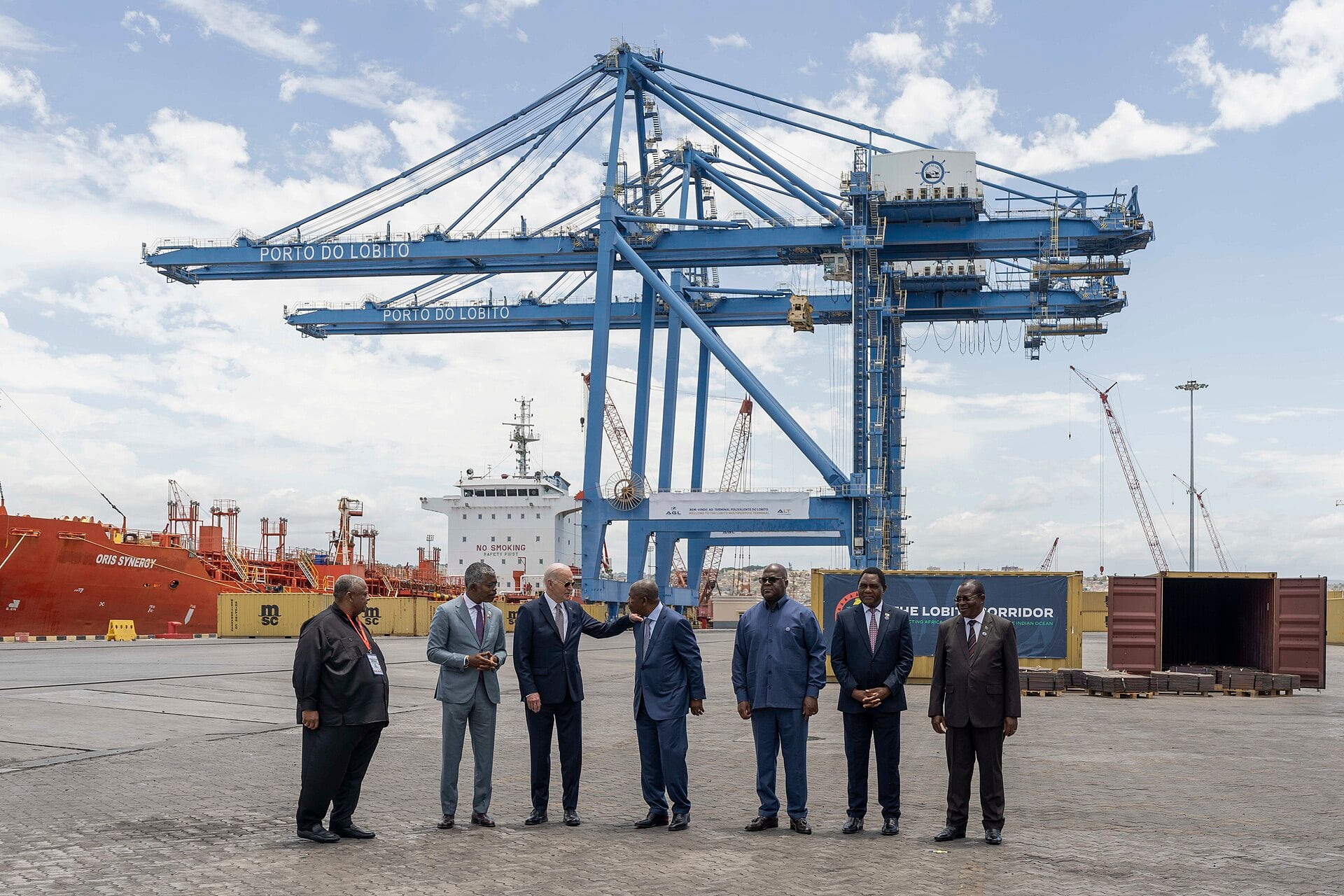
The funding supports rehabilitation and long-term operation of the 1,300-kilometre brownfield rail corridor linking the Port of Lobito in Angola to the DR Congo border.
The corridor is regarded as a strategic entry point to export copper and cobalt from the DRC and Zambia, major sources of the world’s battery and clean-energy supply chains.
The efficiency gains are transformative, not marginal.
The financing is expected to increase Lobito’s transport capacity tenfold to about 4.6 million tonnes a year and to cut the cost of moving critical minerals by an estimated 30 percent.
A shorter, cheaper Atlantic route changes the economics of every tonne of Congolese cobalt.
The Lusophone thread few will notice
Here is where the story loops back to The Rio Times’ own world.
The Lobito Atlantic Railway is a joint venture between the construction group Mota-Engil and the metals-and-minerals logistics company Trafigura.
The concessionaire is owned by a consortium of the European companies Trafigura, Mota-Engil and Vecturis.
Mota-Engil is a Portuguese multinational with deep roots across Lusophone Africa, binding Lisbon, Luanda and the wider Portuguese-speaking world into the deal.
Its deputy chief executive called the signing the culmination of long-term collaboration, and said it reinforced confidence in Angola’s ability to attract world-class infrastructure.
For readers who follow the Lusophone economy, this is a Portuguese-speaking builder helping the United States counter China in the heart of Africa.
The great-power contest beneath the tracks
To grasp why Washington cares, look at who currently controls the cobalt trade.
China has spent two decades locking up Congolese mines and the roads and railways that carry their output east to the Indian Ocean.
The Lobito Corridor offers the West something it has lacked: an alternative artery running the other way, to the Atlantic and onward to American and European factories.
By enabling greater connectivity between key markets and strengthening access to global markets, the project is cast as a milestone in unlocking Africa’s industrial potential.
It is, at heart, a race for the physical control of the energy transition’s raw materials.
This is the same logic driving the Hormuz drama – who holds the choke points of the future economy.
The Latin America read-through
This African railway carries a direct lesson for Latin America, which sits on its own mountain of transition minerals.
Chile and Peru hold vast copper reserves, and the lithium triangle of Argentina, Bolivia and Chile anchors the battery supply chain.
The Lobito model – Western development finance building the logistics to move minerals out – is precisely the template now being weighed for the Americas.
Latin America’s commodity story is already being rewritten by a decade of investment and a Gulf shock that turned every Atlantic-facing terminal into a strategic asset.
The question for the region is whether it becomes a rule-maker in these deals or merely a quarry with better rails.
Angola’s experience, with its months of wrangling over guarantees, is a live case study for every mineral-rich government in the hemisphere.
Development or dependency?
The corridor’s boosters promise broad gains, and some are real.
The railway is expected to create thousands of jobs in construction and operation, support skills development and improve safety standards along the route.
Its financiers argue it proves complex, multi-lender, cross-border project financing can be structured and closed on the continent.
Yet the sceptic’s question lingers: does a mineral-export railway industrialise Africa, or simply speed the raw material out?
The answer depends on whether Angola and Congo can capture more of the value chain than the ore itself.
That is the same dilemma facing Brazil’s iron, Chile’s copper and Bolivia’s lithium – extraction is easy, beneficiation is hard.
Scenarios: what the corridor becomes
Three futures branch out from this week’s financial close.
In the best case, the corridor anchors a genuine industrial cluster, drawing processing and manufacturing to the Atlantic coast and diversifying African economies.
AFC’s chief executive framed it as advancing Africa’s industrialisation and unlocking new opportunities across Angola and the wider region.
In the middling case, it becomes an efficient extraction conduit that enriches traders and governments but leaves the deeper economy little changed.
In the worst case, it deepens a new dependency, swapping Chinese leverage for American without shifting real power to Africans.
For a global-affairs desk in Rio, the corridor is a mirror: the choices Angola makes now are the choices Latin America will face on its own minerals tomorrow.
More: DR Congo news in English, every day from The Rio Times.
Connected Coverage
- The Strait That Divides the World: How One Sea Lane Split the Global Economy in Two
- USA & Canada Intelligence Brief — Wednesday, July 8, 2026
- Africa Intelligence Brief — Wednesday, July 8, 2026
- One Old Railway, Two Superpowers, and the Fight for the Metals That Run the Future
- The Ceasefire Breaks, the Oil Shock Returns, and the World Feels It All at Once
- Mali’s Battle for Anefis Tests Russia’s Grip on the Sahel
- Burna Boy Becomes Africa’s Most-Streamed Artist on Spotify
- Global Investors Court Tanzania in a Trade and Investment Push
Explore the cluster: World · Africa · North America
This article was produced by The Rio Times’ automated newsroom system. How we use AI · Report an error · Editorial responsibility: Matthias Camenzind, Editor-in-Chief
LatAm Markets: Live Signals → — real-time movers, turnover leaders and FX across Latin America.
Frequently Asked Questions
What is the Lobito Corridor?
It is a roughly 1,300km railway from the Atlantic Port of Lobito in Angola to the DR Congo border, being rehabilitated to move copper and cobalt from Central Africa to global markets.
Why is the United States funding an African railway?
Because the corridor gives the West an alternative route to critical minerals like cobalt and copper that are essential for batteries, technology and defence, reducing reliance on China-controlled supply chains.
What is the Latin America connection?
The builder Mota-Engil is a Lusophone Portuguese group, and the model of Western finance funding mineral-export logistics is the same template now being considered for copper and lithium in the Americas.