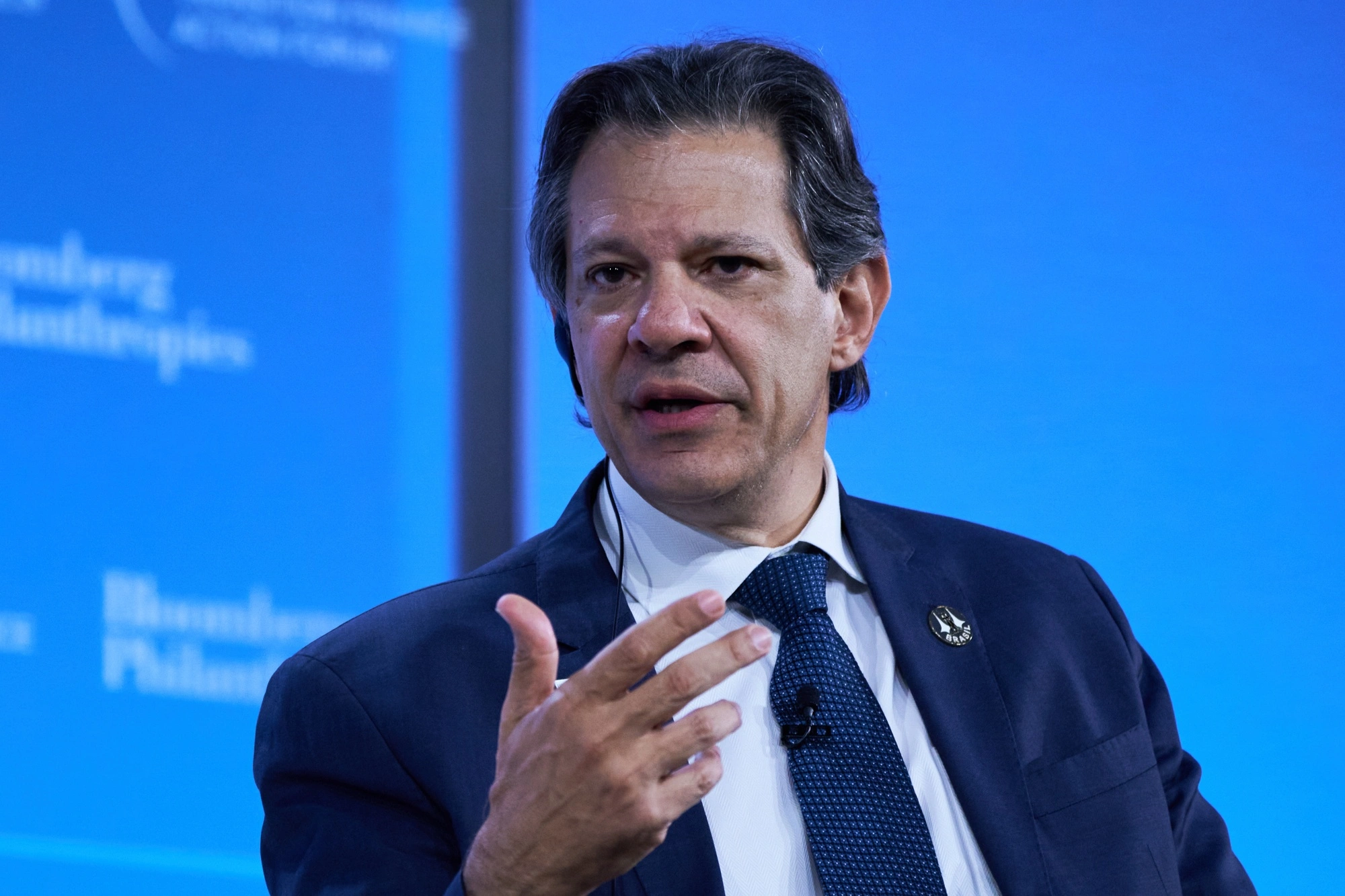
Finance Minister Fernando Haddad recently likened the role of Petrobras’ president to that of a government minister.
He underscored the position’s critical importance shortly after Jean Paul Prates was dismissed from the role.
This comparison indicates the strategic significance of Petrobras, Brazil’s largest company, whose operations have broad implications for the country’s economy and geopolitical stance.
Free daily brief — no card needed
Get every Brazil story in one morning email
We build you a personalized brief around the topics you follow — free for 7 days. Love it? Your first month after that is US$1.
The dismissal of Prates, which market analysts viewed as government intervention by President Luiz Inácio Lula da Silva’s administration, led to notable fluctuations in Petrobras’ stock prices.
These movements reflect the market’s sensitive reaction to changes within this state-controlled giant, emphasizing the role’s impact on investor confidence and economic stability.
Petrobras President’s Role Equated to Ministerial Status by Finance Minister Haddad.
Haddad defended the administration’s decision to replace Prates, stating that such changes are expected and are directly influenced by the president of Brazil.
He revealed that while he provided input on the dismissal, the final decision was made personally by President Lula.
This highlights Lula’s hands-on approach to managing the oil giant’s leadership, consistent with his previous terms.
The aftermath of this leadership change sparked various reactions. Prates commented on his premature departure, influenced by other key government figures.
Despite the controversy, Haddad praised Petrobras’ financial performance under the current administration.
He noted significant profits in early 2024, though they were lower than in previous periods.
Government Initiatives and Corporate Influence
This financial outcome reflects the ongoing challenges and complexities of managing such a pivotal entity within Brazil’s economic landscape.
Additionally, Haddad hinted at future government initiatives to support the industrial sector in Rio Grande do Sul. These initiatives are particularly in response to recent severe weather conditions.
This suggests a broader strategy to bolster economic stability and industrial growth amid environmental and economic challenges.
This evolving scenario highlights the intricate relationship between government policy and corporate governance in one of Brazil’s most crucial sectors.
The role of Petrobras’ president not only influences corporate outcomes but also affects national economic health.
This position is a focal point for discussions on national strategic interests and governance.
Live Company IntelligencePetroleo Brasileiro Petrobras SA ADR — the full investor dossierInside: live share price, market cap, three-year financials, valuation, ESG and peer benchmarks — plus the latest Rio Times coverage.
P
◆ Live Company Intelligence
Petroleo Brasileiro Petrobras
NYSE: PBRPETR4EnergyOil & Gas Integrated43,199 employees
$133.08B
Market cap
Analyst target $22.89
Wall Street view
4.4Buy/ 5
11 Buy3 Hold0 Sell
Avg. price target $22.89 · +29% vs 200-day
Valuation & profitability
Market cap$133.08B
Revenue (TTM)$548.49B
P / E ratio5.2
Profit margin24.3%
Return on equity30.3%
Price & risk
52-wk low $10.6552-wk high $21.99
Beta (volatility)-0.21
200-day average$17.70
Revenue trend · 6y
20202025
Latest $88.10B
Ownership
Institutions22.3%
Shares outstanding3.72B
Top holderGQG Partners LLC
Institutional holders5+ funds
Dividend
Yield18.0%
Payout ratio28.3%
Fwd. annual$1.68
What Petroleo Brasileiro Petrobras does. Petróleo Brasileiro S.A. – Petrobras explores, produces, and sells oil and gas in Brazil, China, the United States, the Americas, Asia, Europe, Singapore, and internationally. It operates through three segments: Exploration and Production; Refining, Transportation & Marketing; and Gas & Low Carbon Energies. The Exploration and Production segment explores, develops, and produces…