Mexico Stocks Fall 0.6% as Peso Hits 19.09 | Mexico Market Report, Nov 19
Key Facts
- IPC: Mexico’s main stock index, the S&P/BMV IPC, fell 0.64% to 68,714, its fifth straight loss.
- Peso: The peso closed at 19.09 per US dollar, its weakest close in at least 12 months.
- Cause: Fear of a US interest-rate rise in December hit emerging markets as the S&P 500 fell 2.02%.
- Movers: Mining group Grupo México fell 3.3% and cement maker Cemex 3.1%; Grupo Carso rose 4.4%.
- Levels: The index is 4.6% below its 11 November high of 72,006 and 11.4% above its 12-month low.
- Prediction markets: Polymarket, a real-money prediction market, puts “no change” in the Bank of Mexico’s December rate decision at 94.7% (US$34,000 traded, 7:39 p.m. ET, 19 November).
Today’s Focus
Mexico’s main stock index fell for a fifth session in a row, and the peso sank to its weakest close in at least a year. The S&P/BMV IPC, the benchmark tracking the biggest companies on the Mexican exchange, ended at 68,714, down 0.64%.
The dollar bought 19.09 pesos, up 1.24% on the day. Over five sessions the index has lost 4.57%, and it now sits 4.6% below the 72,006 high it set on 11 November.
The main cause came from Washington, not Mexico City. Investors fear the US Federal Reserve, the American central bank, could raise interest rates again in December, and that pulls money out of emerging-market currencies such as the peso.
For a traveller or expat paid in dollars, pesos are cheaper this week. For a Mexican importer or a company with dollar debts, the same move is a headache.
What matters today. A fifth straight fall and a 12-month-low peso show Mexico is paying for Fed rate-hike fears, and the next test is whether 70,000 on the index is regained and the peso stops sliding.
01 The session in one read
Think of Mexico’s market as a boat tied to a very large ship. This week the ship, Wall Street, lurched, and Mexico felt every wave.
The S&P/BMV IPC closed at 68,714, down 0.64%, its fifth straight fall. Over five sessions it has lost 4.57%, though it is only 0.79% lower over 20 sessions.
So this is a sharp, recent wobble inside a longer climb, not yet a collapse. The index is 11.4% above its 12-month low of 61,672 from 20 November 2025.
The peso did the heavier lifting on the downside, ending at 19.09 per dollar after a 1.24% fall in its value. That is its weakest close of the past 12 months.
The evidence points mainly outside Mexico: Fed minutes showed officials seeing risks that inflation could persist, and Wall Street fell hard on Thursday. Yet the usual drivers only half agree, because the dollar index rose just 0.06% and the US 10-year yield edged down to about 5.0%, so the peso’s 1.24% slide looks like emerging-market selling rather than a broad dollar surge.
Mexico’s own central bank cutting rates to 6.25% while the Fed talks of hikes narrows the gap that attracts foreign money, which fits the pattern. The variable to watch is the VIX at 28.44: if it calms, the peso should steady.
02 The day’s numbers
| Measure | Level | Change | Read |
|---|---|---|---|
| S&P/BMV IPC close | 68,714 | −0.64% | Fifth straight daily fall |
| Session range | — | — | Not in our scan |
| US dollar vs peso | 19.09 pesos per dollar | +1.24% | Weakest peso close in 12 months |
| Five-session move, IPC | 68,714 | −4.57% | The slide is recent and steep |
| 12-month position, IPC | 61,672 to 72,006 | −4.6% vs high | 11.4% above the low, 4.6% below the high |
| Key technical level | 70,000 | — | Round-number hurdle now overhead |
The table tells a simple story: a modest daily loss on the index, a big loss for the currency. The 0.64% drop looks small until you see it is the fifth in a row.
Inside the 12-month range the index sits closer to its high than its low, so this is a pullback from strength. The peso is different: at 19.09 it is exactly at its 12-month extreme, 13.1% weaker than its early-September best of 16.88. Rio Times · Live Market Intelligence
Live Market IntelligenceMexico — Live Market Board
Mexico — Live Market Board
Instrument Last Change YoY Prev. High Low Volume
IPC MEX
68,891.88
-0.38%
+10.68%
69,154.17
69,407
68,608
166,484,958
USD/MXN
19.11
+1.35%
+4.35%
18.86
19.13
19.05
—
WALMEX
55.40
+1.47%
-10.21%
54.60
55.40
53.92
12,665,234
GMEXICO
192.25
-3.57%
+27.49%
199.37
202.97
190.51
8,238,613
FEMSA
243.16
+0.80%
+40.90%
241.24
245.95
240.84
2,321,035
CEMEX
18.04
-3.22%
-5.00%
18.64
18.77
18.00
21,389,878
GFNORTE
198.90
+0.42%
+14.85%
198.06
205.99
198.00
5,023,099
BIMBO
70.92
-1.40%
+20.35%
71.93
72.05
70.71
3,652,068
TELEVISA
8.20
-3.30%
-20.83%
8.48
8.50
8.19
3,834,047
AMX
23.73
+0.42%
+11.53%
23.63
23.79
23.45
22,706,690
GAP
430.68
+0.10%
+6.54%
430.24
435.00
423.08
484,881
ASUR
266.79
+1.90%
-9.79%
261.81
269.29
260.47
95,379
OMA
246.99
+0.71%
+4.71%
245.24
248.55
244.67
1,462,229
KOF
224.59
-0.12%
+39.77%
224.85
225.97
222.54
472,289
GRUMA
273.89
-1.56%
-12.38%
278.23
279.62
271.93
401,373
KIMBER
38.75
-1.85%
+5.83%
39.48
39.58
38.69
3,458,371
AMX ADR
24.84
+0.00%
+8.76%
24.84
25.03
24.63
1,316,508
03 Why it moved — Fed rate-hike fears hit the peso
Cause one, and the heaviest: fear of higher US interest rates. Minutes of the Federal Reserve’s 27–28 October meeting, published on 18 November, showed officials seeing risks that inflation could persist, a hint that rates may need to rise.
Higher US rates make dollars more attractive, so investors sell currencies like the peso. Confidence: high.
Cause two: a risk-off Wall Street. The S&P 500 fell 2.02% to 7,176, the Dow Jones lost 2.19% and the Nasdaq 2.25%, while the VIX, Wall Street’s fear gauge, jumped 15.80% to 28.44.
When fear rises, traders cut positions in higher-yielding emerging markets first. Confidence: high.
Cause three: Mexico’s own rate gap. Banxico, the Bank of Mexico, cut its benchmark rate to 6.25% on 5 November in a 3–2 split vote.
A central bank easing while the Fed may tighten leaves the peso less well paid for the risk. Confidence: medium.
The usual drivers only partly agree with the move. The dollar index, which measures the dollar against six major currencies, rose only 0.06%, and the US 10-year yield, the interest rate on American government borrowing, edged down to about 5.0%.
Oil’s fund rose 1.45% while the gold fund fell 1.76%, which hurt Mexico’s mining giants. Our best reading is emerging-market selling, with medium confidence.
04 The day’s movers
| Driver | Level / Move | Change | Note |
|---|---|---|---|
| Grupo México (GMEXICOB) | — | −3.3% | Mining and rail group |
| Grupo Financiero Banorte (GFNORTEO) | — | +0.4% | Mexico’s largest locally owned bank |
| Walmex | — | +1.3% | Walmart’s Mexican arm, a defensive favourite |
| América Móvil (AMXB) | — | +0.3% | Telecoms giant, earns in many currencies |
| Femsa (FEMSAUBD) | — | +1.2% | Oxxo convenience stores and Coca-Cola bottling |
| Cemex (CEMEXCPO) | — | −3.1% | Cement maker, sensitive to economic mood |
| Grupo Carso (GCARSOA1) | — | +4.4% | Large gainer |
| Asur (ASURB) | — | +3.6% | Operator of Cancún and other airports |
The most-traded names split into winners and losers. Grupo México fell 3.3% as the gold fund slid 1.76% and miners sold off.
Defensive names held up: Walmex, the retailer, rose 1.3%, Femsa rose 1.2% and Banorte rose 0.4%. América Móvil edged up 0.3%, helped because much of its income is earned outside Mexico.
Asur gained 3.6%, which suggests investors still like businesses paid in dollars and euros. Mexico’s airports benefit from foreign visitors, and a weaker peso makes their dollar-linked revenue worth more.
05 The regional scoreboard
| Index | Country | Change |
|---|---|---|
| Ibovespa | Brazil | −0.69% |
| Merval | Argentina | −0.96% |
| S&P IPSA | Chile | −0.28% |
Latin America moved together, and the live market board above carries the closes. Argentina’s Merval fell 0.96% and Brazil’s Ibovespa 0.69%, so Mexico’s 0.64% drop sat in the middle of the pack.
The currencies tell the same tale: the dollar gained about 1% against Brazil’s real to 5.93, 0.68% against Chile’s peso to 1,015, and more than 1.5% against Colombia’s peso. Mexico’s 1.24% dollar gain sat in the middle of the pack.
So this was a regional risk-off day rather than a Mexican one. Governments and companies that borrow in dollars, from Mexican importers to Colombian and Brazilian firms, face a larger bill this week.
06 The technical picture
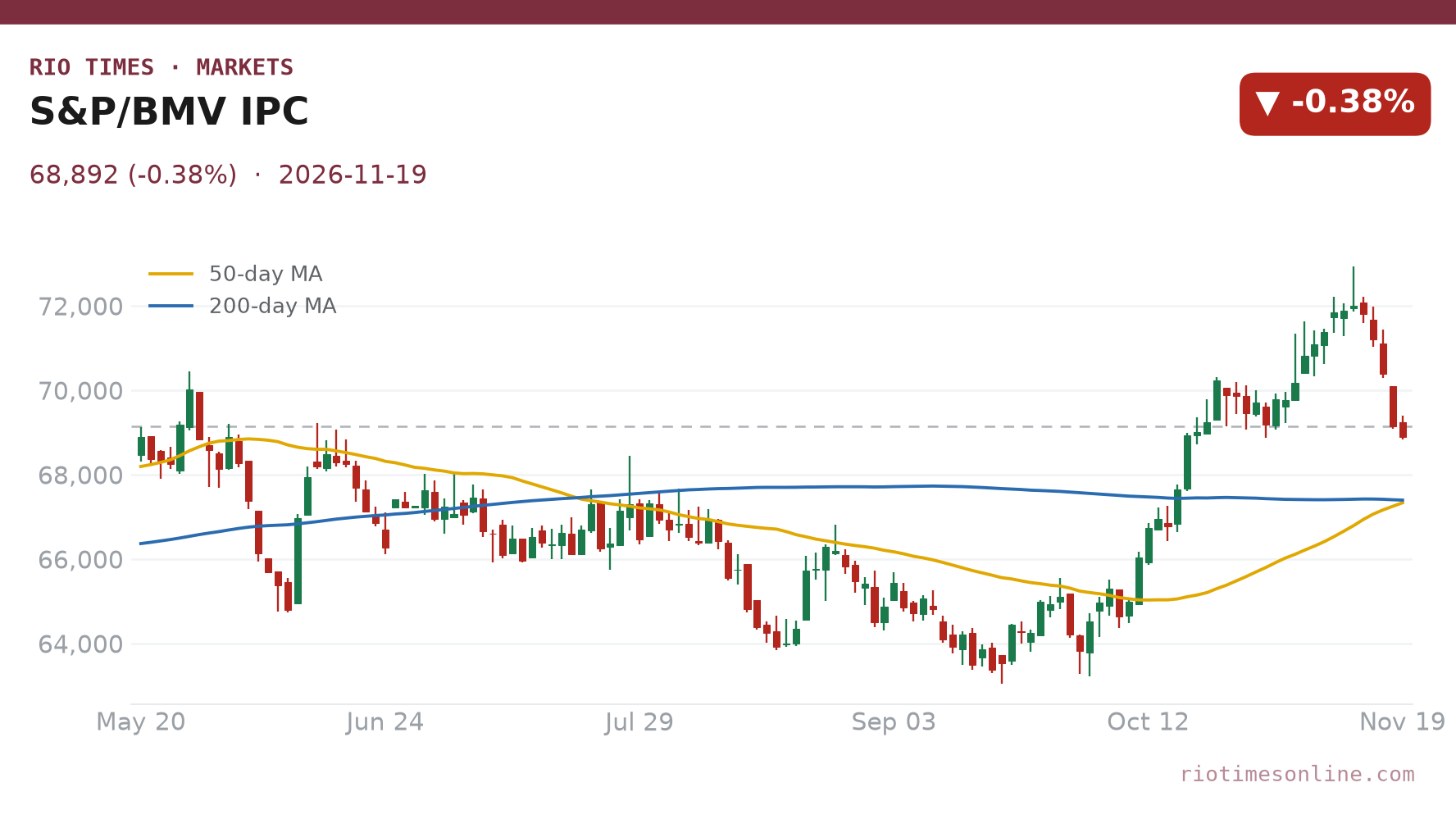
On the chart, the first test above the index is the round 70,000 mark, which it lost this week. Beyond that sits the 72,006 close of 11 November, the 12-month high.
Support is thin until the 12-month low of 61,672 from 20 November 2025, about 10% below where the index sits today. Five straight down days is a heavy streak, so a short bounce would not be surprising.
For the peso, 19.09 is itself the 12-month extreme, so there is no chart ceiling above it. A move back toward 18 would signal that Fed fear is fading.
Does it stop? It stops when the VIX cools and Fed pricing calms; until then, Mexico remains a passenger on Wall Street’s ship.
07 What to watch
- Mexico retail sales: Figures due Friday at 12:00 GMT, according to the RT economic calendar, (6:00 a.m. in Mexico City) for September show whether shoppers are holding up despite a weaker peso.
- US consumer sentiment: The University of Michigan survey is due Friday, with a forecast of 51.5 against 48 before; it feeds Fed rate thinking.
- VIX fear gauge: A fall back from 28.44 would ease pressure on the peso; another jump would add to it.
- Index and peso levels: Watch 70,000 on the IPC and 19.09 on the peso for the next move.
Background: Mexico Stocks Post Biggest Fall Since June.
Background: Mexico Stocks Fall 1.2% as Cemex Drops 4.7%.
What Prediction Markets Say
Polymarket, where users bet real money, lists a market on the Bank of Mexico’s December decision, with US$34,000 traded as of 7:39 p.m. ET, 19 November 2026. It prices “no change” at 94.7%, a 0.25-point cut at 3.6% and a 0.5-point or larger cut at 0.2%.
The same site prices a 0.25-point US Federal Reserve rise in December at 92.5% (US$43.5 million traded). These prices are bets, not polls.
Why we show this: prediction markets turn real-money bets into a live probability that moves within minutes of the news, which is why investors, campaigns and newsrooms in the United States now follow them closely. We show them next to polls and official results, never instead of them.
Frequently Asked Questions
Why did Mexico’s stock market fall?
Mainly because investors fear the US Federal Reserve may raise interest rates, which hit Wall Street and pulled money out of emerging markets. The S&P/BMV IPC fell 0.64% to 68,714, its fifth straight drop.
How weak is the Mexican peso?
The dollar closed at 19.09 pesos, up 1.24% on the day, the peso’s weakest close in at least 12 months. It was 13.1% weaker than its 12-month best of 16.88 in early September 2026.
Which Mexican stocks fell most?
Grupo México fell 3.3% and Cemex 3.1%. Grupo Carso rose 4.4% and airport operator Asur rose 3.6%.
What does a weak peso mean for travellers?
Visitors paid in dollars get more pesos for each dollar, so hotels, meals and tours cost less in dollar terms. Imported goods and dollar debts cost Mexicans more.
Market data: The Rio Times; exchange figures from BMV
In depth
This article was produced by The Rio Times’ automated AI newsroom. Editorial responsibility: Matthias Camenzind, Publisher and Editor-in-Chief. The Rio Times also runs Ask Rio Times, which answers from 100,000+ of our own articles, the daily Latin America Power Map, and prediction-market odds on elections and markets.. How we use AI · Report an error
LatAm Markets: Live Signals → — real-time movers, turnover leaders and FX across Latin America.
Get The Rio Times delivered to your inbox — market intelligence, daily briefs, and breaking analysis across Latin America.
Start for US$1