Merz Elected German Chancellor in Historic Second Vote
Friedrich Merz has been elected Germany’s tenth Federal Chancellor after overcoming a dramatic setback in the Bundestag’s first ballot.
As chairman of the Christian Democratic Union (CDU), Merz failed to win the absolute majority on Monday morning, garnering 310 votes-six short of the 316 needed.
That marked the first time in the Federal Republic’s history that a chancellor‐designate with a clear coalition majority has fallen at the initial hurdle.
Undeterred, Merz’s camp secured a second‐round vote on Tuesday afternoon by fast‐tracking parliamentary procedures with two‐thirds support, including from the Greens and Die Linke-despite the CDU’s previous pledge to shun cooperation with the latter.
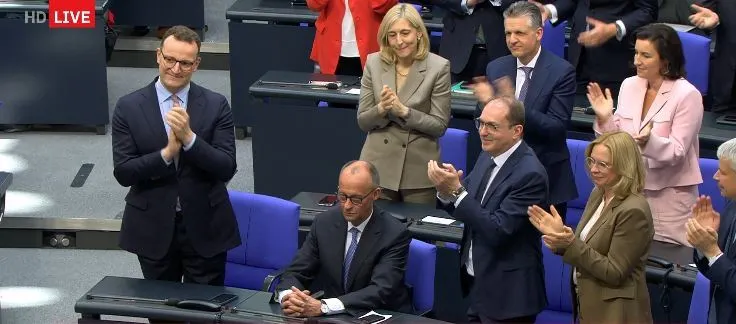
In the rerun, Merz swept to victory with 325 votes in his favor against 289 opposing, comfortably clearing the 316 threshold in the 630‐seat Bundestag.
Immediately after the vote, President Frank‐Walter Steinmeier signed Merz’s instrument of appointment at Bellevue Palace.
Later in the day, Bundestag President Julia Klöckner will administer his oath of office, accompanied by the swearing‐in of his cabinet, which features three ministers from Rheinland-Pfalz.
Merz Elected German Chancellor in Historic Second Vote
Merz now heads a grand coalition of CDU/CSU and the Social Democratic Party (SPD), which together hold 328 seats.
The initial revolt against him exposed fissures within that bloc and prompted sharp rebukes from the opposition AfD, whose parliamentary manager Bernd Baumann termed Monday’s defeat a “historic humiliation.”
Merz’s Chancellor Bid Falters, Marks First Initial-Ballot Defeat in Federal Republic History
As chancellor, Merz inherits a host of pressing challenges: reforming Germany’s energy supply amid Europe’s ongoing crisis, revitalizing an economy mired in low growth, and navigating geopolitical turmoil from Russia’s war in Ukraine to transatlantic tensions.
He has already signaled swift measures-such as cutting energy costs and allowing accelerated investment write-offs-to stabilize business sentiment, though he cautions that meaningful gains may lie beyond 2025.
On foreign policy, Merz aims to reinscribe Germany at the heart of Europe’s security architecture, deepen Franco-German cooperation on electricity market integration, and bolster NATO deterrence.
Domestically, he faces the task of limiting the populist nationalist AfD’s rise by addressing migration and social cohesion.
This article was produced by The Rio Times’ automated newsroom system. How we use AI · Report an error
Read More from The Rio Times