Key Facts
- The S&P 500 vaulted to its first record close of the year at 7,737, leaping 1.79% on a clean tech rally, yet the overnight mood in Asia turned cautious with Tokyo futures slipping as the yen firmed.
- Brazil’s currency, the real, weakened to 5.1284 per dollar, a stiff 0.79% slide that put it at the bottom of the regional league table and signalled active pre-Selic hedging rather than any benign risk-on flow.
- Colombia’s peso plunged by a sharp 3.47% to 3,242, the worst single-session thrashing in the hemisphere, raising alarm as BanRep’s policy minutes land just hours before the next inflation print.
- Buenos Aires’ Merval index tumbled 2.61% to 3,188,971, a heavy blow suggesting portfolios are being lightened before more clarity on the next IMF review and the pace of the crawling-peg crawl.
- Brazil’s central bank is expected to lower the Selic rate to 14.00% in the coming hours, and with services PMIs due first, the real could whip around violently if the composite gauge dips back below 50.
Today’s Focus
A yawning split is opening across global markets. Wall Street’s Nasdaq vaulted 2.59% higher to a new record, powered by chipmakers, and the S&P 500 finally pushed through to a fresh all-time high. Yet that euphoria failed to cross the Rio Grande.
Brazil’s Ibovespa barely moved, the real weakened further, and Argentina’s Merval index was knocked 2.61% lower. The technical message is stark: the MSCI Latin America ETF is trading like a fundamentally different asset class from the SPY this morning.
The immediate catalyst is a wall of policy decisions. Brazil’s Copom is expected to deliver a 25-basis-point cut to 14.00%, but the real danger is in the accompanying statement. If the bank flags a slower easing cycle — concerned by the real at 5.13 and a composite PMI that may have dipped below the 50 expansion mark — the currency and the Ibovespa futures could sell off together.
Mexico holds its own fire until next week, but Colombia publishes its monetary policy minutes tonight after the peso suffered a 3.47% collapse. With Argentine assets still digesting a messy IMF slow-dance, the region is managing a series of home-grown risks that a record S&P 500 cannot paper over.
What matters today. A record US session is not lifting Latam assets, because local rate decisions and a crumbling Colombian peso are forcing investors to price idiosyncratic risk rather than broad beta.

| Instrument | Level | Session |
|---|---|---|
| Ibovespa (Brazil) | 177,895 | -0.06% |
| S&P 500 (US) | 7,737 | +1.79% |
| USD/BRL | 5.1284 | +0.79% |
| USD/MXN | 17.2588 | -0.47% |
| USD/CLP | 911 | -1.56% |
| USD/COP | 3,242 | +3.47% |
| USD/ARS | 1,496 | +0.15% |
Latin American markets — Source: RT close, 2026-08-04. Figures rendered directly from the feed.
01 The overnight tape in one read
US equities shot higher on Tuesday with a furious late-session rally that pushed the S&P 500 to a new record. The Nasdaq led with a 2.59% jump, driven by semiconductor names, while the Dow industrials added 1.71%.
The message from the bond market, however, was less straightforward. The yield on the 10-year US Treasury note fell to 4.619%, a drop of 1.28% on the session, suggesting fixed-income traders were buying protection rather than betting on runaway growth.
In Asia on Wednesday, the rally met a more sceptical reception. Futures on Tokyo’s Nikkei 225 pointed lower, weighed down by a stronger yen and concern that US gains were concentrated in too few stocks. Gold, a classic shelter from uncertainty, was little changed at $4,052 an ounce, keeping the yellow metal firmly above the $4,000 mark.
European equity futures are also flat to slightly lower, with Frankfurt’s DAX contracts reflecting caution ahead of German factory orders data. Brent crude, the international oil benchmark, has not yet found a clear direction in early electronic trade, leaving commodity-sensitive Latam markets without a strong overnight cue from the energy complex.
The evidence points to a hesitant, divergent open for Latin America. While US futures may hold steady, the damage in the Colombian peso (down 3.47%) and the Merval (down 2.61%) is too large for overnight bargain hunters to ignore. The real’s 0.79% slide to 5.1284, occurring on a day the S&P 500 surged, is a clear signal that the market is hedged for a cautious, if not hawkish, Copom statement. The variable to watch is the S&P Global Brazil Composite PMI: a print below 50.0 would confirm contraction, validating the rate cut but simultaneously hurting the earnings outlook for domestic stocks on the B3.
02 The board before the open
| Instrument | Level | Change | Read |
|---|---|---|---|
| S&P 500 | 7,737 | +1.79% | Record high; clean break from August doldrums |
| USD/BRL | 5.1284 | +0.79% | Real weakens sharply into Selic decision |
| USD/COP | 3,242 | +3.47% | Peso crushed; worst regional performer |
| Merval (ARG) | 3,188,971 | −2.61% | Heavy profit-taking or pre-IMF de-risking |
| US 10Y Yield | 4.619% | −1.28% | Bond buying despite equity record |
The board paints a picture of a region that refused to join the US party. The most aggressive move was the Colombian peso, which weakened dramatically to 3,242 per dollar. That 3.47% slide is exceptionally rare for a major Latin American currency in a single session and points to a sharp local shock rather than a broad dollar move.
Argentina’s Merval index, measured in local pesos, fell 2.61% even as the official peso weakened by a controlled 0.15%. For the Merval to drop this much suggests genuine equity selling from local portfolios, possibly linked to profit-taking ahead of the next technical review of the country’s IMF programme. Rio Times · Live Market Intelligence
Live Market IntelligenceLatin America — Cross-Market Board
Latin America — Cross-Market Board
Instrument Last Change YoY Prev. High Low Volume
IBOV
183,476.86
-0.27%
+21.85%
183,965.91
168,310
167,142
—
IPSA
11,255.90
-0.39%
—
11,299.82
11,210
10,984
1,513,213,483
IPC MEX
64,651.92
+0.60%
+12.17%
64,264.16
66,121
65,405
108,886,187
MERVAL
2,893,751
-1.57%
+30.51%
3,022,485
3,042,365
2,991,150
—
COLCAP
2,584.72
-0.95%
—
9.04
9.05
9.02
4,133
BVL PERÚ
59,934.37
+1.27%
—
—
—
—
—
USD/BRL
5.16
+0.01%
-5.13%
5.16
5.18
5.14
—
EUR/BRL
5.95
+1.01%
-5.83%
5.89
5.98
5.94
—
USD/MXN
17.06
-0.24%
-8.58%
17.10
17.08
17.01
—
USD/CLP
913.98
+0.04%
-5.67%
913.65
915.11
906.68
—
USD/COP
3,140
+0.03%
-22.04%
3,139
3,141
3,105
—
USD/PEN
3.36
-0.66%
-4.82%
3.38
3.38
3.35
—
USD/ARS
1,493
+0.10%
+12.96%
1,491
1,494
1,480
—
USD/UYU
40.27
+1.24%
+1.80%
39.77
40.27
40.23
—
USD/PYG
5,939
+1.68%
-19.54%
5,841
5,939
5,925
—
USD/BOB
11.64
-0.76%
+72.04%
11.73
11.72
11.64
—
USD/DOP
58.34
+1.25%
-3.44%
57.62
58.34
58.04
—
USD/CRC
445.92
+0.89%
-9.71%
441.97
448.50
445.92
—
03 What the data shows — high turnover in Vale and Petrobras frames a defensive rotation
| Stock | Move | Turnover | Note |
|---|---|---|---|
| VALE3 | +2.2% | R$1509m | Heaviest volume; miner led the blue chips higher |
| PETR4 | −1.3% | R$1155m | Preferred shares seeing active pre-Selic churn |
| SAUD3 | −11.6% | R$238m | Biggest loser; heavy selling in the meatpacker |
| TGMA3 | +11.5% | R$32m | Top gainer but thin volume; illiquid spike |
| POMO4 | −10.4% | R$303m | Autos slump; stock near bottom of 52-week range |
The B3’s proprietary scan from Tuesday’s close reveals a market churning through the mega-caps but finding little direction. Mining giant Vale (VALE3) printed a staggering R$1.5 billion in turnover and closed 2.2% higher, a sign that buyers were willing to pay up for exposure to Chinese demand. Petrobras preferred shares (PETR4) also saw over R$1.1 billion in volume.
The real pain was in the meatpacker Saudia (SAUD3), which plummeted 11.6% with R$238 million traded, a likely reaction to a specific export or margin scare. On the speculative end, Tegma (TGMA3) topped the leaderboard with an 11.5% surge, but with just R$32 million in turnover, it is not a move that institutional portfolios can lean on for direction.
04 Brazil and the currencies
The Brazilian real is the fulcrum for the entire region this morning. Weakening 0.79% to 5.1284 on the eve of a Copom decision is unusual; typically, the promise of a rate cut invites a carry-trade bid. That this did not happen suggests the market is nervous that Copom will signal a pause after today’s widely expected 25-basis-point cut to 14.00%.
The real’s 52-week range shows it has recovered from a low of 5.5901, but it remains 8.3% below its 52-week high. If the central bank’s post-meeting statement notes concern over the recent currency slide or a slowdown visible in the services PMI data due at 13:00, the real could quickly test the 5.18 level.
Mexico’s peso, by contrast, strengthened 0.47% to 17.2588, shrugging off the broader emerging-market wobble. It is a stark divergence that highlights how Banxico’s steady hand—holding rates at 6.5%—is acting as a magnet for carry traders.
The Argentine peso continues its managed decline, slipping 0.15% to 1,496 per dollar. The central bank there is burning reserves to keep the official rate on this gradual path, but the real action is in the parallel market, where the gap remains a pressure gauge for the Merval.
05 The regional setup
| Index | Country | Change |
|---|---|---|
| Ibovespa | Brazil | −0.06% |
| Mexbol (IPC) | Mexico | +0.20% |
| IPSA | Chile | −0.48% |
| Merval | Argentina | −2.61% |
| COLCAP | Colombia | −0.42% |
The regional equity table confirms the divergence. Mexico’s IPC, the country’s main index, was the only major board to gain, rising 0.20% to 66,833. It is outperforming its Andean peers by holding near its own 52-week highs on the back of a strong peso and stable macro outlook.
Chile’s IPSA slipped 0.48% to 10,996, a gentle decline consistent with a market processing copper prices. The Colombian COLCAP fell 0.42% to 2,375, a relatively contained drop given the 3.47% collapse in the peso, suggesting local equity holders view the currency move as a temporary liquidity shock rather than a fundamental deterioration.
06 The technical picture
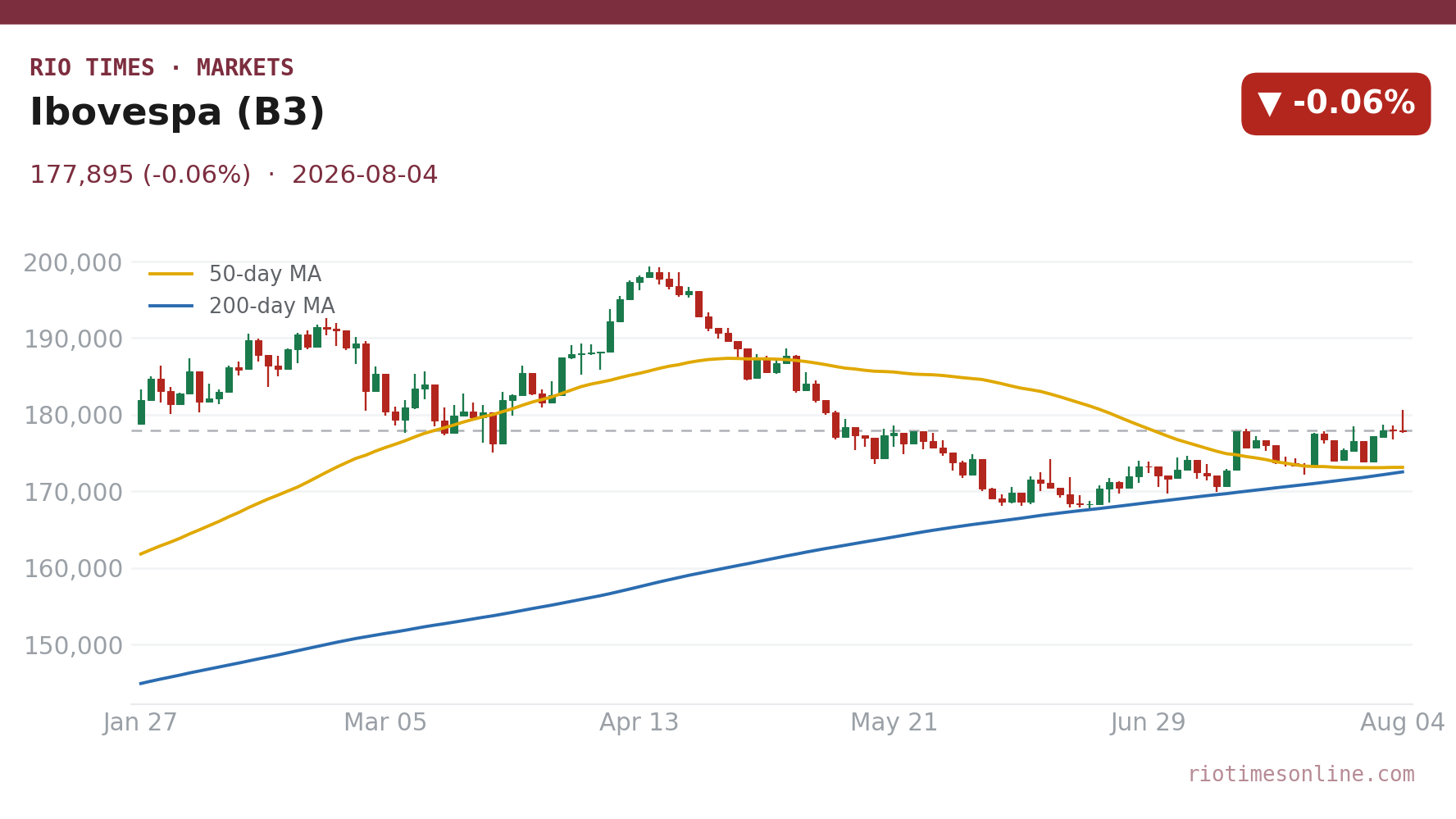
The Ibovespa remains technically vulnerable. Sitting 10.5% below its 52-week high of 198,657, the index failed to hold the 178,000 level on Tuesday. The CBOE VIX, Wall Street’s so-called fear gauge, actually pushed 4.04% higher to 16.5 despite the S&P 500’s record, a contrarian warning that options traders are paying up for downside protection.
The most critical chart is the USD/COP, Colombia’s dollar-peso pair. A 3.47% single-day spike to 3,242 on no obvious global catalyst is a textbook exogenous shock. If BanRep’s minutes, due tonight, reveal divisions over the pace of easing, the technical damage could force the pair toward 3,300.
For the Merval, the 2.61% drop to 3,188,971 is the fourth largest single-day decline in three months. It breaks a short-term trendline that had been supporting the index since mid-July, making a test of the 3.1-million mark a realistic scenario if foreign holders of CEDEARs, the locally listed US stock certificates, continue to lighten exposure.
Silver’s 2.05% jump to $59.45 an ounce offers a small bright spot for Mexico and Peru, two of the world’s largest producers of the precious metal. If the silver bid holds, it could cushion the mining-heavy sectors on the Mexbol and the Lima exchange in today’s session.
07 What to watch
- Brazil Selic and PMIs: A cut to 14.00% is priced in. The danger is the Copom statement flagging a pause. The services PMI dropping below 50.8 would confirm a slowdown, hurting domestic-heavy stocks on B3.
- Colombia’s currency shock: The 3.47% peso crash is a red flag. Tonight’s BanRep minutes must explain the move; if it is a genuine policy spat, Colombian bonds and the COLCAP will open under severe pressure.
- Argentina’s Merval breakdown: A 2.61% slide demands a driver. Watch for IMF staff statements out of Washington. Any hint of a delay in disbursements will accelerate the selling.
- US jobless claims preview: Thursday’s US claims data is the next big macro print. A number above the 202k consensus could reignite a global risk-on mood, but for now, Latam is trading its own story.
Frequently Asked Questions
Why is Latam not rallying with Wall Street?
Because the region’s biggest story is local. Brazil is cutting rates while the currency weakens, Colombia’s peso just crashed 3.47%, and Argentina is navigating IMF talks. These risks drown out the US tech surge.
What is Copom?
It is the Brazilian central bank’s monetary policy committee. It sets the Selic rate, Brazil’s benchmark overnight interest rate. It is expected to cut from 14.25% to 14.00%.
Is the local exchange data reliable for foreign stocks?
No. A BDR like MUTC34 or a CEDEAR like AAPL tracks a foreign share in reais or pesos. Its move reflects the US stock and the currency rate, not a local company’s health.
What does a weaker real mean for Brazilian stocks?
It helps exporters like Vale and Petrobras by increasing the local-currency value of their dollar revenues. But it hurts retailers and domestic-focused firms by raising imported input costs.
This article was produced by The Rio Times’ automated newsroom system. How we use AI · Report an error
LatAm Markets: Live Signals → — real-time movers, turnover leaders and FX across Latin America.
Read More from The Rio Times