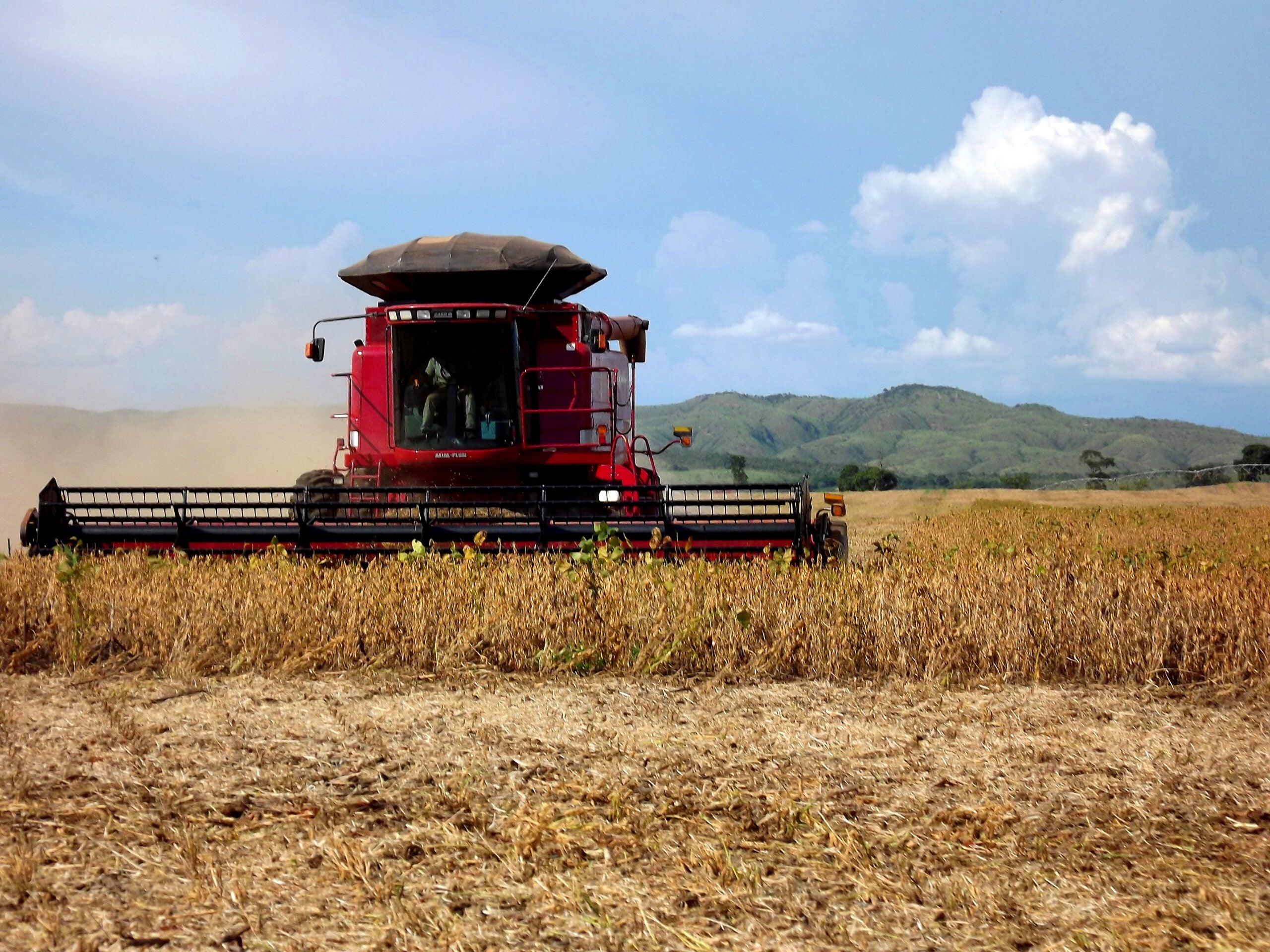
Key Facts
- Soybeans firmed on export demand hopes with the SOYB tracker settling at 26.28 $, up 0.73% day-on-day
- Corn was broadly flat on the day as the CORN tracker closed at 18.30 $, down a marginal 0.05%
- Wheat underperformed the grain complex with the WEAT tracker ending at 25.22 $, a 1.60% drop from the previous session
- Brazil and Argentina remain central to global grain flows acting as the main export engine for soybeans and a key source of corn and wheat to world markets
- Latin American currencies have weakened alongside global risk assets this week with the Brazilian real slipping as USD/BRL moved to 5.0841, shaping local-currency revenues for exporters
- Investor focus in grains stays anchored on China’s import appetite harvest progress across the Americas and the interplay between commodity prices and regional exchange rates
Today’s Focus
Soybeans had the better day among the big grains, with prices grinding higher while investors weighed China’s import needs against a crowded export pipeline from Brazil and Argentina.
Corn traded in a narrow range, reflecting a market that sees ample supply from South America but is wary of weather and shipping disruptions that could tighten balances quickly.
Wheat lagged, with prices slipping as global stocks and competitive exports from the Black Sea and the Americas kept buyers in a strong negotiating position.
Across the board, the story for foreign investors remains the same: Brazil and Argentina drive global export volumes, China anchors demand, and currencies like the Brazilian real and Argentine peso translate each dollar of grain into very different local outcomes.
What matters today. What matters now is whether China steps up purchases just as the South American harvest and Latin American currency swings reset pricing power for the next leg in grains.
01 The session in one read
Soybeans were the quiet winner of the session, with the main soybean tracker closing at 26.28 $, a 0.73% gain that hints at steady demand rather than a full-throated rally. Corn, by contrast, barely moved, with a closing level of 18.30 $ and a day-on-day slide of just 0.05%, underscoring how balanced traders see short-term supply and demand.
Wheat was the weak spot, with the wheat tracker settling at 25.22 $ after a 1.60% decline that left the contract underperforming its grain peers and reminding investors that export competition remains ferocious. In the background, Latin American currencies have had a choppy week, with USD/BRL at 5.0841 and the Mexican peso and Chilean peso also weaker, subtly reshaping the local-currency value of each export dollar.
The price board shows a market catching its breath rather than making a strong directional call, with soybeans edging higher, corn marking time and wheat giving back ground as traders reassess South American supply and Asian demand in tandem. For foreign investors focused on Brazil and Argentina, the key judgment is whether China’s next buying wave and local currency moves reinforce today’s gentle divergence or flip the script entirely, making the yuan–real corridor the variable to watch.
02 The board
On today’s board, the soybean contract stands out as the only one with a clear positive sign, its 0.73% rise positioning it as the relative safe harbour in a mixed grain tape. That move is modest in absolute terms, but for an investor it signals that buyers are still willing to pay up for oilseed exposure even as broader risk assets digested a global tech sell-off.
Corn’s 18.30 $ close, paired with a 0.05% decline, reads more like a holding pattern than a view, consistent with a market that sees comfortable stocks but remains alert to weather and logistical news. Wheat’s 1.60% drop to 25.22 $ paints a starker picture, suggesting that end-users feel little urgency to chase prices higher when exporters from the Americas to the Black Sea are still vying for market share.
| Asset | Level | Change |
|---|---|---|
| Soybeans (SOYB) | 26.28 $ | +0.73% |
| Corn (CORN) | 18.30 $ | -0.05% |
| Wheat (WEAT) | 25.22 $ | -1.60% |
Source: RT close, 2026-07-24. Where a commodity has no spot feed, an exchange-traded tracker or leading producer is shown as a labelled proxy.
Live Market IntelligenceThe live market board
Rio Times · Live Market Intelligence
Latin America — Cross-Market Board
| Instrument | Last | Change | YoY | Prev. | High | Low | Volume |
|---|---|---|---|---|---|---|---|
| IBOV | 169,186.42 | -1.06% | +19.56% | 171,006.10 | 178,526 | 175,157 | — |
| IPSA | 10,545.23 | -1.24% | — | 10,677.94 | 10,722 | 10,633 | — |
| IPC MEX | 69,441.29 | +0.37% | +12.74% | 69,182.39 | 70,008 | 69,383 | 49,372,306 |
| MERVAL | 2,848,945 | — | +12.65% | 2,859,051 | — | — | — |
| COLCAP | 2,489.93 | -0.63% | — | — | — | — | — |
| USD/BRL | 5.34 | -1.32% | -0.84% | 5.42 | 5.42 | 5.30 | — |
| EUR/BRL | 5.95 | +7.53% | -4.87% | 5.54 | 6.04 | 5.92 | — |
| USD/MXN | 18.69 | +0.62% | +1.45% | 18.57 | 18.69 | 18.54 | — |
| USD/CLP | 983.47 | -0.57% | +5.64% | 989.13 | 991.87 | 979.07 | — |
| USD/COP | 3,149 | +3.06% | -18.02% | 3,056 | 3,173 | 3,111 | — |
| USD/PEN | 3.45 | +0.17% | +3.85% | 3.44 | 3.45 | 3.44 | — |
| USD/ARS | 1,537 | -0.28% | +3.77% | 1,541 | 1,541 | 1,537 | — |
| USD/UYU | 40.21 | +3.57% | +2.29% | 38.83 | 40.21 | 40.08 | — |
| USD/PYG | 5,803 | +3.78% | -16.54% | 5,592 | 5,803 | 5,735 | — |
| USD/BOB | 11.97 | +4.93% | +77.92% | 11.41 | 11.97 | 11.82 | — |
| USD/DOP | 60.54 | +1.83% | -4.34% | 59.45 | 61.14 | 59.85 | — |
| USD/CRC | 451.24 | +2.13% | -7.80% | 441.83 | 451.40 | 450.04 | — |
| USD/GTQ | 7.64 | +3.23% | +2.18% | 7.40 | 7.64 | 7.64 | — |
03 What moved it
Soybeans’ resilience owes much to expectations that China will keep buying, even if at a more measured pace than in previous boom years, because its livestock and food industries still lean heavily on imported oilseeds. For Brazil and Argentina, that demand is critical, as both countries depend on soybean exports for foreign currency earnings and have built up logistics—from inland storage to port capacity—around the crop’s global role.
Corn’s sideways session reflects a tug-of-war between generous supply from South America and the United States and the ever-present risk that weather or river levels could disrupt flows just when importers need them most, a scenario foreign investors in the region know well from past seasons. Wheat’s slide is easier to explain: with multiple export origins active and buyers sensing no immediate shortage, the market has little reason to reward longs, especially in a week when broader risk sentiment was already dented by a global tech sell-off that pushed investors toward cash.
04 The Latin American read
For Brazil, a weaker real—illustrated by USD/BRL at 5.0841—tends to make each dollar of soy, corn or wheat revenue go further in local terms, supporting farm incomes even when global prices wobble. That currency cushioning is one reason foreign investors often see Brazilian agribusiness as a partial hedge: softer domestic money can offset softer dollar prices, at least over short stretches.
Argentina’s case is more complex, since its heavily managed peso and recurring policy shifts introduce extra noise between global grain prices and local farm receipts, but the basic story is similar: export dollars are vital for the balance of payments and for the government’s fiscal breathing room. Across the Southern Cone, grains tie directly into the broader investment case that has made Latin America one of the stronger-performing emerging regions, where commodity cycles, politics and currency moves are tightly interwoven.
05 The names to watch
For foreign portfolio investors, the liquid tickers are often the grain trackers themselves—SOYB, CORN and WEAT—because they provide clean exposure to the underlying commodities without the need to navigate local share registers or currency controls. Beyond those, listed agribusinesses, logistics firms and fertilizer producers tied to Brazil and Argentina’s farm belt remain the equity proxies for any sustained turn in grain prices, even if their exact moves can be obscured by domestic politics and broader equity-market swings.
Policy-makers in Brasília and Buenos Aires also belong on any watchlist, since tax regimes, export quotas and FX management can quickly alter how much of a global price move actually reaches local producers and, by extension, how competitive those exporters stay on the world stage. At the same time, China’s state-backed grain buyers and reserve managers quietly shape the order book, making their purchase patterns and trade diplomacy another essential signal for anyone trading or investing around Latin American grains.
06 The outlook
Looking ahead, grain traders will parse every new cargo booking and weekly export inspection figure to gauge whether China is stepping back into the market with conviction as harvest pressure builds across South America. For foreign capital, the interplay between a sliding Brazilian real and steady soybean demand offers a potential cushion, but wheat and corn will likely need a genuine supply scare to break free of their current apathy.
07 What to watch
- China’s next soybean purchases: Weekly export sales data and cargo fixtures from Brazil will reveal whether Asian demand is accelerating, holding steady or cooling, setting the tone for SOYB.
- Brazilian real trajectory: With USD/BRL at 5.0841, any further slide could boost local farm margins for soybeans and corn, potentially encouraging more aggressive selling from Mato Grosso and Paraná.
- South American harvest logistics: River levels, port waiting times and fuel costs across Brazil and Argentina can tighten or loosen global supply much faster than crop forecasts suggest.
- Global risk appetite: This week’s tech sell-off reminded investors that grains rarely trade in isolation; a sustained flight from risk could weigh on the entire commodity complex, however strong the fundamental story.
Frequently Asked Questions
Why did soybeans rise while wheat fell?
Soybeans drew support from steady expectations of Chinese import demand and a weaker Brazilian real, whereas wheat faced pressure from ample global stocks and competitive offers from multiple export origins.
How does a weaker Brazilian real affect grain markets?
A softer real, with USD/BRL at 5.0841, increases the local-currency value of each dollar earned from exports, supporting Brazilian farm incomes and potentially encouraging more grain to flow onto world markets.
What are the main drivers for corn right now?
Corn is caught between comfortable South American supply and the persistent risk that weather or logistical snarls could disrupt shipments, leaving prices broadly flat as traders wait for a clearer signal.
Which Latin American factors should foreign investors watch most closely?
Beyond commodity prices, investors should track the Brazilian real, Argentine export tax policy, China’s state grain buying patterns and the health of harvest logistics across the Southern Cone.
This article was produced by The Rio Times’ automated newsroom system. How we use AI · Report an error · Editorial responsibility: Matthias Camenzind, Editor-in-Chief
LatAm Markets: Live Signals → — real-time movers, turnover leaders and FX across Latin America.