GAMBIA · POLITICS
Key Facts
- The country The Gambia is a small West African republic of about 2.8 million people, almost surrounded by Senegal.
- The president Adama Barrow has governed since January 2017 and seeks a third term on Saturday 5 December.
- Parliament Parliament has 58 members, and no party holds a majority on its own.
- The opposition Ousainou Darboe’s United Democratic Party leads it, but it has split into three rival alliances.
- Now underway Candidates file papers until Saturday 14 November, and the campaign starts on Monday 9 November, according to one Independent Electoral Commission (IEC) page; another gives Tuesday 10 November.
Gambia politics explained in one line: President Adama Barrow holds the main power, parliament is split and the opposition is divided. For US readers, the vote on Saturday 5 December 2026 tests a small West African democracy that ended 22 years of one-man rule in 2016.
This guide names who holds each main office in November 2026 and explains each party and institution. It also shows how power is shared and what the coming vote decides.

Gambia Politics at a Glance
The Gambia is a presidential republic, so the president is both head of state and head of government. He appoints the ministers, and the National Assembly makes the laws and checks the government.
Adama Barrow has been president since January 2017, when he took over from Yahya Jammeh, who had ruled for 22 years. Barrow won a second term on 4 December 2021 with 457,519 votes, or 53.23 percent, according to the Independent Electoral Commission (IEC).
Ousainou Darboe came second in 2021 with 27.72 percent, and Mama Kandeh was third with 12.32 percent. Turnout was 89.34 percent of 962,157 registered voters, the IEC results sheet shows.
The country has about 2.8 million people and is almost surrounded by Senegal. Our Gambia country guide covers its geography, economy and daily life.
The President and the Cabinet
President Barrow leads the National People’s Party (NPP), which he founded in 2019 after winning the 2016 vote as the candidate of an opposition coalition. The constitution sets no limit on the number of terms, so he can run again in December.
Muhammed Jallow is Vice President, according to the Office of the President. Its cabinet page lists the main ministers, and portfolios change in reshuffles.
Who Runs the Main Ministries
Dawda Jallow is Attorney General and Minister of Justice, and Seedy Keita is Minister of Finance and Economic Affairs. Sering Modou Njie has been Foreign Minister since 9 July 2025, after leading the defence ministry.
Abdoulie Sanyang is Minister of the Interior, and Mod Ceesay serves as Chief of Staff and Minister at the Presidency. Check the official cabinet page before relying on any title.
Ebrima Sillah runs Transport, Works and Infrastructure, and Nani Juwara runs Petroleum and Energy. Abdoulie Jobe leads Tourism and Culture, the ministry that matters most to winter visitors.
Dr Ismaila Ceesay is Minister of Information, and Hamat Bah leads Lands and Regional Government. The same page also names ministers for agriculture, trade, education, gender and youth.
Parties and Opposition Camps
The NPP is the governing party and won the most elected seats in the 2022 parliamentary vote. Barrow won his second term under its banner in December 2021.
The United Democratic Party (UDP) is the largest opposition party. Ousainou Darboe, a human rights lawyer, founded it in 1996 and leads its coalition, the Gambia First Coalition.
Talib Ahmed Bensouda, mayor of the Kanifing Municipal Council, left the UDP and leads UNITE, a party the IEC registered on 1 July 2026. He is the flagbearer of a second alliance, Coalition 2026.
A third alliance, Team Gambia Grand Coalition 2026, is coordinated by the veteran left-wing politicians Halifa Sallah and Sidia Jatta. Our report on the three opposition coalitions explains who backs whom.
Mamma Kandeh’s Gambia Democratic Congress (GDC) finished third in the 2021 presidential vote. Yahya Jammeh’s Alliance for Patriotic Reorientation and Construction (APRC) won two seats in 2022 despite its founder living in exile.
Parliament and Its Balance of Power
Parliament, called the National Assembly, has 58 members, of whom 53 are elected and five are appointed by the president. Fabakary Tombong Jatta has been Speaker since the sixth legislature opened in 2022.
In the vote on 9 April 2022, the NPP won 18 of the 53 elected seats and the UDP won 15. Independents took 12, the National Reconciliation Party (NRP) four, and the People’s Democratic Organisation for Independence and Socialism (PDOIS) and the APRC two each.
No party holds a majority on its own, so the president needs allies and independents to pass laws. Lawmakers rejected a new draft constitution in July 2025.
The next parliamentary election is on Saturday 10 April 2027, according to the IEC calendar. Councillors vote on 22 May 2027, and mayors and chairpersons on 26 June 2027.
Courts, the Constitution and the Term Question
Edrissa Faal was sworn in as Chief Justice on Friday 31 July 2026, taking over from Hassan Jallow, who retired on 1 August. The Gambia Bar Association argues that Faal does not meet the constitution’s requirements and has asked the Supreme Court to void the appointment.
The Supreme Court has not ruled on that challenge, so the case remains open. The Chief Justice leads the judiciary, which is formally independent of the president.
The constitution in force sets no cap on presidential terms. Two reform attempts, in 2020 and with the 2024 draft that parliament voted down in July 2025, would have changed that.
Barrow had earlier said he would serve only one term and back term limits, which is why his third-term bid divides opinion. Our analysis of the third-term bid sets out both sides.
The Electoral Commission and the 2026 Vote
The IEC runs the elections, keeps the voter list and clears candidates for the ballot. Joseph Colley chairs it, and the chairman alone declares the official winner.
The IEC says The Gambia has 1,146,474 registered voters and 1,773 polling stations for the presidential vote on Saturday 5 December. Our report on the 1.1 million voters explains how the register was cleaned.
Candidates file their papers in one-hour slots from Tuesday 3 to Wednesday 11 November, with corrections on 13 and 14 November. The IEC scheduled UNITE for Saturday 7 November, the UDP for Monday 9 November and the NPP for Tuesday 10 November.
Each candidate needs 5,000 voter signatures, a sworn asset declaration, a tax clearance certificate and a D1 million deposit. That deposit is about US$13,700 at D72.92 per US$, the central bank rate on 30 October.
The vote itself uses marbles instead of paper ballots. Our guide to the 5 December vote covers polling hours in Eastern time, results and travel rules.
Security Forces and the West African Troops
The Gambia Armed Forces are small and report to the president, who is commander in chief. Major General Ousman Gomez was named Chief of Defence Staff on 30 June 2026, after his predecessor resigned at the end of May.
Brigadier General Sait Njie is his deputy, and Brigadier General Yaya Drammeh commands the army. Colonel Alhagie Sanneh leads the Republican National Guards.
ECOMIG, a regional force sent by the West African bloc ECOWAS, has stayed in The Gambia since 2017. Colonel Aliou Tine took over as its commander in January 2026, ECOWAS says.
Our Gambia geopolitics guide covers the foreign troops, the partial US visa limits and ties with China and Turkey. It also explains why the country’s court cases matter abroad.
The Jammeh Years and Unfinished Justice
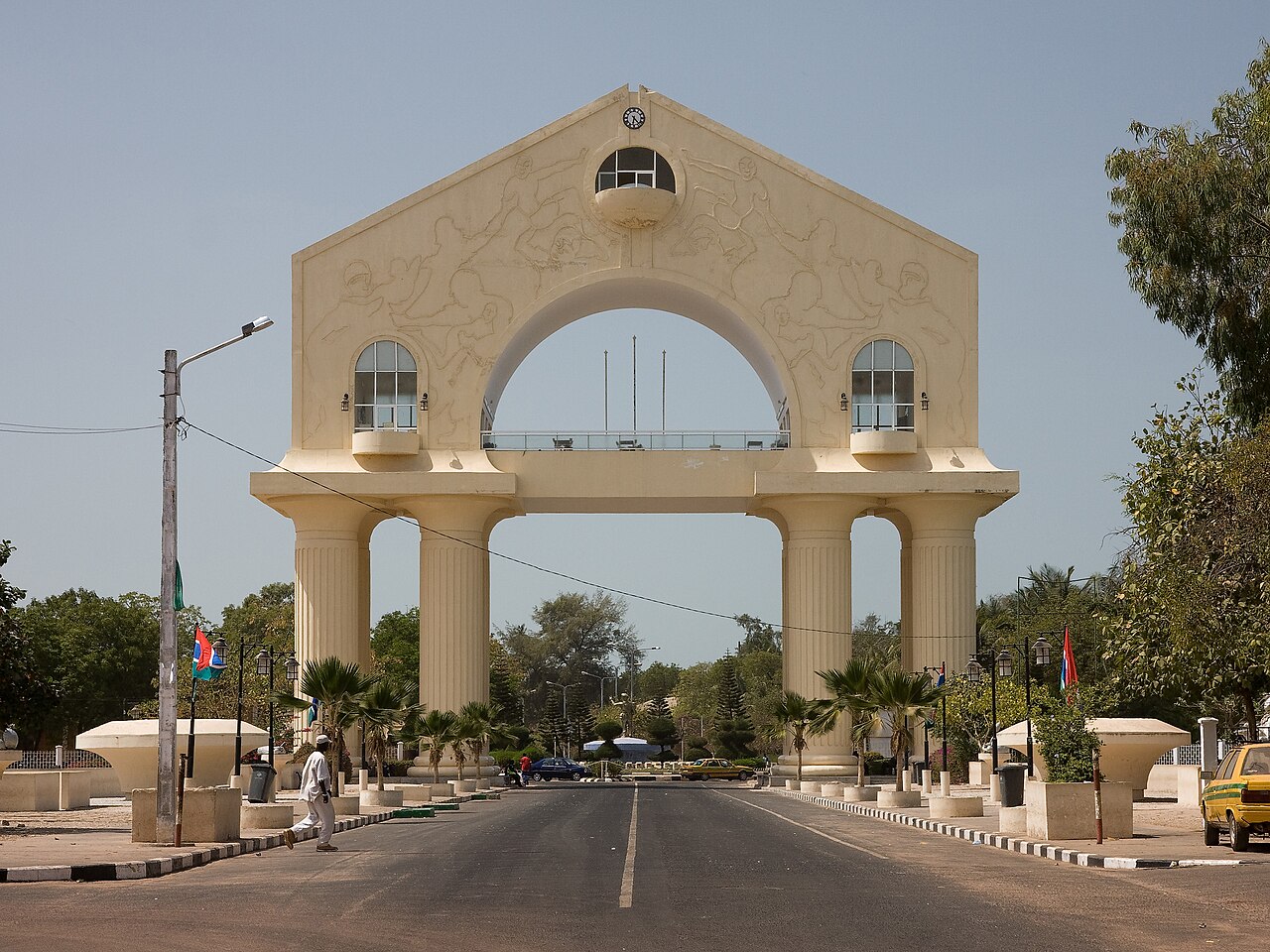
Yahya Jammeh seized power in a military coup in 1994, according to the US State Department. Arch 22 in Banjul was built to mark that coup, and it now stands as a landmark on the road into the capital.
Jammeh lost the December 2016 election to an opposition coalition and left the country in January 2017. He lives in exile in Equatorial Guinea.
A truth commission documented abuses from his rule and recommended prosecutions. A hybrid tribunal backed by ECOWAS was approved in December 2024, but no hearing date has been announced.
The Victims Reparations Act passed on 2 November 2023, and payments have begun in small amounts. Victims’ groups say justice is still incomplete, and the issue is a campaign theme for the opposition.
What the 5 December Vote Decides
Voters on Saturday 5 December choose the president for a five-year term. The winner needs only the most votes, because there is no second round.
If Barrow wins, he governs into a third term with no legal limit on a fourth. If an opposition candidate wins, the new president faces a parliament in which no party has a majority until the April 2027 vote.
The opposition split into three alliances will decide how well it competes in a single round. In 2016 a united coalition won, and in 2021 a divided field lost.
The candidate list becomes official after nominations close on Saturday 14 November. The campaign period starts on Monday 9 November on one IEC page (another gives Tuesday 10 November), and the withdrawal deadline is Thursday 26 November.
More: Africa news in English, every day from The Rio Times.
Frequently Asked Questions
Who holds power in The Gambia in 2026?
President Adama Barrow holds the main executive power and has governed since January 2017. Parliament, with 58 members, and the courts share power on paper.
Can President Barrow run for a third term?
Yes, because the constitution sets no limit on presidential terms. Two attempts to add a limit failed, the latest in July 2025.
When is the next presidential election in The Gambia?
The election is on Saturday 5 December 2026, run by the Independent Electoral Commission. The candidate with the most votes wins, and there is no second round.
Who are the main opposition leaders?
Ousainou Darboe leads the United Democratic Party, and Talib Ahmed Bensouda leads UNITE. Veterans Halifa Sallah and Sidia Jatta coordinate a third alliance, Team Gambia.
Sources: Office of the President of The Gambia, Cabinet; Office of the President of The Gambia, President Barrow appoints new Foreign Minister, 9 July 2025; National Assembly of The Gambia, Our History, accessed 5 November 2026; Independent Electoral Commission (IEC) of The Gambia, Presidential Election Results 4 December 2021; IEC of The Gambia, Results of National Assembly Elections 9 April 2022; IEC of The Gambia, Nomination Schedule for the Presidential Election of 5 December 2026, 30 October 2026; IEC of The Gambia, Chairman provides key updates on December 5th presidential election preparations, 3 November 2026; IEC of The Gambia, Presidential Election Day (official calendar), accessed 5 November 2026; ECOWAS, Colonel Aliou Tine takes over as new ECOMIG Force Commander in The Gambia, January 2026; US State Department, U.S. Relations With The Gambia, accessed 5 November 2026.
This article was produced by The Rio Times’ automated newsroom system. How we use AI · Report an error · Editorial responsibility: Matthias Camenzind, Editor-in-Chief
Expat Guide to Gambia
What The Rio Times publishes for foreigners who live in or move to Gambia.
Coming up in Gambia
Understand Gambia