Fifty-nine Percent Are Against Bolsonaro’s Resignation, Points out National Survey
RIO DE JANEIRO, BRAZIL – President Jair Bolsonaro‘s resignation amid his performance in tackling Covid-19 is rejected by 59 percent of Brazilians. However, 37 percent do wish for his resignation, as has been requested by opposition politicians; four percent had no opinion.
This was the result of a Datafolha survey of 1,511 respondents, conducted over the phone from April 1st to 3rd. The error margin is three points plus or minus.

Although the survey found that only 33 percent of respondents considered the President’s management of the health crisis to be good or excellent, 52 percent believed he was in a position to continue leading the country.
For 44 percent, Bolsonaro has lost such conditions, and four percent did not answer.
The resignation issue has become a topic of discussion in the political arena since the President adopted a negative and confrontational tone towards the Ministry of Health and governors in the handling of the emergency.
A group of left-wing opposition politicians – including former presidential candidates Fernando Haddad, Ciro Gomes, and Guilherme Boulos – last week launched a manifesto calling for Bolsonaro’s resignation, which he rejected.
“For my part, the word resignation does not exist. I am happy to be at the head of the fight against such a big problem. I wonder how the other one who came second [Fernando Haddad] would be doing in my place,” he said.
The Datafolha survey shows the President’s resignation enjoys greater support among youths (44 percent), women (42 percent), those with primary schooling (40 percent) and those with monthly incomes above ten minimum wages (39 percent).
On the other hand, rejection of the proposal appeals most to those who earn between five and ten minimum wages (69 percent), men (65 percent) and those who earn between two and five minimum wages (64 percent).
The Northeast region follows this survey’s general trend and records the highest rate of supporters of Bolsonaro’s resignation: 47 percent, compared to 49 percent opposed to the proposal.
The South, a Bolsonarist region in the elections, shows a 28 percent support for his resignation. The North and Midwest regions both recorded 30 percent and the Southeast a rate of 37 percent.
The gap is maintained when the question concerns the President’s leadership skills. Bolsonaro is perceived as skilled by 62 percent in the South, 60 percent in the North/Midwest, 49 percent in the Southeast, and 47 percent in the Northeast – where he ties with those who find him unfit (49 percent).
Covid-19 is the subject of dispute between the Planalto and the states, but there is no abrupt change in the perception of Bolsonaro among those who best assess the work of their governors.
Among occupations, entrepreneurs and students are at opposite ends. According to 74 percent of the former, Bolsonaro should not resign; 52 percent of the latter believe he should.
Students are the category of people who most believe that the President has lost the ability to lead (57 percent), while entrepreneurs are the ones who most believe he is capable (65 percent).
Among the wealthiest, there is a tie over the President’s leadership image. The positive evaluation is higher among the older generation (59 percent) and with income between five and ten minimums (62 percent).
Among evangelicals, his traditional support base, Bolsonaro rates better than the average. Sixty-four percent of them do not want a resignation, and 60 percent think that the President is able to govern.
Fear over Covid-19 also impacts the assessment. Sixty-six percent of those who do not fear the disease believe that Bolsonaro is still fit for office, a rate that drops to 57 percent among those who are somewhat afraid and to 38 percent among those who are very fearful.
Likewise, 48 percent of those who are very afraid advocate resignation, compared to 32 percent of those who are a little afraid and 28 percent of those who are not fearful.
For illustration purposes, at the same time in her second mandate, President Dilma Rousseff was asked to resign by 60 percent, compared to 37 percent who wanted her in office in April 2016.
The data are not directly comparable because that survey was conducted in person, using a different approach.
The crisis was of another nature as well. At that point, Dilma was days away from suffering the initiation of an impeachment process and being removed, which occurred in May.
Her successor, Michel Temer was rejected by 76 percent of respondents in June 2017, due to the impact of the tape recording of a conversation between Temer and entrepreneur Joesley Batista.
Datafolha also asked how much people knew about the President’s speech on national network on Tuesday, March 31st, in which he tried to soften his denialist tone to the crisis.
Fifty-seven percent of Brazilians watched Bolsonaro’s speech. Out of those, 23 percent think that it helped manage the crisis, 26 percent saw neither an advantage nor a disadvantage, and five percent believe that it got in the way.
The most instructed and wealthiest were the ones who watched it the most: 78 percent, and also those who approved of it as positive: 35 percent and 38 percent, respectively.
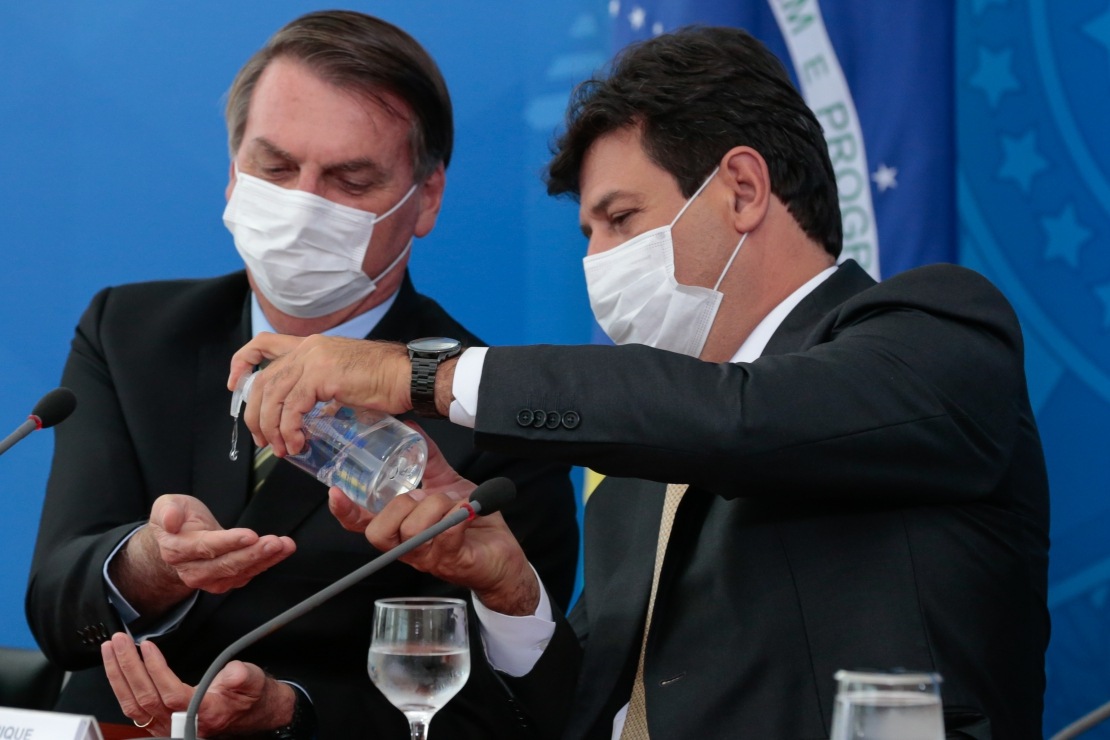
The research was conducted by phone to avoid physical contact
The telephone survey, used in this Datafolha study, seeks to represent the total adult population in the country, but is not comparable to the effectiveness of face-to-face surveys conducted on the streets or in homes.
Consequently, although approximately 90 percent of Brazilians have access to at least a cell phone, Datafolha does not use the method in electoral surveys, for instance.
The telephone method requires quick questionnaires, without the use of visual stimuli, such as cards with the candidates’ names.
In addition, it makes contact with those who are unable to answer calls during certain periods of the day more difficult, particularly those in low-income classes.
Thus, despite the distribution of the sample based on gender and age within each macro-region, and the subsequent consideration of results according to schooling, the data must be analyzed with some caution.
In the survey released on Friday, April 3rd, conducted so as to avoid personal contact between researchers and respondents, Datafolha adopted the technical recommendations required for the results to be as close as possible to the universe they intend to represent.
All Datafolha professionals worked from home, including the interviewers, who carried out the questionnaires from their homes through a remote telephone exchange.
The limitations posed by the telephone method do not jeopardize the findings, due to the magnitude of results obtained and the care taken.
Source: Folha de S.Paulo
More: Brazil news in English, every day from The Rio Times.
This article was produced by The Rio Times’ automated newsroom system. How we use AI · Report an error · Editorial responsibility: Matthias Camenzind, Editor-in-Chief