Fadea to develop an unmanned aerial system for the Argentine Army and Air Force
By Gonzalo Mary
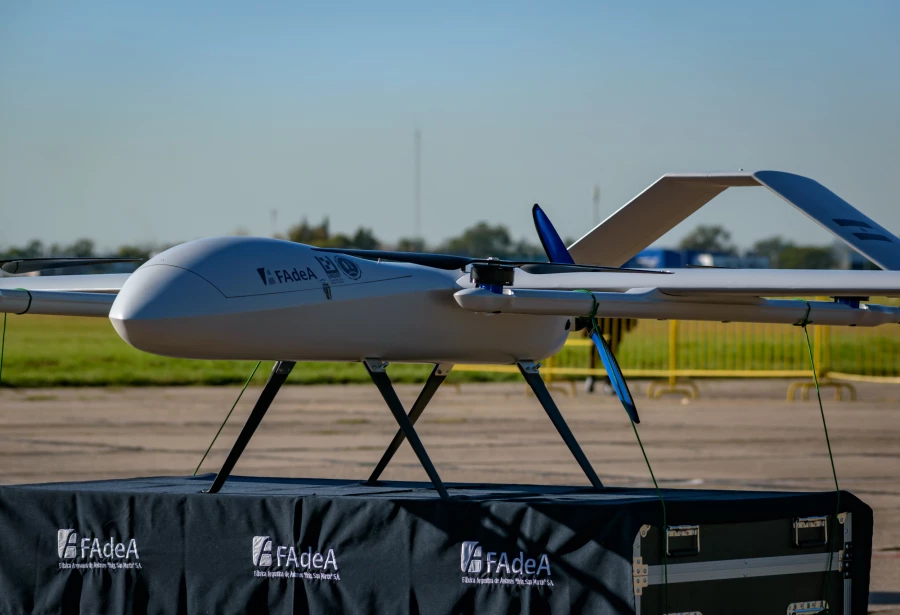
The president of Fábrica Argentina de Aviones (Fadea), Mirta Iriondo, has signed a contract for the development of an unmanned aerial system (UAV) for the Argentine Army (EA), which can be used for surveillance and communication. At the same time, the Argentine Air Force (FAA) will purchase two UAVs Chimango 650.
In a ceremony held at Fadea’s facilities, Iriondo signed a contract with the National Ministry of Defense, whose beneficiary is the Argentine Army, to develop a vertical take-off unmanned aerial system to be used by the Intelligence Directorate.
The first of the three stages of the project establishes the development of three technological demonstrators with their respective ground control stations, which may be used for surveillance and communication.
Lieutenant General Guillermo Olegario Pereda, head of the EA, commented, “We have been working over the last few years designing the operational requirements needed by our Army units.”
“We are facing a process of modernization and reconstitution of the army’s operational capabilities, hand in hand with a law allowing us to have an optimistic view on the development of the future army”.
CHIMANGO 650 FOR THE FAA
As published in the Official Gazette, the FAA will acquire two UAV Chimango 650, valued at $187,745,230.53 (US$808.773 million at official quotation), through direct contracting to the company Aerodyca to increase the training capacity of Samirp (Remotely Piloted Military Air Systems) crew members belonging to the Training and Enlistment Command in its different stages.
When asked by Infodefensa.com about the problems with some products, the head of the FAA, Brigadier General Xavier Julián Isaac, explained that given these deficiencies in the products it already has, which have caused the loss of some UAVs, it was decided to contract a company from Mar del Plata to incorporate the Chimango UAVs.
An agreement was reached with the company to collaborate with the FAA to improve and solve the errors that the Aukan, the Vigía, or the Kuntur may have.
“My idea is to continue betting on the FAA’s development,” he said.
DIFFERENT NEEDS
In an interview with Isaac, he commented that the Ministry of Defense intended to centralize all UAV programs of the different forces, so these acquisitions would not follow that line.
He commented, “There is a reality: the FAA has a unit destined for UAV, it has a UAV school, and our urgencies are different from those of the EA or the Argentine Navy (ARA).”
“Our urgencies lead us to buy a product already flying and tested and integrate it with ours. We don’t have time to start with a development that could be a couple of years away; we need to operate permanent UAVs and simultaneously go down the road”.
And he added that “I believe that ARA with Invap, EA with Fadea, and FAA with a private company, when we consolidate, at some point, we will determine which is the best product, and it will be the one that will drive the rest of the forces”.
With information from Infodefensa
News Argentina, English news Argentina, Argentine Armed Forces
Editorial responsibility: Matthias Camenzind, Editor-in-Chief · Editorial standards · Report an error
Read More from The Rio Times