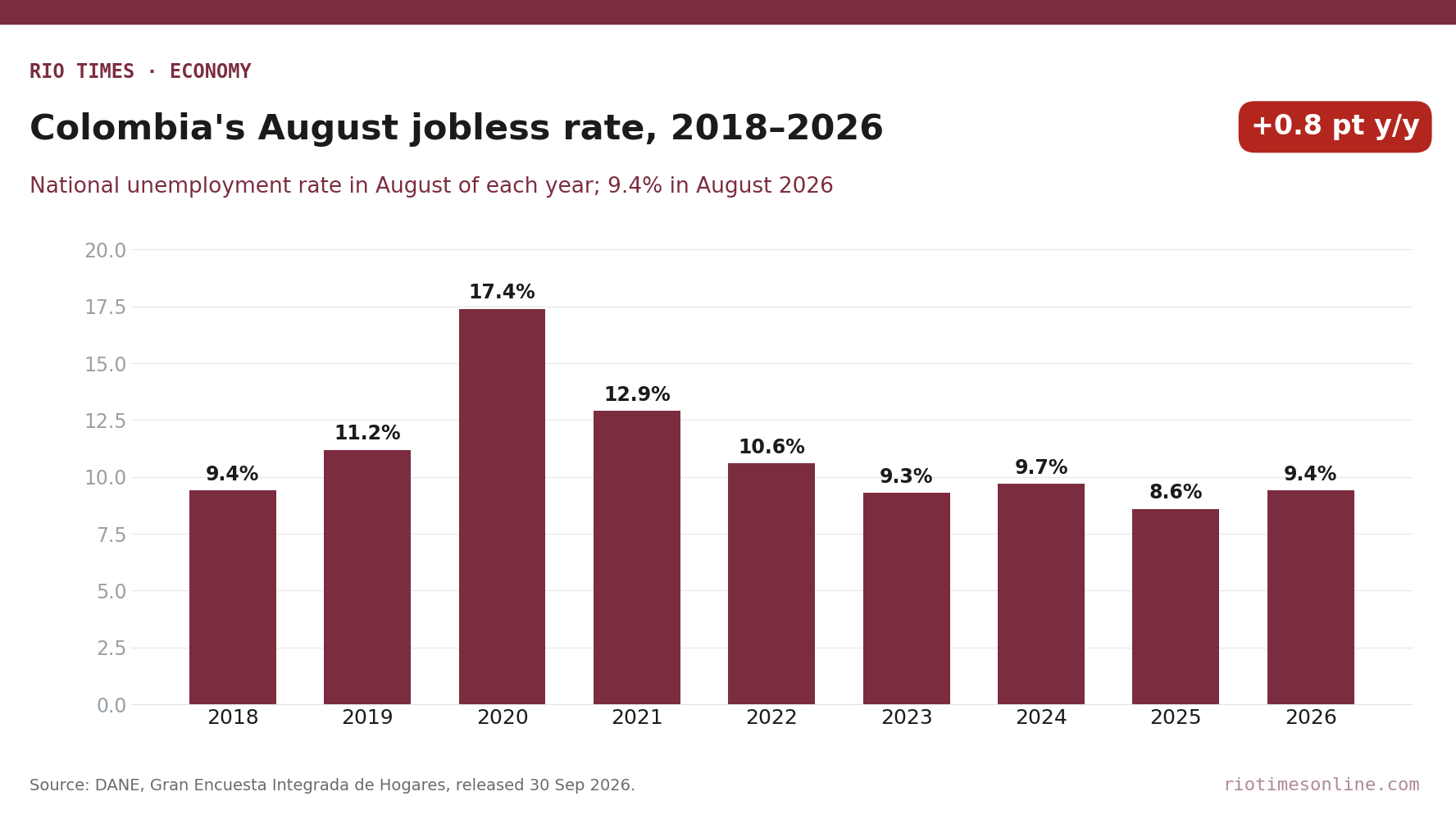
Colombia Unemployment Rises to 9.4% in August, Up From 8.6% a Year Earlier

ECONOMY · COLOMBIA
Key Facts
- The country Colombia publishes monthly jobs data through DANE, its national statistics agency, based on a nationwide household survey.
- What happened Colombia unemployment rose to 9.4% in August 2026, from 8.6% in August 2025, DANE reported on Wednesday 30 September.
- The numbers As of August, 23.69 million people were employed, 126,000 fewer than a year earlier. Unemployed people rose by 207,000 to 2.45 million (DANE).
- What it means for you Borrowing gets dearer as jobs soften: the same day, the central bank raised its benchmark rate to 12.25% from 12%. Informal work still eased, to 54.9% of jobs.
- Still open Whether August is a blip or a turn, and whether the bank hikes again on 30 October. DANE reweighted August’s survey after the earthquake.
Colombia unemployment rose to 9.4% in August 2026, up from 8.6% in the same month of 2025. DANE, the national statistics agency, published the figures on Wednesday 30 September.
The number of people in work fell by 126,000 over the year, to 23.69 million. It is a sharp turn from July, when the rate stood at 8.1%.
Fewer people working, fewer looking
The employment rate, the share of adults aged 15 and over with a job, fell to 57.4% from 58.4%. Participation also slipped, to 63.3% from 63.9%, meaning fewer people were working or seeking work.
The unemployed rose by 207,000, to 2.45 million. Adjusted for seasonal swings, the rate was 9.7%, which Infobae reported is the highest since October 2024.
Across the 13 largest cities and their metropolitan areas, unemployment reached 9.1%, up from 7.8%. The urban rise of 1.3 points was steeper than the national one.
Factories and farms shed the most jobs
Manufacturing lost 240,000 jobs over the year, the biggest drag of any sector. Arts, entertainment and other services lost 102,000, and agriculture 91,000.
Other sectors grew. Commerce and vehicle repair added 150,000 jobs, public administration, education and health 96,000, and construction 80,000.
By type of work, day labourers fell by 154,000 and domestic workers by 118,000. Government employees rose by 124,000.
The job losses fell on men. Male unemployment rose to 7.7% from 6.7%, while the female rate edged up to 11.6% from 11.2%, El Heraldo and DANE reported.
The stabilisers in the data
The three-month picture is calmer than the single month. For June to August, national unemployment averaged 8.5%, slightly below 8.7% a year earlier.
Informal work also eased. DANE put the informal share of jobs at 54.9% in August, down from 55.7% a year before.
Regional gaps stay wide. Over June to August, Quibdó had the highest rate among 23 cities at 23.8%, followed by Cartagena at 14.4%.
Bucaramanga had the lowest, at 7.3%, with Medellín at 7.5% and Bogotá at 7.9%. The July figures are covered in our report Colombia Jobs: 578,000 Created in a Year, but Farming Lost 204,000.
An earthquake, a new government and a rate decision
DANE said it adjusted the survey’s weighting for August after the 10 August earthquake destroyed or emptied some sampled homes. Recovery work is described in Colombia Earthquake Recovery Enters Fourth Week.
August was also the first month of President Abelardo de la Espriella’s government, which took office on 7 August. The same afternoon, the central bank, Banco de la República, raised its benchmark rate by 25 basis points to 12.25%.
Most analysts had expected a hold, as set out in Colombia’s Central Bank Expected to Hold Rates at 12% as the Peso Slides. Four of seven board members backed the rise, two voted to hold and one wanted 50 basis points.
The bank cited annual inflation of 6.2% in August, core inflation at a one-year high of 6.1% and rising inflation expectations. It warned that El Niño could push food and regulated prices higher, even as activity slowed in July.
What Is Not Yet Known
It is not yet clear how much of August’s rise reflects the earthquake, the reweighting or a genuine slowdown. DANE warns that rates below 10% can carry sampling errors above 5%.
The September figures, due next month, will show whether manufacturing losses persist. The central bank meets again on 30 October and said El Niño, the post-earthquake recovery and fiscal policy will guide its next move.
Sources: DANE, labour market bulletin, August 2026 (30 Sep 2026); DANE, labour market presentation, August 2026; El Heraldo (30 Sep 2026); Banco de la República, board press release (30 Sep 2026); Infobae (30 Sep 2026).
More: Colombia news in English, every day from The Rio Times.
This article was produced by The Rio Times’ automated AI newsroom. Editorial responsibility: Matthias Camenzind, Publisher and Editor-in-Chief. The Rio Times also runs Ask Rio Times, which answers from 100,000+ of our own articles, the daily Latin America Power Map, and prediction-market odds on elections and markets.. How we use AI · Report an error