Brazil Stocks Reopen After Lula Win, Real Near 4.98 | Morning Call, Oct 26
Key Facts
- Brazil wakes to Lula’s re-election and a rival who refuses to concede, so investors reprice fiscal risk and the Selic, Brazil’s benchmark interest rate, at the open.
- Prediction markets: Polymarket, an online exchange where users bet real money on outcomes, puts a 60.5% chance on no change to the 13.75% Selic at the 3–4 November meeting of Copom, the central bank’s rate committee, and 22.5% on a 25-basis-point cut (26 October, 00:01 ET).
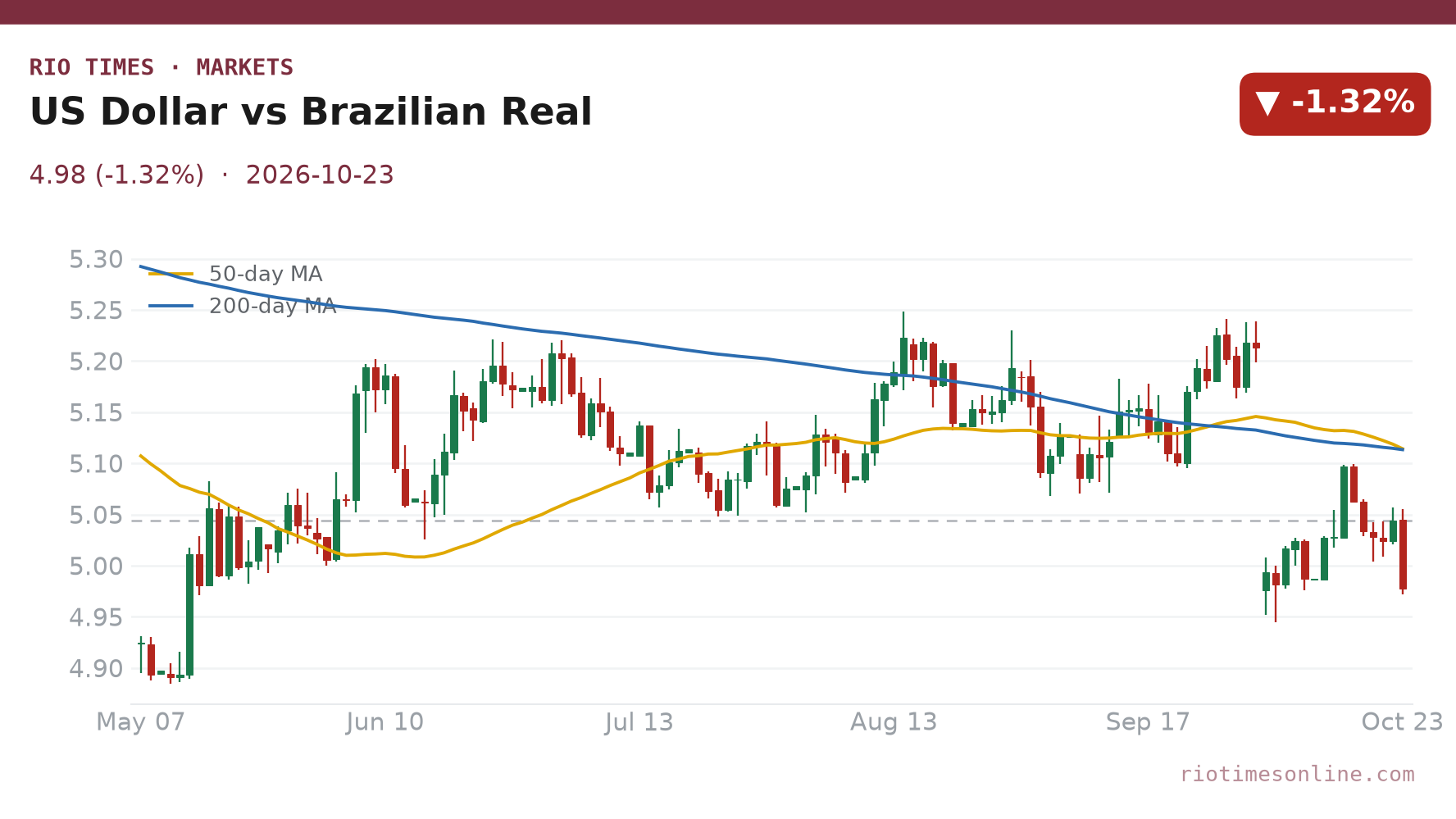
- USD/BRL closed Friday at R$4.98, just under the R$5.00 line that traders treat as the test for Monday’s open.
- Gerdau, a Brazilian steelmaker, and its holding company Metalúrgica Gerdau report third-quarter results after today’s close, making steel the main corporate story at B3, the São Paulo stock exchange.
- Brazil’s data calendar is light: consumer confidence from FGV, an economics institute, at 08:00 Brasília time (BRT), then foreign investment and the current account at 08:30 BRT; Friday’s mid-month inflation came in softer than forecast.
Live tonight
Brazil’s runoff, live
The official TSE count for Flávio Bolsonaro and Lula, updated every minute (voting closed at 7 p.m. Brasília, 6 p.m. ET).
Brazil runoff polls · Polymarket and Kalshi odds · When results come · Brazil election poll data (CSV)
Prediction markets · who wins the runoff
Implied chance of winning Brazil’s presidency on 25 October, from traders’ prices.
Polymarket
Flávio Bolsonaro – · Lula – (US$249 million traded)
Kalshi (regulated in the US by the CFTC)
Flávio Bolsonaro 0.4% · Lula 99.6%
As of 25 October, 11:40 pm ET (03:40 Lisbon), updated every 20 minutes. Prices are bets, not polls, and can move fast.
Why we show this: prediction markets turn real-money bets into a live probability that moves within minutes of the news, which is why investors, campaigns and newsrooms in the United States now follow them closely. We show them next to polls and official results, never instead of them.
Today’s Focus
Monday’s open is not about Friday’s close — it is about what changed over the weekend. Lula’s re-election has shifted the market’s central assumption on fiscal policy, and every Brazilian asset is being repriced through that lens.
The real is the sharpest expression of that repricing. Friday left spot USD/BRL just below R$5.00, and the way the currency behaves at that symbolic threshold in early trading will set the tone for equities and the yield curve.
The Copom wager is now the mechanism by which fiscal fear becomes a tradeable position. With the Selic at 13.75% and the next meeting on 3–4 November, Polymarket bettors currently favour no change at 60.5%, against 22.5% for a 25-basis-point cut, and a weaker real would strengthen the case for a hold.
Corporately, Gerdau and Metalúrgica Gerdau report after the close, a reminder that earnings season is still underway even as the macro storm dominates the tape.
What matters today. Whether the real can hold below R$5.00 through the first hours of trading, because that threshold is the market’s verdict on Lula’s fiscal credibility.
Today’s Economic Events
| Instrument | Level | Session |
|---|---|---|
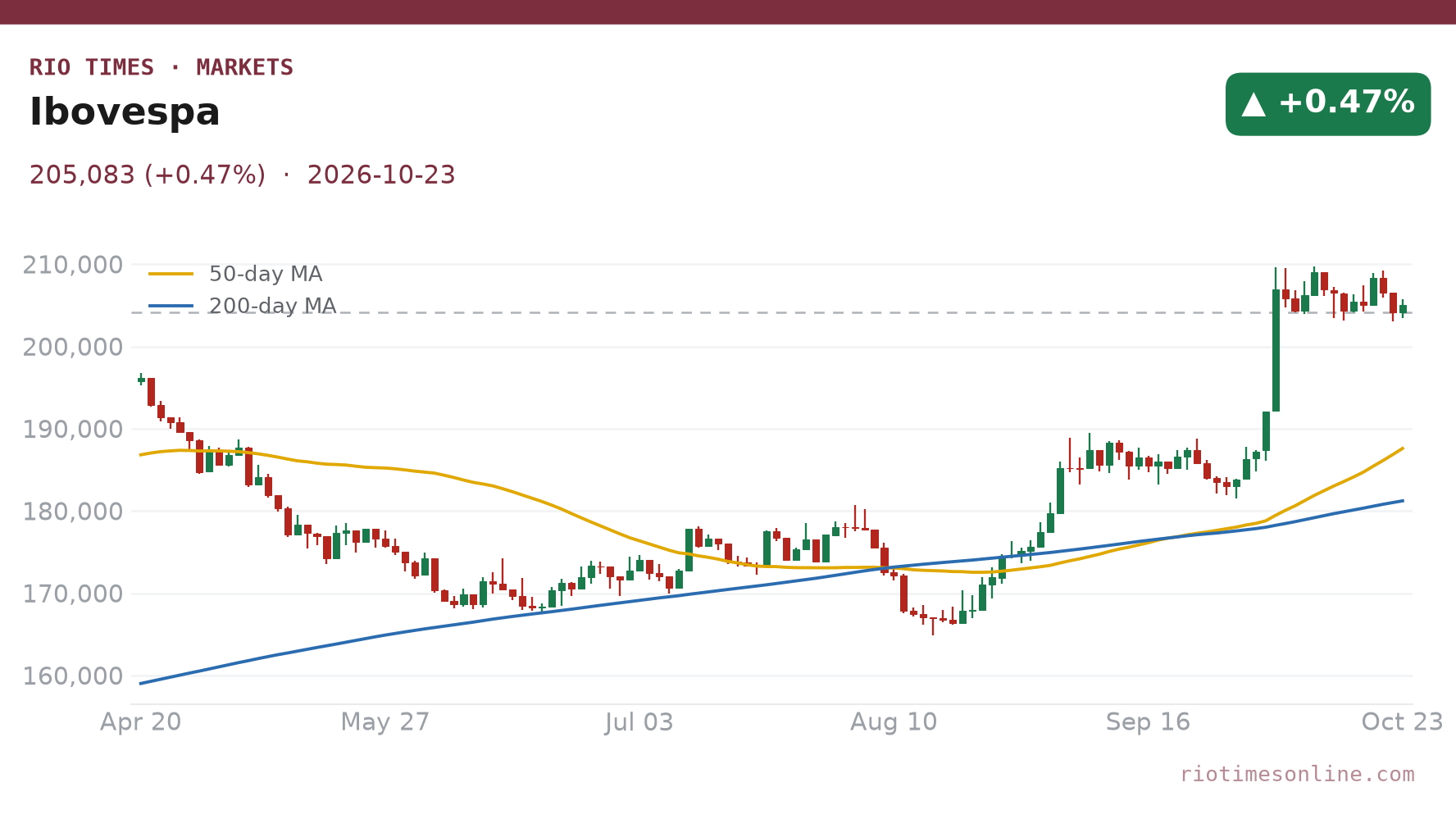
| Ibovespa (Brazil) | 205,083 | +0.47% |
| S&P 500 (US) | 7,624 | -0.52% |
| USD/BRL | 4.9776 | -1.32% |
Source: market close, 23 October 2026.
01 The setup in one read
This is the first full trading session since Lula secured a fourth term, and the market’s entire focus is on what that means for the public finances.
Brazil’s own markets have not yet had their say: B3, the São Paulo stock exchange, opens later this morning, and Friday’s close is the only hard reference for the Ibovespa, its main index, and for the real.
The central bank’s benchmark rate, the Selic, sits at 13.75%, and the next Copom decision lands on 4 November. Polymarket bettors put no change at 60.5% and a 25-basis-point cut at 22.5%.
With no Brazilian data release of consequence until FGV consumer confidence at 08:00 BRT, the early session will be pure risk repricing. The real’s ability to hold below R$5.00 is the market’s first, clearest verdict on the new political reality.
The evidence points to a cautious rather than panicked start: the real strengthened 1.3% on Friday to close at R$4.98 and was still below R$5.00 in early Monday trading. Brazilian stocks and rates will give the first real verdict once B3 opens.
The variable to watch is whether the R$5.00 level breaks in the first hour of cash trading. A clean break would likely drag the Ibovespa toward its 52-week range’s lower half and add to the odds of an unchanged Selic.
02 Where Brazil is set to open
| Instrument | Last close | Indicated | Watch today |
|---|---|---|---|
| USD/BRL (spot) | R$4.98 (below R$5.00) | — | R$5.00 psychological level; a clean break opens the 5.10–5.20 band |
| Ibovespa | 205,083 (board) | — | 205,000 as the immediate reference; a break below puts 200,000 in view |
| Gerdau (GGBR4) | — | — | Q3 earnings after the close; steel-sector margin and demand commentary |
| Metalúrgica Gerdau (GOAU4) | — | — | Reports alongside Gerdau; holding-company discount in focus |
| Rate-sensitive names | — | — | Utilities and financials react to any shift in the Selic odds |
The table’s message is simple: everything today is about the real and the rate path. The spot rate closed Friday at R$4.98, just under the R$5.00 mark, which is now the single most-watched price in Brazilian finance.
No reliable pre-market indication for the Ibovespa was available at the time of writing. The 205,000-point level from Friday’s close is the immediate pivot — lose it, and 200,000 becomes the next magnet. Rio Times · Live Market Intelligence
Live Market IntelligenceBrazil Morning Call — Live Board
Brazil Morning Call — Live Board
Instrument Last Change YoY Prev. High Low Volume
IBOV
205,082.56
+0.47%
+21.85%
204,120.12
168,310
167,142
—
USD/BRL
5.16
+0.01%
-5.13%
5.16
5.18
5.14
—
EUR/BRL
5.95
+1.01%
-5.83%
5.89
5.98
5.94
—
SELIC
14.00%
—
—
—
—
—
BRENT
88.88
-0.03%
+34.42%
88.91
90.07
88.12
29,713
WTI
83.11
-0.11%
+31.57%
83.20
84.35
82.40
166,848
IRON ORE
161.91
—
+58.10%
161.91
161.91
1
GOLD
4,461
+1.78%
+33.20%
4,383
4,503
4,421
139,824
SILVER
65.59
+1.26%
+73.05%
64.77
66.98
64.81
46,406
LITHIUM
75.20
+1.47%
+62.95%
74.11
75.80
75.08
89,275
SOY
1,184
+3.20%
+17.05%
1,148
1,199
1,168
163,179
CORN
480.50
+10.02%
+29.34%
436.75
480.75
459.50
341,248
WHEAT
655.00
+3.93%
+29.70%
630.25
657.75
631.50
128,793
COFFEE
317.25
-5.51%
+0.67%
335.75
321.20
313.55
21,747
SUGAR
16.43
-1.79%
-3.01%
16.73
17.11
16.22
171,992
ORANGE JUICE
138.55
-0.47%
-45.38%
139.20
141.05
137.50
703
COTTON
85.03
+2.33%
+26.78%
83.09
82.90
81.96
16,546
BEEF
223.60
-3.93%
-5.18%
232.75
226.40
223.00
16,126
CATTLE
339.10
-3.16%
-1.82%
350.17
345.50
338.60
10,164
COCOA
5,719
+3.18%
-34.96%
5,543
5,779
5,574
26,773
PETR4
41.64
-0.05%
+35.19%
41.66
41.97
41.15
41,499,400
VALE3
72.97
+0.83%
+30.75%
72.37
73.54
72.66
17,658,000
SUZB3
41.33
+2.35%
-23.55%
40.38
41.48
40.35
3,914,900
KLABIN
17.69
+0.80%
-2.95%
17.55
17.74
17.48
2,057,400
SLCE3
13.34
+0.30%
-12.25%
13.30
13.42
13.20
1,454,200
ABEV3
14.89
-0.80%
+21.91%
15.01
15.07
14.81
16,453,100
ITUB4
38.60
-1.03%
+4.57%
39.00
39.34
38.39
29,487,800
BBDC4
16.85
+0.36%
+3.50%
16.79
16.90
16.67
19,416,900
BBAS3
19.37
+0.47%
+0.73%
19.28
19.44
19.16
11,069,200
B3SA3
14.26
-0.21%
+12.73%
14.29
14.47
14.11
33,037,800
WEGE3
47.59
+0.49%
+29.99%
47.36
48.08
47.36
3,364,600
PRIO3
59.14
-0.19%
+50.67%
59.25
59.81
58.74
3,325,600
RENT3
34.68
-0.09%
+0.84%
34.71
34.96
34.35
7,979,100
AZZA3
15.89
-2.63%
-53.76%
16.32
16.42
15.82
1,330,300
CSNA3
4.30
+0.47%
-42.65%
4.28
4.41
4.26
10,076,100
GGBR4
24.69
+2.19%
+51.38%
24.16
24.85
24.18
7,047,600
ENEV3
24.21
-1.38%
+70.49%
24.55
24.64
23.99
9,297,000
LREN3
11.87
-1.33%
-28.65%
12.03
12.17
11.83
9,683,300
03 On the B3 radar today — post-election repricing and Gerdau earnings
| Item | When | Why it matters |
|---|---|---|
| FGV Consumer Confidence | 08:00 BRT | First read on household sentiment after the election; forecast 83.7 vs 84.2 before |
| BCB Focus Market Readout | 08:30 BRT | Weekly survey of economists; shows whether Selic and inflation expectations are drifting |
| Foreign Direct Investment (September) | 08:30 BRT | Estimate 9.5 vs 7.4 prior; a sign of whether foreign capital is still committing to Brazil |
| Current Account (September) | 08:30 BRT | Estimate -4.5 vs -5.06 prior; the external financing gap matters for the real |
| Gerdau (GGBR4) Q3 results | After close | Steel-sector earnings; margins and demand outlook set the tone for the sector |
| Metalúrgica Gerdau (GOAU4) Q3 results | After close | Holding-company results; discount to Gerdau’s operating subsidiaries may widen or narrow |
The domestic data calendar is light but not irrelevant. The FGV consumer confidence number at 08:00 BRT is the earliest opportunity to see whether voters feel better or worse about their own finances after the outcome.
The Central Bank’s Focus survey of economists, also due at 08:30 BRT, is the quiet mover. If economists lift their Selic expectations or push out the easing cycle, that repricing will hit rate-sensitive shares — banks, utilities and homebuilders — within minutes.
04 Copom and the macro backdrop
The Selic is 13.75%, and the next Copom meeting on 3–4 November is now the single most important date on the Brazilian calendar. The committee’s last decision came before the runoff result.
What Prediction Markets Say
On Polymarket, an online exchange where users trade real money on outcomes, bettors put no change at the 3–4 November meeting at 60.5%, a 25-basis-point cut at 22.5%, a rise of 50 basis points or more at 6.7%, a 25-basis-point rise at 1.8% and a cut of 50 or more at 1.6% (US$92,979 traded; 26 October, 00:01 ET). These prices are bets, not polls.
Why we show this: prediction markets turn real-money bets into a live probability that moves within minutes of the news, which is why investors, campaigns and newsrooms in the United States now follow them closely. We show them next to polls and official results, never instead of them.
Friday’s data pointed to easing price pressure. IBGE, Brazil’s statistics institute, reported mid-month inflation (IPCA-15) of 0.32% in October against a 0.43% forecast (previous 0.70%), and the annual rate reached 4.62% against a 4.73% forecast (previous 4.47%). Across the Atlantic, US activity stayed strong: the S&P Global manufacturing PMI, a survey of purchasing managers in which 50 separates growth from contraction, was 56.0 (forecast 55.5, previous 55.9), services 57.9 (forecast 58.0, previous 58.8) and the composite 57.6 (forecast 57.6, previous 58.4), while University of Michigan consumers expect 4.7% inflation over one year (forecast 4.7%, previous 4.6%) and 3.5% over five years (forecast 3.5%, previous 3.4%). Source: RT economic calendar (RT).
The mechanism is straightforward: a government that signals looser fiscal policy pushes up inflation expectations, which ties the central bank’s hands. If the Focus survey today shows expectations drifting upward, the Copom’s room to cut shrinks, and the yield curve steepens.
This is also why the real matters so much. A weaker currency imports inflation, and a slide through R$5.00 would reinforce the case for holding the Selic flat in November, which would weigh on equities and especially rate-sensitive sectors.
05 Corporate stories to watch today
Gerdau and Metalúrgica Gerdau report third-quarter results after the close, and they matter because steel is a leveraged play on both the domestic economy and the exchange rate. A weaker real helps exporters like Gerdau translate dollar-denominated revenue into stronger local results, even as higher rates squeeze domestic construction demand.
Beyond Gerdau, the post-election tape will separate exporters from domestic demand names.
The currency move is the swing factor today. If the real weakens through R$5.00, exporters with dollar-linked revenue — iron-ore producers, pulp makers, processed-food exporters — should hold up better than banks, retailers and utilities that live and die by domestic rates and consumption.
Earnings season is under way, and today’s Gerdau report is a steer from the heavy industry sector. Its commentary on freight costs and domestic demand will show how heavy industry is coping with high rates.
06 The levels to watch at the open
For the real, R$5.00 is everything. Friday’s close at R$4.98 leaves almost no margin for error.
A clean break above R$5.00 in the first hour of cash trading would open the door to 5.10 and then 5.20, levels that would force a serious conversation about the November Copom decision and possibly December’s meeting too.
For the Ibovespa, 205,000 points is the immediate reference from Friday’s close, but traders will be watching 200,000 as the psychological floor. The index is about 2% below its 52-week high near 209,700, and a post-election sell-off could push it back toward the lower part of its 146,200–209,700 range.
The early session should be framed as a test of whether the market believes Lula’s team can deliver fiscal credibility. If the real holds below R$5.00 and the Ibovespa stabilises around 205,000, the repricing was overdone; if both break, the move has further to run.
07 What to watch
- USD/BRL and the R$5.00 line: The first hour of cash trading is the real stress test; a clean break through R$5.00 would extend the move and hit rate-sensitive sectors hard.
- BCB Focus Survey at 08:30 BRT: Any drift in Selic or inflation expectations will reprice the November Copom odds and hit banks, utilities and homebuilders.
- Gerdau Q3 after the close: The steel sector’s big report this week; export leverage and domestic demand commentary will frame the sector trade.
- The Selic odds on prediction markets: If bettors move away from the 60.5% no-change call toward a hike or a cut, the yield curve and B3 will reprice within minutes.
Background: Brazil’s Real Falls 9% After Lula Win.
Background: Brazil’s Azul Gets Up to US$397M Fuel Loan.
Frequently Asked Questions
What is the Selic?
The Selic is Brazil’s benchmark interest rate, set by the central bank’s Copom committee. It is the main tool for controlling inflation and is currently at 13.75%.
Why does R$5.00 matter for the real?
R$5.00 is a psychological threshold for USD/BRL. A break above it signals that investors are losing confidence in Brazil’s fiscal outlook, which pushes up inflation expectations and rates.
When is the next Copom decision?
The next Copom meeting is on 3–4 November, with the decision due on 4 November. Polymarket bettors currently assign 60.5% to no change and 22.5% to a 25-basis-point cut.
What is the Ibovespa?
The Ibovespa is Brazil’s main stock index, tracking the largest and most traded companies on the B3 exchange in São Paulo. It is the benchmark for Brazilian equity performance.
Market data: RT
This article was produced by The Rio Times’ automated newsroom system. How we use AI · Report an error · Editorial responsibility: Matthias Camenzind, Editor-in-Chief
LatAm Markets: Live Signals → — real-time movers, turnover leaders and FX across Latin America.
Read More from The Rio Times