Bolsonaro’s Brazil Totters Blindly, as Government Support Crashes After Moro’s Exit
RIO DE JANEIRO, BRAZIL – The explosive departure of ex-Minister of Justice Sérgio Moro has opened a new and dangerous chapter for Brazil and Jair Bolsonaro’s government that is poisoning loyal voters, wards off potential investors, and strengthens the discourse of those calling for the President’s impeachment.
The São Paulo stock market plummeted almost ten percentage points on Friday while Bolsonaro lost his symbol of the fight against corruption, following serious allegations that he removed Maurício Valeixo from the Federal Police leadership, and sought to interfere in investigations, something even Bolsonaro’s arch-enemy predecessors had not done.

“Imagine if, during Lava Jato, then-President Rousseff and ex-president Luiz [Lula] were to keep calling the authorities for information?” Moro said in a statement that surprised the political world.
Just as serious as Moro’s departure, is Bolsonaro’s penchant to fire nuclear bombs on his government and to engender soap operas that twist around himself, as Brazil lives the panic of the coronavirus pandemic which has killed more than 3,000. “There is a surge of crises – [the switch of health ministers was the most recent] while fighting the largest of all in this generation, the coronavirus pandemic,” notes Thiago de Aragón, a political scientist at Arko Advice.
“It’s as if a couple were kidnapped, and during the kidnapping, the woman decided to ask for a divorce,” he compares. The betting market is already speculating on a potential departure of Minister Paulo Guedes in the aftermath, but for now, it’s just speculation.
Bolsonaro tried to circumvent the Moro earthquake, appearing alongside virtually the whole team of cabinet ministers – including a mask-wearing Paulo Guedes – to defend himself against Moro’s accusations. Ironically, the cure seemed worse than the disease. The president denied that he interfered with the work of the PF, but admitted that he was looking for a direct interlocutor to learn about a number of investigations.
“I want a police chief I can interact with. Why not?” The disappointment of part of the President’s constituency immediately materialized. “Bolsonaro no longer represents me, he fell out with the only hero Brazil had,” lamented Ulysses, an administrator from Belo Horizonte, who until Thursday had been a fierce advocate of the current government.
In São Paulo, financial analyst Debora jumped ship as soon as Moro presented his reasons to resign. “I wanted the PT (Workers’ Party) out of power anyway possible so I voted for Bolsonaro. Now I believe in Moro more than in him,” she says.
Both Debora and Ulysses were part of the group of voters who applauded Lava Jato and saw in Minister Moro the hope that the siege against corruption would continue firmly under the Bolsonaro administration. It is this government support base that started to crumble with the exit of Sérgio Moro, now more popular than President Jair Bolsonaro, as shown by the Political Atlas Institute poll.
Moro enjoys a 53 percent favorable rating among Brazilians, compared to 39 percent for Bolsonaro, according to the institute’s most recent survey.
“Within the Bolsonarist discourse, the most resilient slant has always been related to fighting corruption and crime,” explains Andrei Roman, a political scientist at Atlas. “As the person in charge of the main convictions in Lava Jato and the imprisonment of [ex-president] Lula, Moro ensured the Bolsonaro government a seal of legitimacy and authenticity with respect to this discourse,” he adds.
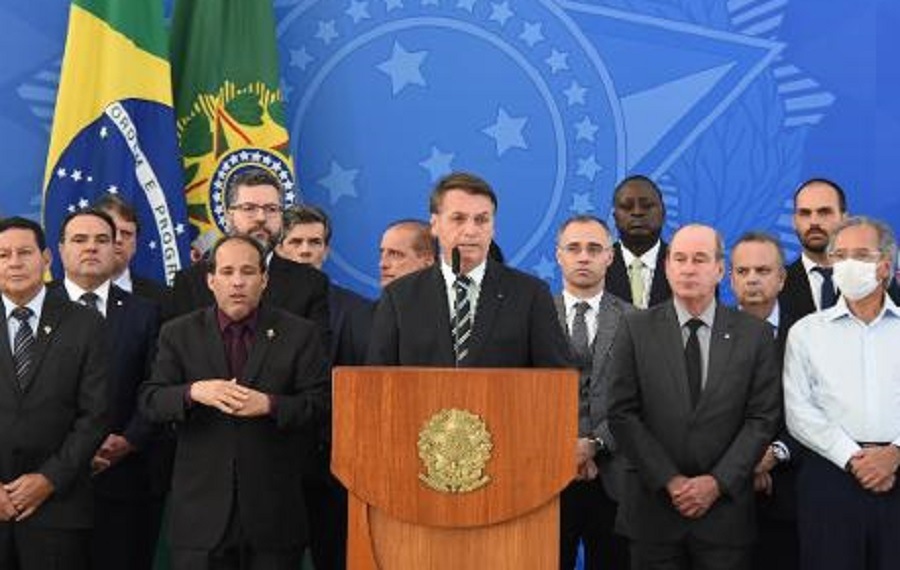
However, the radical voters who support any of Bolsonaro’s decisions, and who amplify his corrosive lines, a group that will support him for some time, are firmly behind him. The President’s appearance alongside his Ministers, including those of military rank, has also fostered the notion that the President is not alone, and that the Armed Forces are standing firmly by him, although behind the scenes there are many indications of unease.
“There’s still plenty of fuel left in the tank. The President can take on an even more aggressive narrative, to consolidate the support of 22 percent of Brazilians,” says Thiago de Aragão, a political scientist with Arko Advice. With this popularity, Bolsonaro would secure enough support, and would be shielded from the pressure of impeachment, for instance.
The issue came up again this Friday, with pressure from politicians, such as former president Fernando Henrique Cardoso, and organizations such as the Brazilian Bar Association (OAB), to assess the president’s removal from office. There are now more than 20 impeachment petitions lodged in Congress against the President. Aragão believes it is too early for that. He recalls that Dilma Rousseff had about eight percent support when she was removed from office in 2016.
Former president Michel Temer (2016-218) also had less than ten percent support in the polls but relied on Congress’ support. Not by chance did the government start negotiating with deputies from the so-called Centrão (center-right parties), renowned for their crony-favoring “physiological” profile – several of them under investigation by Lava Jato – to garner the support he lacks today.
Bolsonaro decided to invest in an alliance with a congressional bloc that would give him a majority in Congress needed to win a tug-of-war with the Chamber president, Rodrigo Maia and guarantee governance. In exchange, there would be a distribution of executive top-echelon positions. The strategy, however, is shaky, in the reading of an experienced observer of the Centrão’s behavior.
“There are moments when there are no conditions to hold anything at all,” says leftist José Eduardo Cardozo, who was the Minister of Justice in Dilma Rousseff’s administration. “I remember in the impeachment proceedings [in 2016] how people jumped ship. The feeling is the same,” says Cardozo, who stood up for Dilma at the time.
The former Justice Minister believes that Moro’s speech on his way out has had a devastating impact on Bolsonaro, irrespective of his negotiations.
“The President signals that he intends to intercept inquiries trying to surface, like the fake news [conducted by the Supreme Court, which may affect his son Carlos Bolsonaro, suspected of spreading false news to benefit his father],” he says.

“When someone wants to obstruct an investigation, using non-republican methods, it’s because they have something to hide,” he adds, recalling the culture of independence that’s been built at great cost by the Federal Police.
This is causing more damage to the already fragile image of the President worldwide. “An investor told me: ‘How can I expect, in the short and medium-term, that decisions will be made rationally and not emotionally in Brazil?”, says Aragão, recalling that money holders seek predictability to make their choices.
Predictability is something that Brazil lost a long time ago.
Source: El País
More: Brazil news in English, every day from The Rio Times.
Live Market IntelligenceBrazil — Live Market Board
Rio Times · Live Market Intelligence
Brazil — Live Market Board
-1.15%
204,116.29
-1.15%
70,249.54
+1.43%
10,746.44
-2.18%
3,017,221
—
2,529.36
-1.21%
59,561.23
-4.00%
| Instrument | Last | Change | YoY | Prev. | High | Low | Volume |
|---|---|---|---|---|---|---|---|
| IBOV | 204,116.29 | -1.15% | +21.85% | 206,495.23 | 168,310 | 167,142 | — |
| USD/BRL | 5.16 | +0.01% | -5.13% | 5.16 | 5.18 | 5.14 | — |
| SELIC | 14.00% | — | — | — | — | — | |
| PETR4 | 41.64 | -0.05% | +35.19% | 41.66 | 41.97 | 41.15 | 41,499,400 |
| VALE3 | 72.97 | +0.83% | +30.75% | 72.37 | 73.54 | 72.66 | 17,658,000 |
| ITUB4 | 38.60 | -1.03% | +4.57% | 39.00 | 39.34 | 38.39 | 29,487,800 |
| BBDC4 | 16.85 | +0.36% | +3.50% | 16.79 | 16.90 | 16.67 | 19,416,900 |
| BBAS3 | 19.37 | +0.47% | +0.73% | 19.28 | 19.44 | 19.16 | 11,069,200 |
| B3SA3 | 14.26 | -0.21% | +12.73% | 14.29 | 14.47 | 14.11 | 33,037,800 |
| ABEV3 | 14.89 | -0.80% | +21.91% | 15.01 | 15.07 | 14.81 | 16,453,100 |
| WEGE3 | 47.59 | +0.49% | +29.99% | 47.36 | 48.08 | 47.36 | 3,364,600 |
| PRIO3 | 59.14 | -0.19% | +50.67% | 59.25 | 59.81 | 58.74 | 3,325,600 |
| SUZB3 | 41.33 | +2.35% | -23.55% | 40.38 | 41.48 | 40.35 | 3,914,900 |
| RENT3 | 34.68 | -0.09% | +0.84% | 34.71 | 34.96 | 34.35 | 7,979,100 |
| AZZA3 | 15.89 | -2.63% | -53.76% | 16.32 | 16.42 | 15.82 | 1,330,300 |
| CSNA3 | 4.30 | +0.47% | -42.65% | 4.28 | 4.41 | 4.26 | 10,076,100 |
| GGBR4 | 24.69 | +2.19% | +51.38% | 24.16 | 24.85 | 24.18 | 7,047,600 |
| ENEV3 | 24.21 | -1.38% | +70.49% | 24.55 | 24.64 | 23.99 | 9,297,000 |
This article was produced by The Rio Times’ automated newsroom system. How we use AI · Report an error · Editorial responsibility: Matthias Camenzind, Editor-in-Chief