Agribusiness in Brazil leaps forward in 20 years and is now equivalent to Argentina’s GDP

By José Maria Tomazela
This year’s record harvest of more than 300 million tonnes expected for Brazil shows the proportion that agribusiness has taken within the Brazilian economy.
Between 2002 and 2022, the country’s agricultural GDP jumped (in deflated numbers) from US$122 billion to US$500 billion – the equivalent of Argentina’s GDP.
According to economist José Roberto Mendonça de Barros, Brazilian agribusiness has shown extraordinary growth over the last 40 years, with the last 20 years standing out.
“Unlike what happened in the urban sector, whether in industry or in services, the growth of agribusiness is persistent, and this is the first lesson agribusiness gives. Always growing is more important than growing a lot in some years and falling in the following years. It’s a sustainable growth, which makes agribusiness very competitive.”
According to specialists, this growth is based on the investment in research and public policies for the field, which have propitiated successive records in agricultural production.
According to the National Supply Company (Conab), Brazil should break the barrier of 300 million tonnes of grains this year, establishing itself as the third largest world producer of grains, behind China and the United States.
In 20 years, the grain harvest increased from 120.2 million tonnes to 310.6 million tonnes, an increase of 258%.
The planted area went from 43.7 million to 76.7 million hectares, an increase of 76.5%.
The numbers show that production grew three times more than the area occupied by crops due to the gain in productivity, thanks to investments in research and technology.
The highlight of the Brazilian fields is soybean.
This oleaginous plant has adapted to the country’s different microclimates, being cultivated in colder regions in the extreme South and the tropical climate of the North and Northeast.
Brazil has overtaken the USA to become the largest soybean producer and the main exporter.
While the 2002/03 harvest yielded 47.4 million tonnes of soybeans, the current harvest will have a production of 152.9 million, an increase of 322%, according to Conab.
Corn, used in crop rotation with soybeans, grew 260%, from 47.4 million to 123 million tonnes.
The agribusiness GDP, calculated by the Center for Advanced Studies in Applied Economics (Cepea) of the University of São Paulo, will only be released next month but should be close to US$500 billion, according to researcher Nicole Rennó, from the macroeconomics area of Cepea.
The good harvests partly offset the drop in value caused by high costs in the sector.
DOUBLING THE AVERAGE
The agronomist Tamires Tangerino, 33, technical consultant of Stoller, a company specializing in plant physiology and nutrition, has applied her knowledge to help producers in the southwestern region of São Paulo reach high productivity levels.
Last 14th, in a commercial soybean plantation of the Capão Bonito Agricultural Cooperative, she obtained productivity of 6,672 kg per hectare, twice the national average and above the excellent regional average of 4,800 kg/ha – a demonstration of the impact of research as an engine for growth.
SOYBEANS AND CORN IN THE SAME AREA
In the Capão Bonito Agricultural Cooperative area, it is possible to get an idea of the soybean expansion in the southwestern part of the state.
In 2005, the cooperative had 55 associated farmers, and none had soybean as their main crop – beans were the main crop, and corn was only planted in the summer.
Today, with 102 members, the cooperative plants 24 thousand hectares of soybean, with an average production of 80 bags per hectare, and, in the case of corn, more than 70% of the total is cultivated in the off-season (“safrinha”).
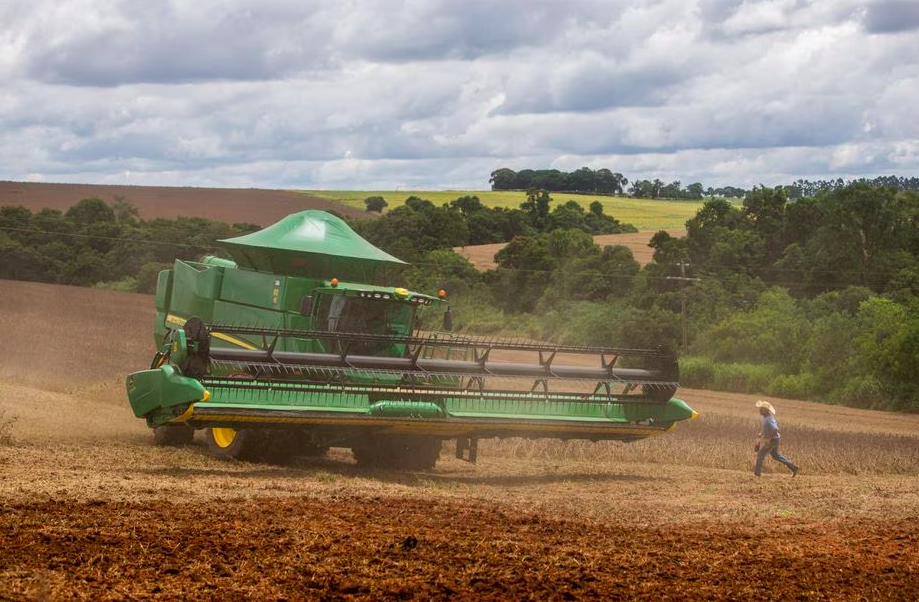
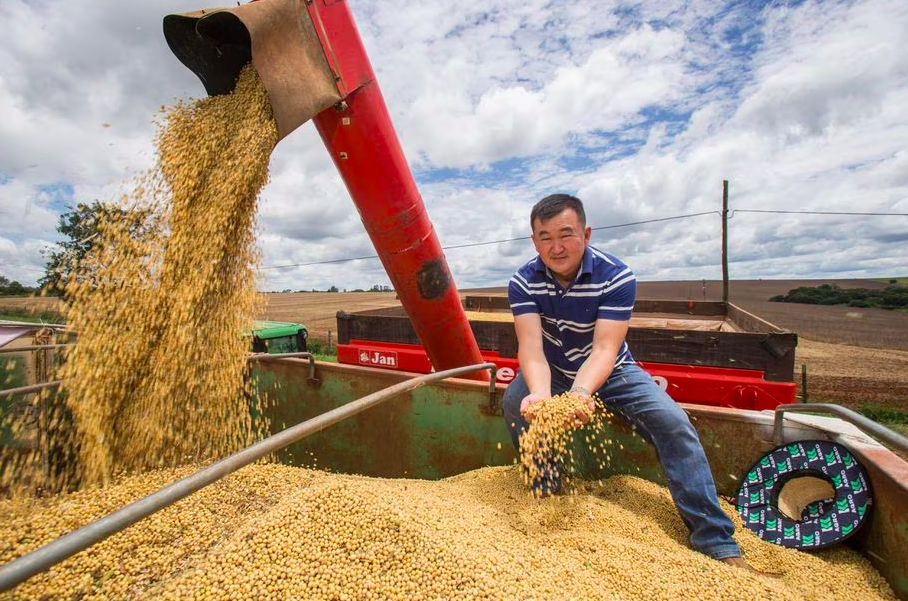
One of the cooperative members, 48-year-old producer Walter Kashima, who cultivates around 2,500 hectares of soybean close to the urban area of Capão Bonito, was harvesting last Thursday, 16th, an average of 80 sacks (4,800 kilos) of soybean per hectare.
In the same area, he was sowing corn that would be harvested between June and July.
“We are taking advantage of the truce given by the insistent rains. This little sun is a blessing,” said Kashima.
TROPICALIZATION
The turning point in Brazilian agriculture started with the advent of soy in the South of the country, according to the coordinator of the Agribusiness Center of the Getúlio Vargas Foundation (FGV), Roberto Rodrigues, former Minister of Agriculture.
“It was the great kick-off because soybeans, with a shorter cycle, made it possible to grow a winter crop after it, such as wheat, oats, or sorghum. Soybeans made the second crop possible. With time, this process evolved to other regions of the country, with other characteristics”, he explained.
In the states where it doesn’t rain in the winter, like most of the Southeast, Midwest, and Northeast, it wasn’t possible to plant a second crop, but this didn’t stop the producers, according to Rodrigues.
“When I was Minister of Agriculture (from 2003 to 2006, in the first Lula government), I launched with Embrapa the crop-livestock integration, later crop-livestock-forest integration, allowing to do two crops in regions where it doesn’t rain in the winter, basically because of the pasture. You plant corn, soybeans, or cotton, which are summer crops, and after the harvest, you have the pasture formed for the cattle”.
Our agricultural sector is open to the world, having no problems with market limitations, so it can significantly increase production,” said economist José Roberto Mendonça de Barros.
The evolution continued with irrigation, which allowed the producer to grow three effective crops, such as soybeans, corn, and beans, irrigating when needed.
“It’s a sum of evolutionary processes over time that started with soy, a practically new crop in the country,” says Rodrigues.
He says he remembers that in 1965, when he graduated in Economics, there were only 400,000 hectares of soybeans in Brazil, producing 1,200 kilos (per hectare).
Today there are 44 million hectares, producing 3,600 kilos.
“The technological evolution, the tropicalization of soy and other crops allowed this spectacular progress in productivity. We will evolve much more because we have the main thing, the entrepreneurship of the Brazilian farmer. The sky is the limit”.
For Mendonça de Barros, Brazil has evolved in technology besides natural resources.
“We have research, diffusion of information, and people’s competence. Our agricultural sector is open to the world, not have problems with market limitations, which is why it can significantly increase production.”
“International organizations project that to face the growth of global food demand in the next 10 or 15 years, Brazil will be a supplier of at least 30% to 35%.”
With information from Estadão
More: Brazil news in English, every day from The Rio Times.
This article was produced by The Rio Times’ automated AI newsroom. Editorial responsibility: Matthias Camenzind, Publisher and Editor-in-Chief. The Rio Times also runs Ask Rio Times, which answers from 100,000+ of our own articles, the daily Latin America Power Map, and prediction-market odds on elections and markets.. How we use AI · Report an error
Brazil runoff, Sunday, October 25: Brazil runoff date. Latest: Brazil runoff polls, Flávio 51%, Lula 49%.