By Salman Rafi Sheikh*
(Opinion) Geopolitical competition has no limits. This is especially the case when superpowers with global ambitions compete.
As long as the competition is fair, it could drive development, although it might still have its socio-political and economic discontents.
But when competition itself is projected as a phobia, it becomes more of an anomaly than a driver of growth and development.
Read also: Check out our coverage on curated alternative narratives
The most recent example of the super-power rivalry being framed in terms of ‘Sinophobia’ and ‘Russophobia’ is Washington’s newly revealed ‘Africa Strategy’ – a document that seeks to insert the US in Africa not as a competitor but as a country solely responsible for imparting ‘democracy’ and ‘openness’ to the so-called ‘backward’ societies of Africa.

This is classical colonial statecraft reframed as a strategy for ‘engagement’ and ‘development.’
The document stipulates a US strategy to “foster … open societies”, “deliver democratic and security dividends”, and “support conservation, Climate Adaptation, and a Just Energy Transition.”
This is an ambitious agenda with very ambitious objectives. But are these the real objectives?
These are only auxiliary objectives.
At the very start, the strategy document makes it clear that Washington’s real objective is to counter – and displace – China and Russia in Africa.
The document says while the US – and its allies – seek to develop a meaningful engagement with Africa,
“The People’s Republic of China (PRC), by contrast, sees the region as an important arena to challenge the rules-based international order, advance its own narrow commercial and geopolitical interests, undermine transparency and openness, and weaken US relations with African peoples and governments.”
The US, thus, is a ‘better’ partner for Africa, according to the document. Washington contrasts itself equally with Russia in Africa,
The document highlights that,
“Russia views the region as a permissive environment for parastatals and private military companies, often fomenting instability for strategic and financial benefit.”
“Russia uses its security and economic ties, as well as disinformation, to undercut Africans’ principled opposition to Russia’s further invasion of Ukraine and related human rights abuses.”
Apart from the fact that the document projects Russia and China as two ‘enemy’ states, the overall US policy also involves an expectation from the African continent to do the same.
In fact, when the US ambassador to the United Nations, Linda Thomas, recently visited Ghana and Uganda – the visit came only a few days after Lavrov’s visit to Africa – she was quick to outline the primary anti-Russia nature of the US engagement with Africa.
To quote Linda, “Countries can buy Russian agricultural products, including fertilizer and wheat”, but “If a country decides to engage with Russia, where there are sanctions, then they are breaking those sanctions”, therefore liable to be punished for this insubordination to Washington.
Since driving Russia – and China – is the primary goal of U.S. engagement in Africa, many African countries would have little difficulty understanding that African interests will always be secondary to Washington’s.
African interests are served only to the extent that they are consistent with the primary U.S. objective of driving Russia and China out of the continent.
Very few, if any, will subscribe to this idea.
In fact, there is already a reaction coming from Africa.
In her recent meeting with Antony Blinken, South Africa’s Minister for International Relations and Cooperation called the so-called “Countering Malign Russian Activities in Africa Act” an “offensive legislation.”
Standing alongside Blinken, Naledi Pandor was explicit in calling out the US politics of choosing sides as a means to dictate geopolitics to the African states.
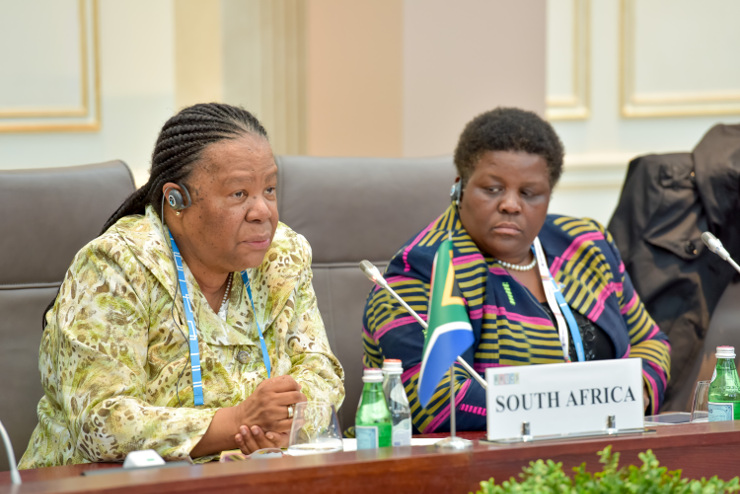
To quote her:
“And one thing I definitely dislike is being told, “either you choose this or else.”
“When a minister speaks to me like that, which Secretary Blinken has never done, but some have, I definitely will not be bullied in that way, nor would I expect any other African country worth its salt to agree to be treated.”
Even Uganda’s current president, Yoweri Museveni, who has been in power for 36 years and has always enjoyed bipartisan support from various US administrations, thinks that, as he recently told the BBC in a talk focused on Uganda’s relations with global partners, “trying to transplant the polarization of Europe [i.e., the geopolitics surrounding the ongoing Russia-Ukraine war] is a mistake, and those who are trying to do it, they are simply mimicking the European way of life.”
With most African states having refused to side with the US in the Russia-Ukraine war and/or maintaining a nonaligned stance, it becomes clear that the US strategy of countering Russia in Africa, with active help from the African states, is quite unlikely to get any traction, let alone find any meaningful success.
Despite the resistance to the US rhetoric of “choosing sides”, what also dims the chances of this strategy’s success is the extent of China’s investment in the continent, ranging from building dams, roads, highways, etc.
The US strategy gives no plan to roll back Chinese investment, which has increased from a meager US$490 million in 2003 to US$43.4 billion in 2020.
China has been ahead of the US since 2014 as Africa’s fourth largest investor. Why would African countries risk this investment by “choosing sides” to appease the US?
Wishful as it sounds already, Washington’s policy makes no sense either.
Therefore, while the US Africa strategy document acknowledges that the success of this strategy will not be “easy”, the most important thing making its success quite unlikely is the very anti-China and anti-Russia product that the US is seeking to sell.
There are simply no buyers for a strictly partisan form of geopolitics and geoeconomics.
*Salman Rafi Sheikh, research analyst of International Relations and Pakistan’s foreign and domestic affairs, exclusively for the online magazine “New Eastern Outlook”.
Join us on Telegram: t.me/theriotimes
This article was produced by The Rio Times’ automated AI newsroom. Editorial responsibility: Matthias Camenzind, Publisher and Editor-in-Chief. How we use AI · Report an error