Brazil Stocks Slip 0.5% as Real Weakens 1.4% | Brazil Market Report, Nov 10
Key Facts
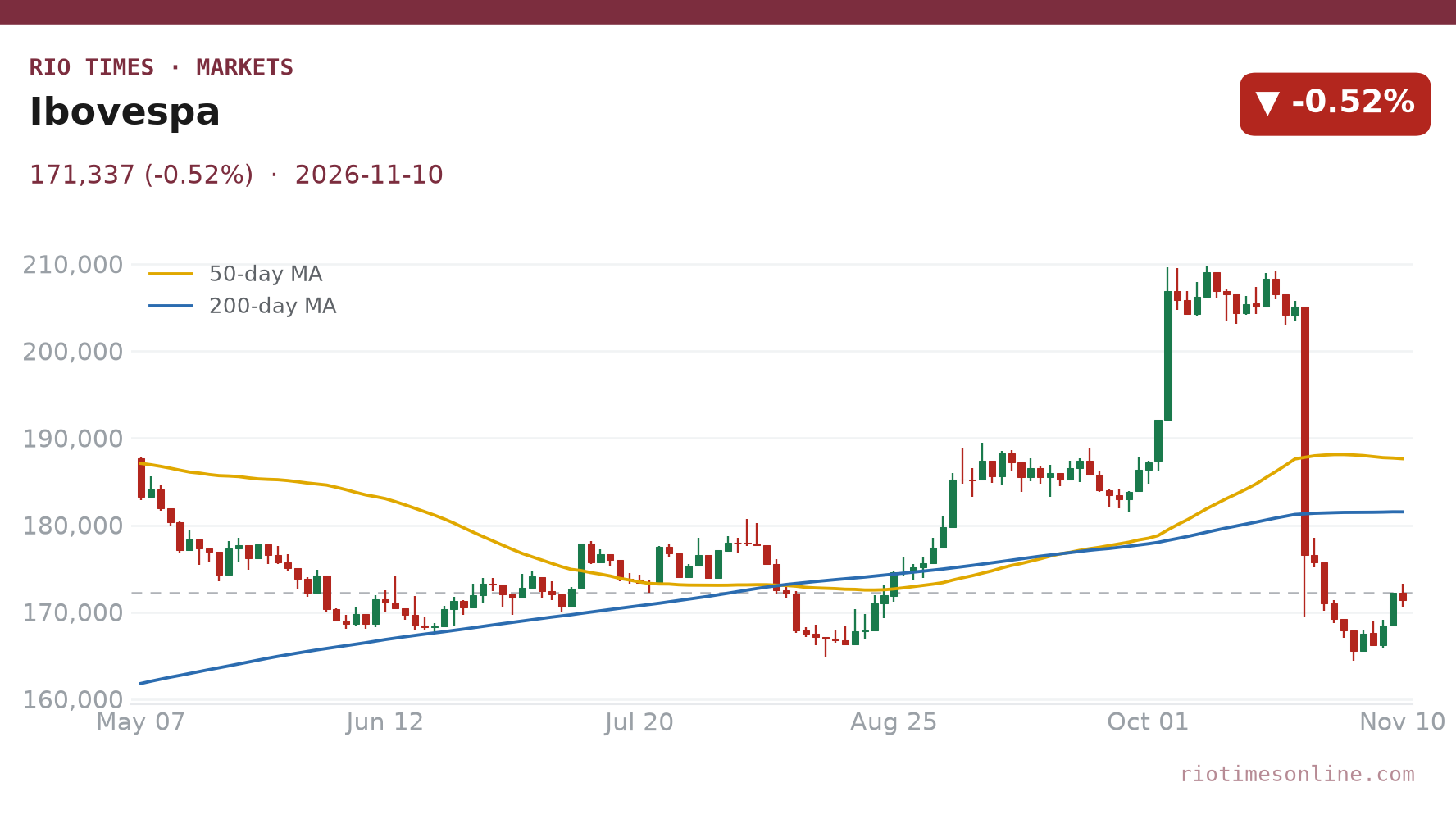
- Brazil’s main stock index, the Ibovespa, slipped 0.52% to 171,337, breaking a run of gains and leaving the index 18.0% below its 9 October peak of 209,067.
- The real lost 1.36% to the dollar and closed at 5.5833 per dollar, its weakest close in at least six months, with the dollar 11.06% dearer than 20 sessions ago.
- Hotter US inflation was the trigger, pushing the US 10-year Treasury yield to 4.99% and the dollar index up 0.55% to 102.22.
- History gives no clear call on the currency, because in 7 of 14 earlier moves this large the dollar was higher 20 sessions later.
- Latin American currencies fell together, with the dollar up 0.50% against the Mexican peso and 1.76% against the Chilean peso.
- Prediction markets: Polymarket, a platform where users bet real money, puts 90.5% on no change in Brazil’s interest rate in December (US$69,526 traded, 7:57 p.m. ET, 10 November 2026).
Today’s Focus
Brazil’s main stock index, the Ibovespa, slipped 0.52% to 171,337 on Tuesday 10 November, the latest settled session. The bigger story was the currency: the real lost 1.36% against the US dollar and closed at 5.5833, its weakest close in at least six months.
The spark came from Washington. US inflation data for October came in hotter than economists expected, which pushed the yield on 10-year US government bonds up 10 basis points to 4.99% and lifted the dollar everywhere.
Zoom out and the picture is stark. The Ibovespa is 18.0% below its 9 October peak of 209,067, and it has fallen 18.05% over the past 20 sessions, even though it has gained 3.51% over the past five.
For a newcomer, think of it as a sharp slide followed by a tentative bounce, now interrupted by a stronger dollar. The dollar has become 11.06% more expensive in reais over 20 sessions, and that is what drives the mood.
What matters today. A stronger dollar makes Brazilian assets cheaper for foreigners but makes life dearer for Brazilian importers, so the currency, not the index, is the number to watch.
01 The session in one read
Brazil’s stock market had a quiet fall on a loud day for currencies. The Ibovespa, Brazil’s main stock index and a basket of the country’s most traded companies, slipped 0.52% to 171,337.
The real, Brazil’s currency, took the real hit. It closed at 5.5833 per US dollar, which means a dollar bought 1.36% more reais than the day before.
That is the highest dollar close in at least six months, and it sits just 0.1% below the 12-month high of 5.59 set on 22 December 2025.
The evidence points outside Brazil: the dollar index rose 0.55%, the US 10-year yield jumped 10 basis points, and the S&P 500 fell 0.38%. Currencies across the region sank at the same time, which a purely Brazilian cause would not explain.
Brazil’s own worries, fiscal doubts and a central bank that has paused its rate cuts, add weight, but we rank them second because the Ibovespa’s fall was modest. The variable to watch is the US 10-year yield: while it stays near 5%, emerging-market currencies stay under pressure.
02 The day’s numbers
| Measure | Level | Change | Read |
|---|---|---|---|
| Ibovespa | 171,337 | −0.52% | Down 18.0% from its 9 October peak of 209,067 |
| Session range | — | — | Intraday high and low not verified |
| Dollar vs real | 5.5833 | +1.36% | Real weaker; dollar at its highest close in at least six months |
| Ibovespa 52-week range | 150,704 to 209,067 | — | 13.7% above the November 2025 low, 18.0% below the October peak |
| Dollar 52-week range | 4.89 to 5.59 | — | Within 0.1% of the 22 December 2025 high; 14.2% above the May 2026 low |
| Key technical level | 170,000 | — | Round number just under the close; first support to watch |
Read the table from the bottom up. The index is still far from its low of 150,704, set on 4 November 2025, but also far from the peak it hit a month ago.
The currency is the opposite: it is pressing against its own 12-month ceiling. Over 20 sessions the dollar has risen 11.06% against the real, an unusually fast move for a major currency. Rio Times · Live Market Intelligence
Live Market IntelligenceBrazil — Live Market Board
Brazil — Live Market Board
Instrument Last Change YoY Prev. High Low Volume
IBOV
171,336.99
-0.52%
+10.36%
172,236.05
173,272
170,569
—
USD/BRL
5.58
+1.35%
+5.54%
5.51
5.58
5.58
—
SELIC
13.75%
—
—
—
—
—
PETR4
44.95
-0.53%
+38.91%
45.19
45.68
44.50
54,961,500
VALE3
64.80
-1.98%
-0.63%
66.11
66.11
64.20
22,893,100
ITUB4
41.20
-1.25%
+4.94%
41.72
42.50
41.15
20,213,600
BBDC4
14.54
-0.95%
-23.79%
14.68
14.84
14.30
51,531,000
BBAS3
17.10
+0.47%
-24.93%
17.02
17.17
16.82
27,692,900
B3SA3
14.48
-2.49%
+10.37%
14.85
15.14
14.26
39,095,500
ABEV3
15.79
+1.15%
+19.80%
15.61
15.79
15.55
25,853,700
WEGE3
50.95
+0.41%
+12.30%
50.74
51.83
50.58
12,799,900
PRIO3
60.02
+1.06%
+53.00%
59.39
60.09
58.35
10,242,700
SUZB3
54.46
+0.48%
+16.62%
54.20
55.50
53.86
9,241,700
RENT3
29.79
-3.37%
-29.19%
30.83
31.29
29.70
13,596,000
AZZA3
14.73
-2.58%
-47.69%
15.12
15.55
14.52
2,463,700
CSNA3
4.38
-2.45%
-47.17%
4.49
4.57
4.36
18,925,300
GGBR4
25.83
+3.65%
+35.24%
24.92
25.93
25.14
9,678,500
ENEV3
27.05
-1.28%
+39.79%
27.40
27.74
26.75
8,263,300
03 Why it moved — hot US inflation and a firmer dollar
First and heaviest: US inflation for October beat forecasts, so traders now expect US interest rates to stay high or rise. The US 10-year Treasury yield rose 10 basis points to 4.99% — a basis point is one-hundredth of a percentage point — and the dollar index, a gauge of the dollar against major currencies, rose 0.55% to 102.22. Confidence: high.
Second: Brazil’s own central bank. The minutes of the Copom — the committee that sets Brazil’s benchmark interest rate, the Selic — were published on Tuesday on the central bank’s website (bcb.gov.br). The committee left the Selic unchanged at its 4 November meeting, so borrowing costs stay high, which supports the real in theory but also keeps growth under pressure. Confidence: medium.
Third: fiscal nerves. Doubts about government spending and debt may have added to the currency’s slide, although we cannot measure that from the daily figures. Confidence: medium-low, because the daily figures cannot isolate this cause.
The usual drivers mostly agree with the move. The S&P 500 fell 0.38% and gold, a classic refuge, fell too, a sign that investors were moving into dollars rather than into safety in general.
04 The day’s movers
| Driver | Level / Move | Change | Note |
|---|---|---|---|
| US dollar index | 102.22 | +0.55% | Dollar firmer against major currencies |
| US 10-year Treasury yield | 4.99% | +10 basis points | Higher yields pull money towards the US |
| S&P 500 | 7,521 | −0.38% | Wall Street fell after the inflation data |
| Oil fund (USO) | 141.45 | −0.85% | Down sharply over five sessions, hurting oil exporters |
| Gold fund (GLD) | 369.36 | −2.68% | Gold also sold as the dollar rose |
| VIX fear gauge | 19.46 | −2.31% | Calm enough: no panic, just repricing |
We have not verified company-level moves for the Brazilian session, so this table shows the forces behind the board rather than single stocks. The live market board above carries the individual closes.
The oil fund tells a longer story: it has fallen 10.57% over five sessions. Brazil is a big oil exporter, so cheaper crude weighs on the country’s energy sector and on its trade income.
05 The regional scoreboard
| Index | Country | Change |
|---|---|---|
| IPC | Mexico | −0.42% |
| IPSA | Chile | +0.07% |
Brazil’s 0.52% fall was close to Mexico’s 0.42% drop, while Chile’s IPSA edged up by 0.07%. We have no verified closes for the stock markets of Argentina, Colombia or Peru. The live board above carries the full closes.
Currencies told the sharper story. The dollar rose 0.50% against the Mexican peso, 1.76% against the Chilean peso and about 0.9% against the Colombian peso, while the Argentine peso was almost flat.
For Latin America this is a currency tax: countries that borrow in dollars or import fuel and food pay more. Exporters of commodities and tourism earn more reais, pesos and soles per dollar, but only if the move holds.
06 The technical picture
On the chart, 170,000 is the nearest round-number support for the Ibovespa, only just below Tuesday’s 171,337. Below it, the 12-month low of 150,704 is the floor that has held since November 2025.
Resistance is distant: the 9 October peak of 209,067 sits 18.0% above, and 180,000 is the nearest round number a rally would need to retake.
For the dollar, 5.59 is the ceiling to watch, because it is the December 2025 high and the market is within 0.1% of it. Above that, 6.00 is the round number traders will talk about, and 5.50 is the first support.
Our own price history since 2007 gives a sober reference. After 14 earlier 20-session dollar jumps this large, the dollar was higher 20 sessions later in 7 of 14 cases, or 50%, with a median change of −0.3%. The worst case was −11.4% and the best +14.8%; history is not a forecast.
07 What to watch
- US 10-year yield: The yield closed at 4.99%; a move above 5% would add pressure on the real and on other emerging-market currencies.
- Car data: Brazil’s October Auto Production (forecast +1.8% against −1.1% previously) and New Car Sales (forecast −0.8% against +2.3%) were due on 10 November; we do not yet have the results.
- Dollar at 5.59: A close above the December 2025 high of 5.59 would open the way to the 6.00 round number; a retreat towards 5.50 would signal relief.
- Ibovespa at 170,000: This round number is the nearest support; a close below it would put the 150,704 low back in view.
- Oil and iron ore: A further fall in crude after the 10.57% five-session drop would hurt Brazil’s export earnings and its energy-heavy index.
Background: Brazil Stocks Jump 2.2% on Wall Street Rally.
Background: Brazil Stocks Rise 1.39% on Tech Rebound.
What Prediction Markets Say
Polymarket, where users bet real money, lists a market on the Bank of Brazil’s December decision, with US$69,526 traded as of 7:57 p.m. ET, 10 November 2026. It prices no change at 90.5%, a 0.25-point cut at 6.6%, a 0.5-point or larger cut at 1.4%, a 0.25-point rise at 0.7% and a 0.5-point or larger rise at 0.6%.
These prices are bets, not polls. They show traders expect the central bank to hold its benchmark interest rate, the Selic, steady next month.
Why we show this: prediction markets turn real-money bets into a live probability that moves within minutes of the news, which is why investors, campaigns and newsrooms in the United States now follow them closely. We show them next to polls and official results, never instead of them.
Frequently Asked Questions
Why did the Brazilian real weaken on Tuesday?
US inflation data came in hotter than expected, pushing US bond yields and the dollar higher. The dollar bought 1.36% more reais, closing at 5.5833.
Where is the Ibovespa compared with its recent high?
It closed at 171,337, which is 18.0% below its 9 October peak of 209,067. It is still 13.7% above its 12-month low of 150,704.
What does a weaker real mean for travellers and expats?
A dollar buys more reais, so visitors and dollar earners find Brazil cheaper. Brazilians buying imports or travelling abroad pay more.
Does the history of big dollar jumps suggest what comes next?
In our records since 2007, the dollar was higher 20 sessions later in 7 of 14 comparable cases. The median change was −0.3% and history is not a forecast.
Market data: The Rio Times; exchange figures from B3
This article was produced by The Rio Times’ automated AI newsroom. Editorial responsibility: Matthias Camenzind, Publisher and Editor-in-Chief. The Rio Times also runs Ask Rio Times, which answers from 100,000+ of our own articles, the daily Latin America Power Map, and prediction-market odds on elections and markets.. How we use AI · Report an error
LatAm Markets: Live Signals → — real-time movers, turnover leaders and FX across Latin America.
Brazil runoff, Sunday, October 25: Brazil runoff date. Latest: Brazil runoff polls, Flávio 51%, Lula 49%.
Get The Rio Times delivered to your inbox — market intelligence, daily briefs, and breaking analysis across Latin America.
Start for US$1