Brazil Coffee Exports to US Jump 86% in September

MARKETS · BRAZIL
Key Facts
- —The country Brazil is the world’s largest coffee grower and exporter, and the United States, its traditional top customer, has just regained first place.
- —Why it matters US cafés and roasters depend on Brazilian beans. Shipments to the US fell sharply while Washington’s tariffs on Brazilian coffee were in force.
- —Why now Brazil’s coffee exporters’ council, Cecafé, published its September data on Friday 9 October, after US buying picked up in August and September.
- —What happened The US bought 625,192 bags of Brazilian coffee in September, up 86.4% from 335,339 a year earlier, and regained first place among buyers for 2026.
- —The numbers Brazil shipped 3.894 million 60 kg bags in September, up 3.1%, but earned US$1.282 billion, 7.1% less than a year ago.
- —What it means for you More Brazilian beans are flowing to US ports again, while the price Brazil earns per bag has fallen.
- —Still open Whether US purchases recover to 2025 levels by December, and how the next Brazilian crop fares through the flowering season.
Brazil coffee exports to the United States nearly doubled in September, as American buyers returned after Washington removed its tariffs on Brazilian coffee. The country’s exporters’ council reported on Friday that US purchases rose 86.4% from a year earlier. For American coffee drinkers and roasters, it means the world’s largest supplier is shipping to the US at close to normal pace again.
The figures come from the monthly report of the Conselho dos Exportadores de Café do Brasil (Cecafé), the trade body for Brazil’s coffee exporters. Founded in 1999, it says its more than 100 members, from exporters and producers to cooperatives, make up 96% of the players in Brazil’s coffee export market.
The US imported 625,192 bags of all types of Brazilian coffee in September, against 335,339 bags in the same month of 2025. A standard bag holds 60 kilograms.
How the US Took First Place Again
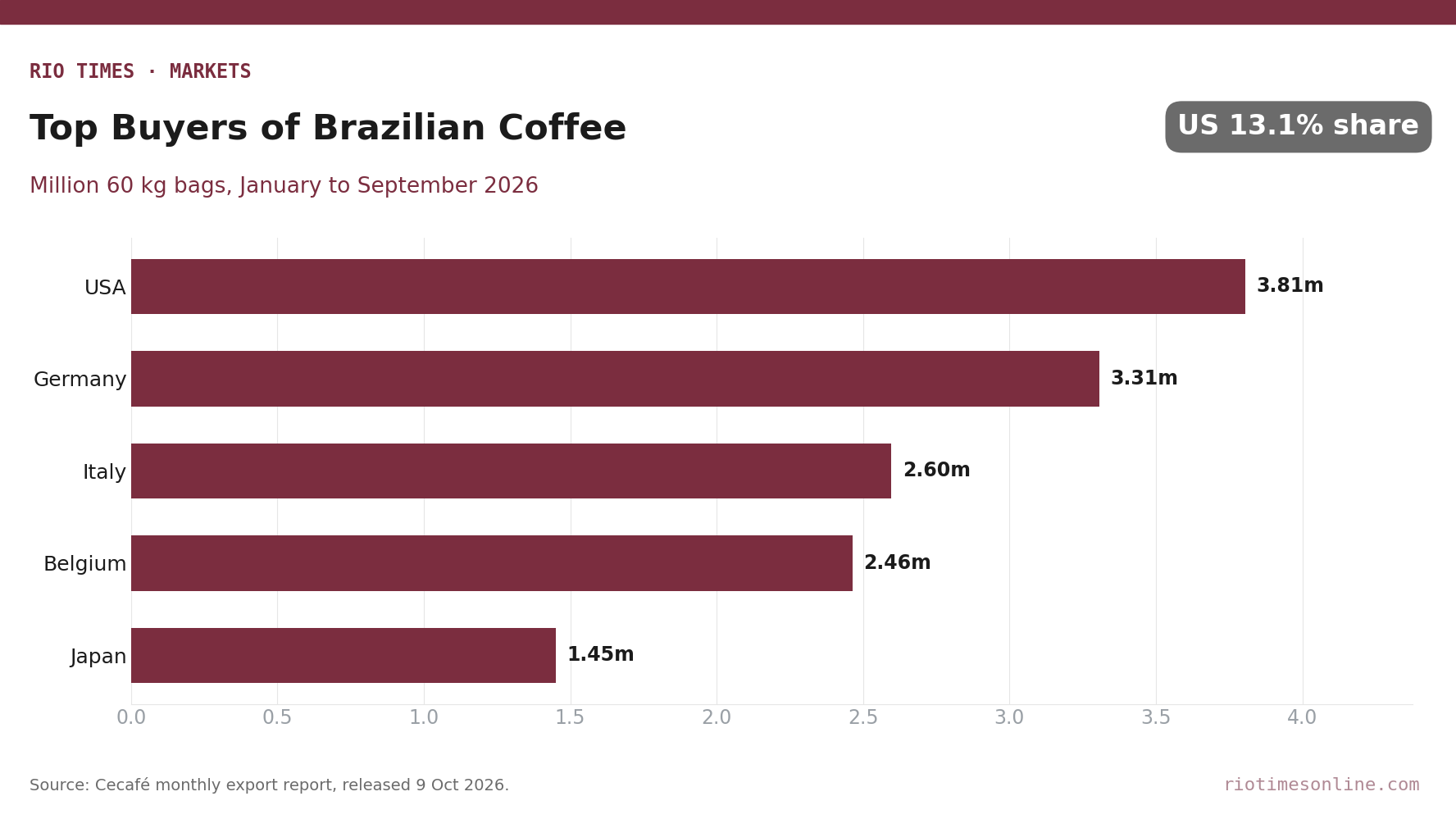
With strong purchases in August and September, the United States has overtaken Germany as the top buyer of Brazilian coffee for the first nine months of 2026, Cecafé said.
American buyers took 3.805 million bags from January to September. That is 13.1% of everything Brazil shipped, though still 12.8% below the same period of 2025.
Germany came second with 3.307 million bags, down 11.4% from 3.732 million a year earlier. Italy followed with 2.597 million bags, up 11.6%. Belgium took 2.463 million, up 44.5%, and Japan 1.451 million, down 23.3%.
The US also leads in what Cecafé calls differentiated coffees: specialty, certified and higher-quality lots. It bought 813,829 bags of them, 16.4% of that segment.
Why US Buyers Came Back
Cecafé president Márcio Ferreira linked the recovery directly to the end of tariff uncertainty in Washington.
“In November 2025, the US removed the tariff on most of the Brazilian product, but until July this year soluble coffee was still taxed,” he said in the council’s statement.
According to Ferreira, the council worked with the US National Coffee Association, the main American industry group, and with Brazil’s government. He said they secured confirmation that green coffee stayed exempt in new US investigations, and that soluble coffee was added to the exception lists.
That, he said, made bilateral trade clearer and allowed business to resume. CNN Brasil, reporting the same data, described the soluble-coffee exemption as dating from July 2026.
Volumes Up, Revenue Down
The recovery in Brazil coffee exports has not lifted earnings. Brazil shipped 3.894 million bags in total in September, 3.1% more than the 3.778 million of September 2025. Export revenue fell 7.1% to US$1.282 billion.
By our calculation, that is roughly US$329 a bag, against about US$365 a year earlier.
For January to September, Brazil exported 29.095 million bags, almost unchanged (down 0.2%). Revenue fell 8.6%, from US$11.065 billion to US$10.113 billion.
Ferreira gave three reasons: lower international prices, weaker quality in early arabica lots damaged by rain, and a bigger share of cheaper canephora beans. Canephora, which covers conilon and robusta, rose 68.3% to 5.162 million bags. Arabica still made up 71.3% of shipments, at 20.739 million bags, but fell 10.7%.
The new crop has started to flow. The first three months of the 2026/27 crop year, July to September, brought 11.210 million bags, up 15.5%, with revenue up 0.8% at US$3.561 billion. Ferreira said rain had delayed the harvest, mainly in July, and new beans appeared for export from August.
What It Means for You
For US roasters and importers, the main change is supply certainty. Most Brazilian coffee has entered the US without the extra tariff since November 2025, according to Cecafé, and soluble coffee has now joined it.
Lower revenue per bag tells a second story about Brazil coffee exports. Brazil is earning less for each sack it sells. That can ease cost pressure for buyers, though retail prices on US shelves depend on roasters, retailers and futures markets, not on one month of export data.
There are risks on the other side. Rain hurt the quality of part of the arabica crop, and the next harvest depends on the weather during the flowering season. Cecafé expects exports to keep rising and to overtake last year’s total by the end of 2026, but that is a forecast, not a result.
For investors, the shift towards cheaper robusta and conilon beans matters for blends and pricing across the coffee chain. It also follows a wider pattern: Brazil Beef Exports to US Jump 524% in September, another product freed from the extra tariff. Brazil’s main rival for premium arabica is also under pressure, as Colombia Coffee Output Drops 15% to 12.7 Million Bags.
What Is Not Known
Cecafé did not say how much of September’s US volume was green coffee and how much was soluble. It also did not publish US-bound revenue separately in its statement.
It is not clear whether US buying will close the remaining 12.8% gap with 2025 by December. The council’s forecast covers total exports, not the US alone.
The details of the new US investigations Ferreira mentioned, and whether they could affect Brazilian coffee again, were not set out in the statement.
Most shipments still leave through the port of Santos, which handled 20.573 million bags, or 70.7%, from January to September. The Rio de Janeiro port complex handled 7.335 million bags, or 25.2%.
Frequently Asked Questions
Why did Brazil coffee exports to the US rise in September?
Cecafé says US buyers returned after tariffs ended. Most Brazilian coffee was freed from the extra US tariff in November 2025, and soluble coffee joined the exception lists in July 2026.
Is the United States the biggest buyer of Brazilian coffee?
Yes, again. From January to September 2026 the US bought 3.805 million bags, 13.1% of Brazil’s exports, ahead of Germany with 3.307 million bags.
Why is Brazil earning less from coffee if volumes are up?
Cecafé cites lower international prices, rain damage to early arabica lots and a larger share of cheaper robusta and conilon beans. September revenue fell 7.1% to US$1.282 billion.
Sources: Cecafé, monthly export report for September 2026, released 9 October 2026 (cecafe.com.br); CNN Brasil, “Brasil exporta 3,9 milhões de sacas de café em setembro, com alta de 3,1%”, 9 October 2026 (cnnbrasil.com.br).
Editorial responsibility: Matthias Camenzind, Editor-in-Chief · Editorial standards · Report an error
LatAm Markets: Live Signals → — real-time movers, turnover leaders and FX across Latin America.