Brazil’s Lower House Votes on Spending Curbs
Brazil’s lower house takes up a bill to cap spending and trim tax breaks, and lawmakers disagree on how much it saves.

Politics: Brazil
Brazil’s Chamber of Deputies, the lower house of Congress, opens debate on Monday 23 November 2026 on a bill that would make President Luiz Inácio Lula da Silva’s government spend less and collect more next year. The bill, known as PLP 299/2026, has already cleared the Senate, and the Chamber’s session is set for Monday evening, according to the Chamber’s news service.
The Chamber’s rapporteur, Deputy Mauro Benevides Filho, has said he will change nothing, so the text can go straight to the president for signature. Whether the vote ends tonight is not yet known, because the Chamber says it depends on how long the discussion phase lasts.
Key Facts
- What. A fiscal bill, PLP 299/2026, that tightens the spending cap and trims tax breaks.
- Savings. Estimates of 2027 savings range from US$7.6 billion to US$11.9 billion.
- Next. The vote may finish on Tuesday 24 November; then the bill goes to Lula.
- Power Index. Brazil ranks 1st of 14 in The Rio Times Latin America Power Index, with 74.2 points (November 2026 edition).
- As of. Monday 23 November 2026, 11:30 GMT.
Brazil’s lower house takes up a bill to cap spending and trim tax breaks, and lawmakers disagree on how much it saves.
The bill answers a hole in the budget, since the Chamber’s news service said on 23 November that 2026 will close with a deficit of about R$52 billion (about US$8.8 billion), and the aim is a primary surplus of R$18.7 billion (US$3.2 billion) in 2027. A primary surplus means the government takes in more than it spends before paying debt interest, and amounts here convert at R$5.91 per US$1, the RT market rate on the morning of 23 November.
The size of the saving depends on who is counting, because the Senate’s budget staff estimated a R$45.1 billion to R$56.1 billion (US$7.6 billion to US$9.5 billion) improvement in the 2027 primary result, while the Chamber’s news service put the figure at R$70.6 billion (US$11.9 billion) on 23 November. The two figures may use different assumptions, and neither institution has explained the gap.
The bill works through several levers: it lowers the cap on real spending growth, meaning growth above inflation, from 2.5% to 2% from next year in years when the government adopts containment measures, the Senate said on 17 November. It also lets the government freeze more spending than the Fiscal Responsibility Law now allows, cuts some tax incentives, and allows limits on how companies offset tax credits against federal tax bills.
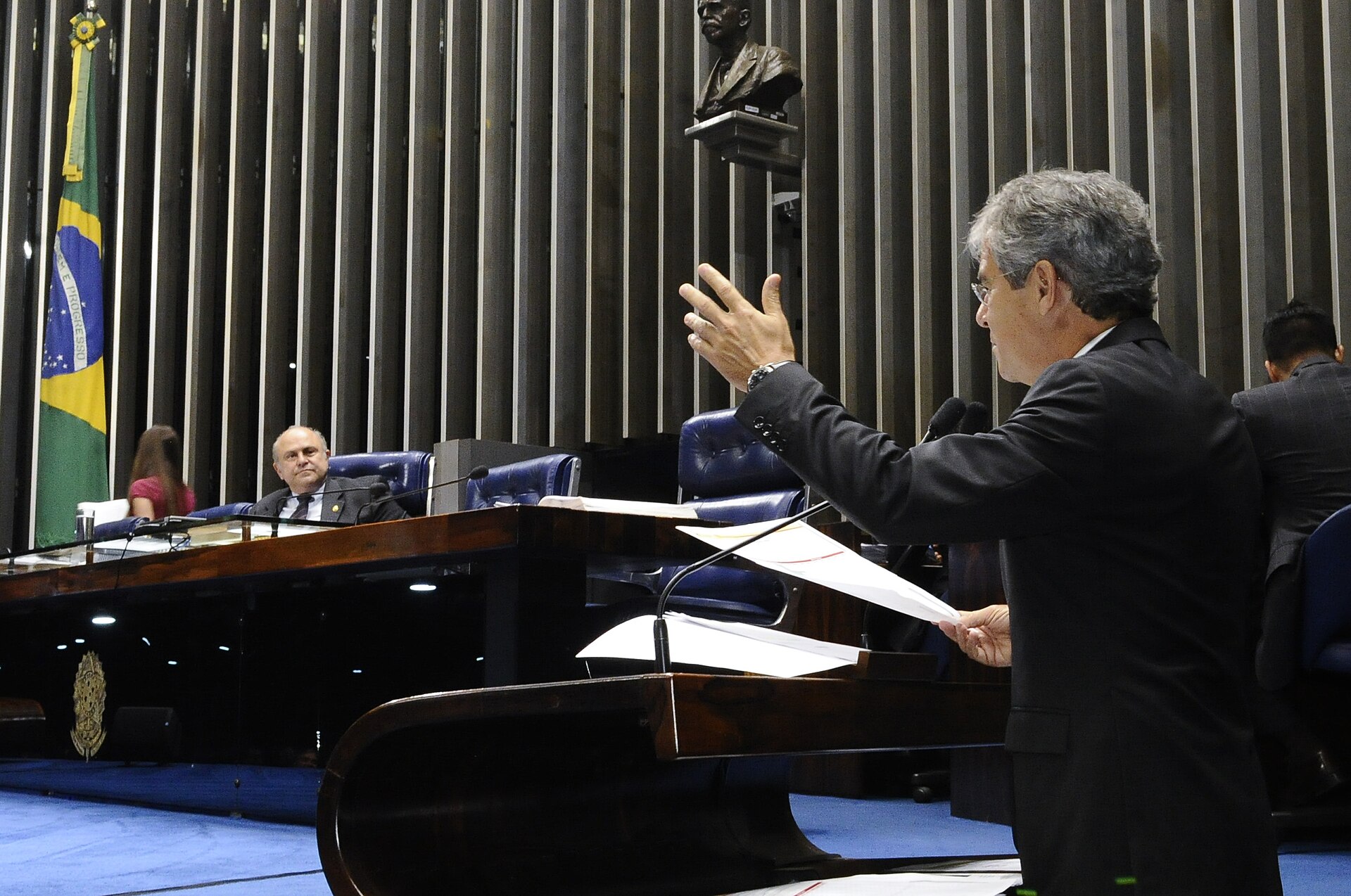
The Senate rejected the opposition’s main amendments on 18 November, by 47 votes to 30 and 49 to 31, before approving the bill 69 to 2. The bill also cuts the annual federal payment to states under the Kandir Law, a compensation scheme for exporters’ lost state tax, and a Senate deal set a floor of R$2 billion (US$0.3 billion) a year.
Chamber president Hugo Motta, of the Republicanos party, has pushed the bill through at speed, and he says the country needs a stronger adjustment. The Chamber’s news service quoted him on 23 November: “Nós precisamos garantir um ajuste econômico e fiscal mais robusto para o país.”
The opposition wants a harder line, and Senator Rogério Marinho of the Liberal Party, the opposition leader, proposed on 17 November to cut the spending cap from 2% to 0.6% above inflation, an amendment the Senate rejected by 47 votes to 30 on 18 November. Senator Alan Rick of Republicanos sought to strip out the power to limit tax-credit offsets.
Senator Eduardo Braga of the Brazilian Democratic Movement (MDB), the bill’s rapporteur, or lead lawmaker on the text, in the Senate, proposed a deal on one of the amendments, and the Senate says it produced an agreement on transfers to states and municipalities. The earlier debate over Lula’s weak hold on a divided lower house shows why the rapporteur wants no changes: any amendment would send the bill back to the Senate.
For foreign investors, the test is credibility rather than size, and a lower spending cap, if it holds, would slow federal spending growth in 2027, and the bill lets the government freeze money if revenue falls short. The government has not said how much of the saving depends on the tax-credit limits, which companies can challenge.
Chamber president Hugo Motta expects to finish the analysis by Tuesday 24 November, according to the Senate’s news service. If the Chamber approves the text unchanged, Lula’s signature is the last step before the new rules can apply from 2027.
Frequently Asked Questions
What does the bill do?
It tightens the limit on federal spending growth and gives the government more tools to freeze money and trim tax breaks. The aim is a smaller budget gap in 2027.
When does it become law?
If the Chamber passes the text without changes, it goes to President Lula for signature. Any change would send it back to the Senate.
Why does it matter outside Brazil?
Investors read Brazil’s spending discipline as a sign of how safely it can borrow. A weaker plan would push up the cost of that borrowing.
Sources: Chamber of Deputies, Plenary agenda and news service, 18 and 23 November 2026 (camara.leg.br); Federal Senate, news service, 17 and 19 November 2026 (senado.leg.br); RT exchange rate, 23 November 2026.
This article was produced by The Rio Times’ automated AI newsroom. Editorial responsibility: Matthias Camenzind, Publisher and Editor-in-Chief. The Rio Times also runs Ask Rio Times, which answers from 100,000+ of our own articles, the daily Latin America Power Map, and prediction-market odds on elections and markets.. How we use AI · Report an error
Brazil runoff, Sunday, October 25: Brazil runoff: date, poll closing times and when results start. Latest: Brazil runoff polls, Flávio 51%, Lula 49%.