Days Before Brazil Votes, a Patron-Saint Row Pulls In Bishops and Judges
BRAZIL · ELECTION 2026
Key Facts
- —The country Brazil, Latin America’s largest democracy, holds the first round of its presidential election on Sunday 4 October.
- —Why it matters A story, reported as false, that Flávio Bolsonaro would demote Our Lady of Aparecida is now a fight over policing campaign speech.
- —What happened On Sunday 27 September the candidate said “people inside” the Catholic bishops’ conference helped spread it. The bishops denied it that evening.
- —Who is involved Electoral-court president Kassio Nunes Marques was due to raise a colleague’s ruling with Supreme Court president Edson Fachin on Monday 28 September.
- —What it means for you Expect more clashes between courts, church and campaigns over online posts this week. The voting date and rules are unchanged.
- —Still open When the full Supreme Court rules on Dino’s decision, what Fachin will do, and whether the row moves any Catholic voters.
Six days before Brazil votes, a story about Our Lady of Aparecida, the country’s patron saint, has reached its Catholic bishops. It has also exposed an open feud among Brazil’s top judges.
The story claimed that presidential candidate Flávio Bolsonaro, the former president’s eldest son, wanted to strip the saint of her official title. He denies it, and Estadão, O Globo and Correio Braziliense all describe it as false.
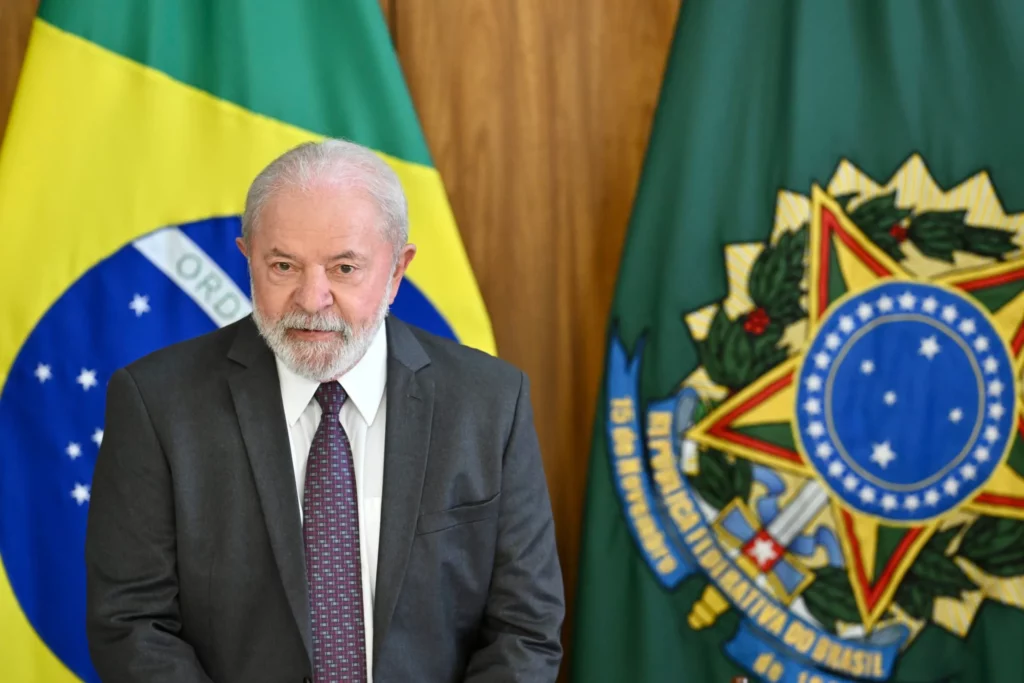
The candidate and the bishops
Campaigning in Goiânia on Sunday, Flávio said President Lula’s Workers’ Party (PT) had spent days trying to launch the story. It succeeded, he said, “with the help of people inside the CNBB”, Estadão and O Globo reported.
The CNBB, the National Conference of Bishops of Brazil, replied that evening. It said it had not “produced, authorised or taken part” in spreading false election information, CNN Brasil and CartaCapital reported.
Blaming it without “facts and proof”, the bishops said, “unjustly harms the institution”. Their note ended: “A lie is not fought with another lie.”
A feud inside the courts
On 25 September, electoral-court vice-president André Mendonça ordered posts repeating the claim removed. The Superior Electoral Court (TSE) runs and polices Brazilian elections.
On Sunday, Supreme Court Justice Flávio Dino voided that order at a comedian’s request. He found no “degree of certainty of illegality” to justify curbing free expression, Folha and O Globo reported.
Flávio’s campaign said it was perplexed that a body outside the electoral courts had “usurped” the TSE’s role, Estadão reported. The TSE’s president, Kassio Nunes Marques, is preparing a response, according to Folha.
Folha reported that he would press Fachin on Monday for rules against steering cases to hand-picked judges. CNN Brasil said he describes the pattern privately as a “parallel TSE”.
On Monday, Dino sent his ruling to the full Supreme Court, CNN Brasil and O Globo reported. Flávio’s lawyers have asked Justice Luiz Fux to suspend it, G1 and Poder360 reported.
In an editorial headlined “Dino acts to re-elect Lula”, Estadão called the ruling “exclusively political”. Dino served as Lula’s justice minister before joining the court.
On the campaign trail
Fernando Haddad, the PT’s candidate for São Paulo governor, attended Mass at the city’s Sé Cathedral on Sunday. Afterwards he accused Flávio of religious intolerance, Jovem Pan and O Globo reported.
Ronaldo Caiado, a former Goiás governor running for president for the PSD, rebuked Flávio on Monday. “Have respect for religions and for the faith of the Brazilian people,” he wrote, Correio Braziliense reported.
What Is Not Yet Known
No outcome of the Nunes Marques–Fachin meeting had been reported by Monday afternoon. Nor is it clear whether Fachin will change how cases are assigned.
Fachin must set a date for the full court to judge Dino’s ruling, and none had been announced. According to O Globo, Flávio has named no one and offered no evidence against the bishops.
Sources: Estadão; O Globo; CNN Brasil; CartaCapital; Folha de S.Paulo; CNN Brasil (Caio Junqueira); Estadão (campaign note); Estadão editorial; Jovem Pan; Correio Braziliense; CNN Brasil (plenary referral).
This article was produced by The Rio Times’ automated newsroom system. How we use AI · Report an error
Read More from The Rio Times