Asia Intelligence Brief — Thursday, September 24, 2026
Executive Summary
Asia Intelligence Brief for 24 September 2026: India doubts the count and turns on its election referee, Dhaka adds up what a 20-taka fuel rise costs a.
Asia Intelligence Brief — Thursday, 24 September 2026

Asia is arguing with its own institutions this week, and the loudest arguments are in the south. India is quarrelling over whether its electoral roll can be believed, Sri Lanka over whether its judges should sit longer, and Nepal over why its state still cannot count its own dead.
The region’s temper is suspicion rather than fear. What is being doubted is not a policy but a referee, a commission, a court, a register, and the doubting is being done by lawyers, doctors, rickshaw drivers and opposition benches at the same time.
Delhi’s quarrel reached the pavement on Thursday. Rahul Gandhi called the prime minister and the chief election commissioner traitors, and a satirical youth movement gave the commissioner forty-eight hours to resign.
Dhaka is answering a price rather than a principle. Three days after every fuel rose by 20 taka (about US$0.16) a litre, the argument has shrunk to what a day on a rickshaw now yields, and the state minister for energy has apologised for it.
Colombo votes on Friday evening on whether its judges may sit to 67. Forty professional bodies and the Bar Association are against it, and the justice minister answers with 1.1 million cases waiting in the courts.
What ceremony there is belongs to Beijing. Xi Jinping was received on the South Lawn with a band and a fly-past, and the one firm thing to come out of the visit, a tariff truce carried forward to 10 January 2027, was settled the day before by an American official.
Key Facts
Delhi Doubts The Count And Turns On Its Referee
India spent Wednesday and Thursday arguing not over who should govern it, but over whether the count that produced its government can be believed. Rahul Gandhi, who leads the opposition in the lower house of parliament, called the prime minister, the home minister and Gyanesh Kumar, the chief election commissioner, “deshdrohis”, meaning traitors, at a press conference reported by the Deccan Chronicle, a Hyderabad English daily.
The quarrel began with a report in the Indian Express, a Delhi daily, that two of the three members of the Election Commission had objected in writing to the way the voter lists were being rewritten. A reader should know that the commission is India’s constitutional referee, answerable to no minister, and that its Special Intensive Revision is a house-to-house re-verification of who may vote.
The scale is disputed as sharply as the motive. Countercurrents, a left-wing Indian website, put the removals, a figure the opposition has pressed, at about 13 crore names, some 130 million, across thirty states and territories; OpIndia, a Hindu-nationalist site, wrote on 23 September that the same figure describes draft lists rather than final exclusions, so the two accounts differ on what the number measures at all.
The dissenting commissioners, Sukhbir Singh Sandhu and Vivek Joshi, recorded objections on at least fourteen occasions over ten months, calling one procedural change “unauthorised” and “illegal” and warning of a “gradual centralisation of the electoral roll database”, NewsX, a Delhi television news channel, reported on 23 September. The commission answered the same day that “Differing views and observations are a normal part of deliberation in any institution”.
The governing Bharatiya Janata Party answered with arithmetic, its national spokesman Sambit Patra telling The Wire, a left-leaning Delhi site, that the argument inside the commission was “a sign of a healthy democracy”. In the twenty seats where most names were struck off in the eastern state of West Bengal, he told the Indian news agency IANS on 23 September, the regional Trinamool Congress won thirteen and his own party six, and he asked: “If we (BJP) have stolen votes, then how did some other party win on these seats?”
Mr Gandhi went further than his party has before, calling the 2024 general election “completely fake” and promising that “traitors will definitely be punished”, with The Tribune, a Chandigarh liberal daily, recording his claim of “a 100 per cent certainty, not 99 per cent”. Against him stands a judgment his side seldom mentions: on 27 May the Supreme Court upheld the revision, finding it bore “a direct nexus to the constitutional goal of free and fair elections”, as Business Standard, a New Delhi business daily, reported.
By Thursday the quarrel had left parliament for the pavement. The Cockroach Janta Party, the satirical youth movement whose July protests drove the education minister from office, gave the commissioner forty-eight hours to resign, its founder Abhijeet Dipke telling ThePrint, a Delhi digital daily, that it would otherwise “start a nationwide agitation”.
The left pressed from the other flank, the politburo of the Communist Party of India (Marxist) saying on 23 September that he “cannot continue in office any longer”, in a statement carried by the Indian news site Social News XYZ. Mr Patra answered for the governing party that neither the commission “nor any constitutional body in India is under dictatorial rule”, he told the same site.
Money moved for reasons of its own, and the week’s temper did not help. The Sensex, the Bombay Stock Exchange’s benchmark of thirty large companies, closed on Thursday at 73,580.54, down 1,247.71 points or 1.67 per cent, a fall that Business Standard and The Sunday Guardian, a Delhi conservative weekly, both laid to rising American bond yields and dearer oil rather than to the political row.
India felt pressed from outside as well, and answered carefully. The external affairs minister, Subrahmanyam Jaishankar, met the American secretary of state, Marco Rubio, in New York on 23 September and said he had “Reiterated India’s interests and concerns with regard to SRIA”, the Sanctioning Russia and Iran Act, the new American statute allowing tariffs of up to 100 per cent on the largest buyers of Russian oil, of which India is the second biggest, The Week, an Indian news weekly, reported.
Dhaka Adds Up What Patience Costs
Bangladesh is not shouting this week so much as counting. Three days after the pumps changed, the quarrel over fuel has shrunk to the size of a household ledger, and what carries in Dhaka is less fury than the flat voice of people redoing their sums.
Mokbul Mia has pulled a pedal rickshaw in the capital for twenty years and takes 300 to 400 taka (about US$2.44 to US$3.26) on a day, of which 150 taka (about US$1.22) goes to the machine’s owner. He does not know how he will buy food or medicine, he told bdnews24.com, a Dhaka news site, on 22 September, and ended in three words: “Only God knows.”
Among those who drive for a living the note is resignation rather than revolt. Touhidul Islam, who rides a motorcycle for a hailing app, told The Business Standard, a Dhaka business daily, on 23 September that a whole day now yields about 1,000 taka (about US$8.14) where 1,500 to 2,000 taka (about US$12.21 to US$16.28) once remained, and that he sets his own complaints aside because he has a family to run.
Fares moved before the state did. Operators began charging more from the Monday, before any official chart existed, and Dhaka’s oldest financial daily, the Financial Express, reported passengers on one cross-city route alleging that fares had doubled; the government then set a city bus at 2.70 taka (about US$0.022) a kilometre, up from 2.53 taka (about US$0.021), and the minister for railways, roads and shipping, Shaikh Rabiul Alam, warned that operators charging extra “will be fined under the law. After that, you will not be given a route permit again”.
The government has answered with a ledger and an apology. Bangladesh Petroleum Corporation, the state importer that supplies the country’s fuel, lost 228.75 billion taka (about US$1.86 billion) between March and August by holding prices below world levels, the state minister for power, energy and mineral resources, Anindya Islam Amit, said, adding, as the Daily Star, a Dhaka English-language daily, reported on 21 September: “I sincerely apologise to them.”
He has also promised that the rise is temporary, and his opponents dispute the arithmetic behind it. Mr Amit said on 23 September that prices would fall once the international market stabilised, according to the private news agency United News of Bangladesh; Masud Rana of the Marxist party Bangladesher Samajtantrik Dal told the Daily New Nation, a Dhaka daily, that the same importer had banked about 520 billion taka (about US$4.23 billion) of profit over eleven years.
In the factories that earn most of the country’s foreign currency, the mood is arithmetic as well. Reuters, in a report the Karachi business daily Business Recorder carried on 22 September, quoted the garment exporter Shahidullah Azim saying “Our margins are already very thin”, and Mohiuddin Rubel of Denim Expert Ltd, which supplies the retailer H&M, saying that holding Bangladesh’s place against rival sourcing countries “depends on how well we manage it”.
The newest shortage is at the stove, and the prime minister is in New York asking Iran for help. Prothom Alo, the country’s largest-circulation daily, reported on 24 September that twelve-kilogram cooking-gas cylinders were selling above 2,000 taka (about US$16.28) against a regulated 1,585 taka (about US$12.90), and that Tarique Rahman asked Iran’s president at the United Nations to release Bangladeshi ships stranded in the Strait of Hormuz once the war ends.
Colombo Weighs Its Judges Against Its Queues
Sri Lanka has stopped litigating and started arguing, and the temper in Colombo is suspicion rather than anger. Hardly anyone denies that the courts are slow; the question that filled Thursday was whether the National People’s Power, the left-wing movement swept into office in 2024 in rejection of the old political class after the 2022 economic collapse, can be trusted with the people who would judge it.
The government has now put its case on the floor in its own words. Opening the two-day second-reading debate on 24 September, the minister of justice and national integration, Harshana Nanayakkara, said the changes were not meant to establish authoritarianism or suppression but to hear cases quickly and ensure fairness, Ada Derana, a Colombo broadcaster’s news site, reported from a ministry statement.
His argument is a queue, not a principle. He told parliament that about 1.1 million cases sit in the system and that Sri Lanka has roughly nineteen judges for every million people against about fifty-one in England and forty-four in Australia, and that today “people spend years attending courts while cases are repeatedly postponed”.
What the bill itself does is narrow, which is part of why it alarms people. It would lift the retirement age of Supreme Court judges from 65 to 67 and of Court of Appeal judges from 63 to 65, and it would cap the chief justice’s tenure at six years or at the age of 67, whichever comes first. After 67 petitions the Supreme Court told the Speaker on 22 September that it needs a two-thirds majority but no referendum, Lanka News Web, a Colombo news site, reported; the vote falls at seven on Friday evening, 25 September.
The opposition took the fight outside on Thursday morning. The Samagi Jana Balawegaya, the main opposition party, blocked the Polduwa Junction approach to parliament and snarled the roads around it, and its leader, Sajith Premadasa, had already set the terms: “The government may have 159 seats, but this amendment must be defeated through the strength of the people,” he said on 20 September, the Colombo news site Newswire reported.
The lawyers went not to the streets but to consciences. The Bar Association of Sri Lanka asked every party on 23 September to let its members vote as they see fit, noting that in 48 years many amendments had passed legal muster and still had “a negative effect on democracy, constitutionalism, the independence of the judiciary and the rule of law”, Ada Derana reported.
What makes this feel national rather than parliamentary is the breadth of the objection. Forty professional bodies and unions, among them the Government Medical Officers’ Association, the Government Nursing Association and the Railway Station Masters’ Union, joined the lawyers on 31 August in saying judicial power forms part of the sovereignty of the people, the Sri Lankan news portal Onlanka reported; at a Colombo rally on 3 September the Associated Press reported banners reading “Don’t touch the judiciary”.
Underneath the constitutional language is a suspicion about one man’s clock. The court required a proviso sparing whoever is chief justice when the act begins from a new six-year limit, and the bench that ruled was headed by the present chief justice, Preethi Padman Surasena; the Colombo business site Financial Chronicle, which noted that nothing improper follows from that, asked on 24 September who exactly gets the extra two years and from when.
Kathmandu Counts Its Dead And Cannot Agree On The Number
Nepal is four weeks into a grief it cannot finish, because the state still cannot say how many of its people are gone. The flood that came down the Bhotekoshi on 26 August, after a glacier collapsed high in the Himalaya near the Tibetan border, left a body count that creeps and a missing list that lurches.
Khabarhub, a Kathmandu news portal, reported on 22 September that 1,451 bodies had been recovered and 4,718 people were missing; the Kathmandu Post, a liberal Kathmandu daily, wrote on 24 September that at least 1,436 were dead and 5,644 missing. The two counts differ by more than nine hundred missing, because the police, the disaster authority and the prime minister’s own rescue portal each keep a separate register of the missing, which in early September held 4,077, 5,132 and 12,641 names, Nepal News, the country’s first online news portal, reported on 10 September.
On the ground the feeling is less grief now than exhaustion. Survivors on the far bank of the Trishuli walk five or six hours to reach a tuin, a basket slung from a steel cable, which the able-bodied must help haul themselves, then wait four or five hours more for a turn, and Gokarna Adhikari of Dandathok told the Kathmandu Post on 23 September that “It is an ordeal just to get across the river”.
The charge in parliament is incompetence rather than bad luck, and it is aimed at a novice government: Balendra Shah, a rapper and former mayor of Kathmandu, took office on 27 March after his young Rastriya Swatantra Party swept the election that followed last year’s Gen Z revolt. Bhishma Raj Angdembe of the opposition Nepali Congress said the government “focused more on managing publicity than saving lives”, as Online Khabar, a Kathmandu news site, reported on 2 September, and the former prime minister Pushpa Kamal Dahal told the house that it “has not succeeded in rescue operations; it has failed”, in New Spotlight Magazine, a Kathmandu weekly, of 8 September.
The government’s answer is a ledger. The energy minister, Biraj Bhakta Shrestha, told the lower house on 23 September that more than 800 hydropower workers were still missing, that the state had “accorded high priority to the search and rescue of people trapped inside underground hydropower structures”, and that families of missing power-authority staff would receive 500,000 rupees (about US$3,260) at once, the Kathmandu Post reported, while Nepal News put preliminary damage to the power sector at 390.62 billion rupees (about US$2.55 billion).
Unable to settle the argument at home, Mr Shah took it abroad, flying to New York to address the General Assembly on Thursday afternoon and to press what his foreign minister, Shisir Khanal, frames as climate justice rather than charity. Mr Khanal put the loss on 24 September, in remarks carried by Nepal News, at over 1,400 dead and nearly 6,000 missing, and the loss from recent climate-related disasters at above US$5 billion, some 15 per cent of what Nepal produces in a year.
The bill is already being written into the forecasts, and the sky is not finished with the country. The Asian Development Bank cut its growth forecast on 23 September to 4.1 per cent from 4.5, and the flood-warning service has stretched its flash-flood window from twenty-four hours to forty-eight, with heavy rain forecast again from Friday.
Washington Receives Beijing Before A Word Is Spoken
China is being received as an equal, and the receiving is most of what exists. The state visit runs from 23 to 25 September, the highest grade of diplomatic welcome. The South Lawn ceremony and the military review were held on Thursday morning, with nearly 500 military personnel, the United States Marine Band and opening remarks from both leaders, the South China Morning Post, a Hong Kong daily, reported.
One thing was settled, and an American official settled it. Scott Bessent, the US treasury secretary, said on 23 September that “We have agreed today that we will extend what we call the Busan Agreement”. That moves the expiry of the tariff truce from 10 November to 10 January 2027, Al Jazeera, a Qatari state-funded international broadcaster, reported.
How far that has travelled matters more than the date. It has been announced and described as agreed, with no schedule of tariffs published and no signature reported. Mr Bessent also said “We’re open to the idea of just continuing the Busan arrangement, or examining the bigger deal”, CBS News reported; Busan is the South Korean port city where the two leaders struck the original bargain.
For a reader with no background, the truce is the whole floor. Tariffs between the two economies passed 100 per cent during the trade war, Reuters reported, and the truce is what holds that off; it now expires two months later than it did.
Beijing’s words for its own public were historical rather than commercial. Xinhua, the Chinese state news agency, carried Mr Xi saying the two countries should be “partners, not rivals” and that the “historical logic of peaceful coexistence” between them was unchanged, as reported by Reuters and by Al Jazeera. The Korea Times carried the same words from Mr Xi on his arrival.
The American right reads the meeting as a contest over machines. Fox News, a conservative American network, led on artificial intelligence. It quoted Mr Trump saying “Whoever wins superintelligence wins” and “we’re leading now over China by a lot”, where Reuters led on trade.
Chinese and Hong Kong shares read the week down rather than up. The Shanghai Composite closed 1.22 per cent lower at 3,888.37, the weakest of the Asian majors, and the Hang Seng in Hong Kong 0.29 per cent lower at 24,761.13.
What is not yet known is what the closed meeting produces. The bilateral session was set for 15.30 UTC and the state dinner in the East Room for 22.45 UTC, CBS News reported, and by 18.00 UTC on 24 September no outcome from that session had been announced.
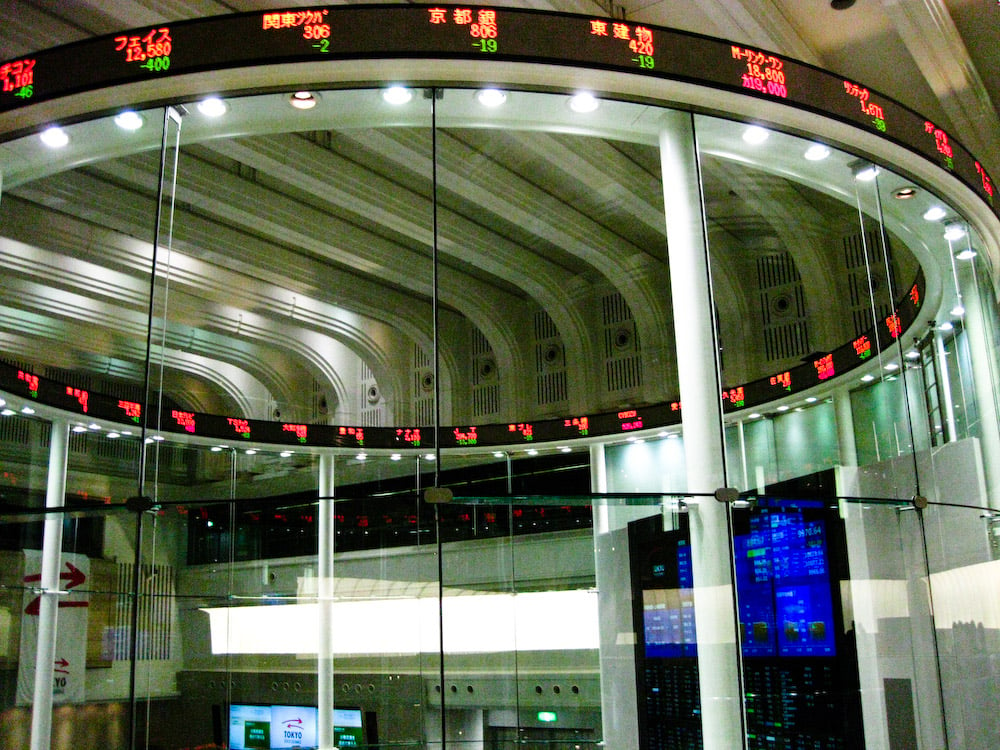
Tokyo Returns To Its Desks And Counts Its Dead
Japan went back to work on confidence it did not earn. The Tokyo exchange had been shut on 21, 22 and 23 September for Respect for the Aged Day and the Autumnal Equinox, and it reopened on Thursday to news of an American rally in chip shares.
The figure is the day’s Asian story and it is a narrow one. The Nikkei 225 closed at 65,513.99, up 495.04 points or 0.76 per cent against Friday 18 September’s close of 65,018.95. Technology and artificial intelligence shares led the rise.
Behind the rally sits the highest Japanese interest rate in 31 years. The Bank of Japan decided on 1.25 per cent at its meeting of 17 and 18 September, and the rate is in force by today. Wednesday’s brief reported that it applied from 24 September, and sources differ on the effective date.
At home the arithmetic of the storm keeps moving. Twelve people are dead and three missing after Typhoon Dujuan, seven in Chiba, four in Kanagawa and one in Miyazaki. That is Japan’s Fire and Disaster Management Agency’s count, reported on 24 September by The Watchers, an independent natural-hazards monitoring site.
The count has risen on each of three days, and it is not a disagreement. Wednesday’s brief carried nine dead and four missing. Jiji Press, a Japanese news agency, put it at ten dead and four missing at 18.30 Japanese time on 23 September, as Nation Thailand, a Bangkok English-language daily, reported.
One detail tells a reader in São Paulo what this was. Embankments gave way near Lake Inbanuma and flooded the towns of Narita and Sakae, and the prefectural government says no such breach had happened since it began managing the lake in 1969, Nation Thailand reported.
Seoul Is Refused At Home While It Sells Abroad
South Korea is being turned down by its own institutions. President Lee Jae-myung is on a state visit to Mexico, and behind him in Seoul a judge and a resignation letter are both unresolved.
The refusal is flat and it is on the record. Chief Justice Cho Hee-dae declined the president’s request to re-nominate a Supreme Court candidate. His words were “Since no other specific constitutional grounds and reasons can be found to justify the request for re-nomination, I cannot comply with it”, SBS, a South Korean commercial broadcaster, reported.
Wednesday’s brief reported that the quarrel between the president’s office and the chief justice had not moved. The refusal of 22 September corrects it, and some Seoul outlets write his name Jo Hee-de.
For a foreign reader this is a lock with one key. A Supreme Court justice in South Korea cannot be appointed without the chief justice’s nomination, and SBS reports the seat, vacant since Mr Noh retired in March 2026, could stay empty until Mr Cho retires in June 2027.
The president’s office argues that the constitution cannot mean what the judge says it means. A presidential official said that “Interpreting the Constitution as requiring the president to accept the chief justice’s recommendation would effectively amount to allowing the chief justice to appoint Supreme Court justices himself. Such an interpretation would be unconstitutional”, the Korea Times reported.
The conservative opposition has raised the charge from criticism to illegality. Jeong Jeom-sik is floor leader of the People Power Party, whose name Wednesday’s brief romanised as Chung Jum-sik. He said Mr Lee had committed “an unconstitutional act that trampled on the Chief Justice’s right of recommendation”, SBS reported.
Abroad Mr Lee is selling a partnership in confident language. He arrived in Mexico on 23 September for the first Korean state visit there in 16 years. He called Mexico “a key strategic platform for accessing markets in North America and across the globe”, Korea JoongAng Daily, a centre-right Seoul English-language daily, reported.
Seoul’s own market took no part in any of it. The Korea Exchange is shut on 24 and 25 September for Chuseok, the harvest festival, on its published calendar. The last close of the Kospi, the Korea Exchange’s main index, therefore stands at 7,080.92 from Wednesday 23 September.
Islamabad Seals The Road And Opens A Channel
Pakistan is fighting, fortifying and negotiating in the same week. It struck across its western border early on Thursday, it is walling its capital in before an opposition march, and it is talking to that opposition through intermediaries.
The strikes came before dawn and Pakistan named them itself. Attaullah Tarar, the information minister, said the strikes were “deliberate, precise, calibrated, and proportionate, and strictly limited to identified military objectives directly linked to the attempted attacks against Pakistan”, Al Jazeera reported. He called the drone flights a “deliberate and unlawful incursion into Pakistan” and “a grave and unacceptable act of aggression”.
Kabul answered within hours, and it answered with a threat. Zabihullah Mujahid, the Taliban government’s spokesman, said four civilians were killed in Kandahar, Paktia and Khost, and warned that “Such reckless, careless, and hostile actions will undoubtedly provoke the anger of the Afghan people and will have adverse consequences for the Pakistani military”, Reuters reported.
At home the capital is being closed against a march. Pakistan Tehreek-e-Insaf, the party of the jailed former prime minister Imran Khan, marches on Islamabad on 27 September to demand his release. “More than 2,000 containers have been placed across Islamabad and at Attock Bridge”, Al Jazeera reported on 24 September, according to media reports.
Two figures are in circulation. Al Jazeera reported on 24 September, according to media reports, “19,000 police officers on their way from Punjab and Sindh, and thousands more deployed at Attock”, while Wednesday’s brief carried more than 23,000 security personnel from The Media Line, an American-based Middle East news agency, counting a different category on a different day.
The interior minister frames it as protection rather than politics. Mohsin Naqvi said “Our captain was killed, our soldiers were killed, our policemen were killed, and these people are preparing to storm a city”, Al Jazeera reported.
The party answers that it is bringing nothing at all. Sohail Afridi, chief minister of Khyber Pakhtunkhwa province, which the party governs, said “We will go there on nothing but two hands and two feet. There will be nothing else in our hands”, the same broadcaster reported.
What may steady the week is bargaining rather than force. Contact has been running between the government and the opposition, the Express Tribune, a Karachi English daily, reported on 20 September. On one side are Mr Naqvi and Prime Minister Shehbaz Sharif, on the other Senate Opposition Leader Allama Raja Nasir Abbas and the party chairman, Barrister Gohar Ali Khan.
The sticking point is who is allowed to call it off. The government wants the march cancelled and kept cancelled; the opposition says only Mr Khan can decide, and Mr Abbas wrote on X that “No one can minus Imran”, the same paper reported.
What This Means From Latin America
The oil that Brazil sells is dearer again. November Brent settled at US$103.08 a barrel on Wednesday, up US$3.83, and Thursday’s readings were higher still. That raises what Brazil earns and what Delhi, Dhaka and Colombo pay.
The harvest is the sharper Latin American stake. Chinese purchases of American farm goods are among the things Washington expected to announce this week, Reuters reported. Such cargoes would compete with Brazilian and Argentine crops, and by 18.00 UTC no purchase had been announced.
One Asian president is in the region now, and his agenda is industrial. Mr Lee’s summit with Ms Sheinbaum was set for Thursday in Mexico City, with a business forum on 25 September, and his pitch was electric-vehicle batteries and components into Mexican car plants.
The rest of the region’s reading is in the dossier. It carries the country health check, the deep dive and the outcome table with its Latin America column: read the Asia Intelligence Dossier →.
What We Are Watching
- Sri Lanka votes on the 22nd Amendment — 25 September at seven in the evening, after the two-day second-reading debate that opened on Thursday, Lanka News Web reported. A two-thirds majority is needed and no referendum is required.
- India’s chief election commissioner faces a deadline from the street — 26 September, when the forty-eight hours the Cockroach Janta Party gave him on Thursday expire, its founder telling ThePrint it would otherwise begin a nationwide agitation.
- Mr Trump and Mr Xi sit down at the White House — 24 September, with the bilateral meeting set for 15.30 UTC and a state dinner for 22.45 UTC, CBS News reported. By 18.00 UTC no outcome from it had been announced.
- Mr Lee meets Ms Sheinbaum in Mexico City — 24 September, followed by a business forum on 25 September. Seoul’s market is shut for Chuseok on both days.
- Aleema Khan’s detention returns to court — 25 September, at the Lahore High Court. Her sisters Uzma Khan and Noreen Niazi were before the same court on 24 September.
- Imran Khan’s party marches on Islamabad — 27 September, with more than 2,000 containers placed and 19,000 police mobilised from two provinces, Al Jazeera reported.
- South Korean law-enforcement vacancies take effect — 2 October, on the count of Jeong Jeom-sik, the People Power Party floor leader, who calls the timing absurd.
- The Busan tariff truce expires — 10 January 2027, two months later than the 10 November date it replaced, on Mr Bessent’s announcement of 23 September.
The Bigger Picture
Asia’s week is being decided in registers and courtrooms rather than at summits. Beijing has the lawn, the band and the fly-past; India, Sri Lanka and Nepal are arguing about who counts, who judges and who is missing.
The steadying forces are ratings and calendars. Fitch Ratings raised Sri Lanka’s long-term foreign-currency rating to B- from CCC+ on 22 September, Lanka News Web reported, and the tariff truce between Washington and Beijing now has two more months to run.
The straining forces are the ones nobody has scheduled. A satirical party has given India’s chief election commissioner forty-eight hours, Islamabad has a march in three days and a border it is bombing, and Nepal’s registers of the missing still differ by more than nine hundred names.
What the region does with the week is still open. The ceremony has been delivered, the vote in Colombo falls on Friday evening, and the argument beneath all of it is about institutions rather than policies.
Frequently Asked Questions
Why is India arguing about its own voter rolls?
Because two of the three people who run the referee have objected to it in writing. The Election Commission of India is a constitutional body answerable to no minister, and its Special Intensive Revision is a house-to-house re-verification of who may vote. NewsX, a Delhi television news channel, reported on 23 September that the commissioners Sukhbir Singh Sandhu and Vivek Joshi had recorded objections on at least fourteen occasions over ten months, calling one procedural change “unauthorised” and “illegal”; the commission answered that “Differing views and observations are a normal part of deliberation in any institution”. How many voters are affected is itself disputed: Countercurrents, a left-wing Indian site, puts the removals at about 130 million names, while OpIndia, a Hindu-nationalist site, wrote on 23 September that the figure describes draft lists rather than final exclusions. On 27 May the Supreme Court upheld the revision, finding it bore “a direct nexus to the constitutional goal of free and fair elections”, as Business Standard reported.
What is Sri Lanka’s 22nd Amendment, and why does it divide the country?
It raises the retirement age of Supreme Court judges from 65 to 67 and of Court of Appeal judges from 63 to 65, and caps the chief justice’s tenure at six years or at the age of 67, whichever comes first. Parliament votes on it at seven on Friday evening, 25 September. The government’s case is a queue. The justice minister, Harshana Nanayakkara, told the house on 24 September that about 1.1 million cases are waiting and that Sri Lanka has roughly nineteen judges per million people against about fifty-one in England. Today “people spend years attending courts while cases are repeatedly postponed”, he said, Ada Derana reported. Against him stand the opposition parties, the Bar Association of Sri Lanka and forty professional bodies, from doctors to railway station masters, who say judicial power is part of the sovereignty of the people. After 67 petitions the Supreme Court told the Speaker on 22 September that the bill needs a two-thirds majority but no referendum.
Why did fuel rise in Bangladesh, and how are people taking it?
The state importer had been selling below what it paid. Bangladesh Petroleum Corporation lost 228.75 billion taka (about US$1.86 billion) between March and August by holding prices down. On 21 September petrol, diesel, octane and kerosene each rose by 20 taka (about US$0.16) a litre, taking diesel to 135 taka (about US$1.10). The reaction has been arithmetic rather than revolt: Mokbul Mia, who has pulled a rickshaw in Dhaka for twenty years and takes 300 to 400 taka (about US$2.44 to US$3.26) a day, told bdnews24.com he did not know how he would buy food or medicine. The state minister for power and energy, Anindya Islam Amit, said “I sincerely apologise to them” and promised prices would fall when the world market steadies; the Marxist opposition answers that the same importer banked about 520 billion taka (about US$4.23 billion) of profit over eleven years.
What did the Trump–Xi summit actually produce?
One thing, and it was announced before the two men sat down. Scott Bessent, the US treasury secretary, said on 23 September that the tariff truce known as the Busan Agreement would run to 10 January 2027 instead of 10 November, a two-month extension, Al Jazeera reported. Busan is the South Korean port city where the original bargain was struck. It has been announced and described as agreed, with no schedule of tariffs published and no signature reported. The South Lawn ceremony was held on Thursday morning, where Mr Xi said he was ready to “steer the giant ship of the China-US relationship on a steady course”. The bilateral session was set for 15.30 UTC and the state dinner for 22.45 UTC; by 18.00 UTC no outcome from the closed session had been announced.
This article was produced by The Rio Times’ automated AI newsroom. Editorial responsibility: Matthias Camenzind, Publisher and Editor-in-Chief. The Rio Times also runs Ask Rio Times, which answers from 100,000+ of our own articles, the daily Latin America Power Map, and prediction-market odds on elections and markets.. How we use AI · Report an error