Argentina: grocery shopping in pesos is expensive, but it is a “bargain” in US dollars
RIO DE JANEIRO, BRAZIL – A recent Bloomberg report states that “in Argentina, inflation has been hitting the pockets of the population for years, which, due to the loss of purchasing power, faces greater difficulties in accessing basic food basket products, clothing, and other mass consumption items”.
In addition, inflation is a major problem. For Argentines, buying products in pesos at the supermarket is becoming more and more expensive, but for tourists who bring US dollars, it is a “bargain”.
This situation also leaves savers with fewer and fewer pesos to buy dollars, the traditional safeguard currency for Argentines against local volatility.

On the other hand, adds the international news agency, “amid an economic scenario with dispersions and a pronounced exchange rate gap, for those who earn their salaries in the US currency and for those who arrive in the country with dollars, consuming in pesos is an unusually cheap option”.
In this sense, it is interesting to analyze the weight in the pocket of a supermarket purchase limited to essential products at a local level and in neighboring countries, considering the information provided by preciosmundi.com.
IN ARGENTINA, GROCERY SHOPPING IS CHEAP IN DOLLARS
The following table shows the price of several products expressed in dollars, and the cost of this “changuito” (“shopping cart”) is reflected in the average salary.
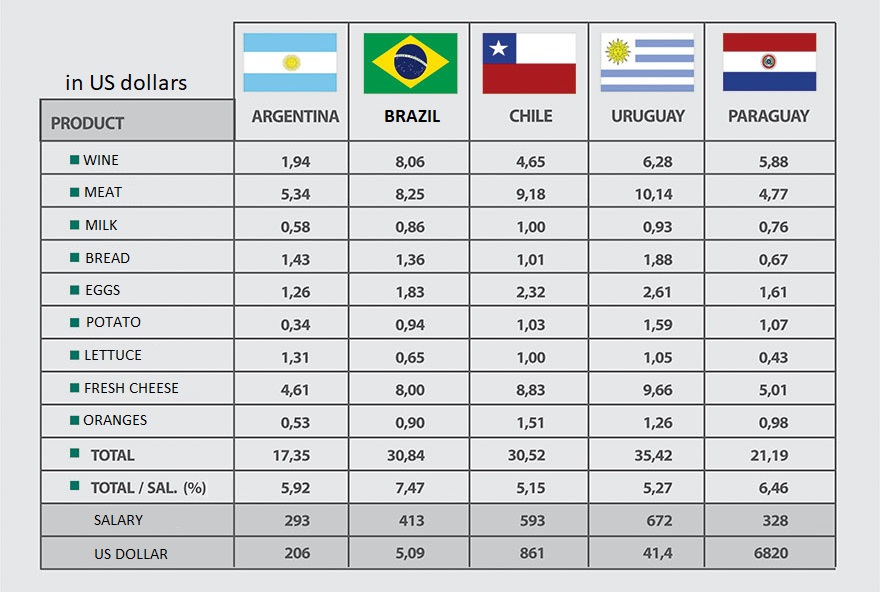
It shows that it is in Chile where this purchase has the lowest impact on the salary since it barely exceeds 5% of it, followed closely by Uruguay, with 5.3%. Curiously, Argentina appears in the middle, with 5.9%, being surpassed by Paraguay, with 6.5%, and finally, the highest weight is observed in Brazil, since it has an incidence of 7.5%.
In other words, according to this small sample, the average Chilean citizen is the one whose income is least affected by this item, while at the opposite extreme is the Brazilian, who has to spend almost 50% more.
This inward look changes when comparing Argentine prices with those of neighboring countries, since with one or two exceptions, in all cases, the prices in dollars are substantially lower, which can be seen when comparing the sum of the “ticket”, which, compared to US$17.35 in Argentina, rises to US$21 in the case of Paraguay, a little more than US$30 for Brazil and Chile and US$35 in the case of Uruguay.
In addition, the salary in dollars (measured at the blue exchange rate) is the lowest in the sample since, according to different measurements, it is below US$300, compared to US$328 in Paraguay, US$413 in Brazil, US$593 in the case of Chile and more than US$670 in Uruguay.
ARGENTINA, VIRAL FOR HOW CHEAP IT IS IN DOLLARS
Although this sample is small, it helps to understand why the number of visitors from this group of countries who go on shopping tours to border cities is growing.
For example, two YouTubers from Peru came on a trip to Argentina and uploaded a video to their channel “Misiasperoviajeras,” showing their tour of different places in Buenos Aires and how cheap it is to come as a tourist to this city.
Of course, to take advantage of these “bargain” prices, visitors must go to the blue market, either “Cuevas” or “Arbolitos,” because if they pay by credit card, the price is taken at the official exchange rate.
Although, until not long ago, this modality was little known abroad, lately, its practice has spread at least among those coming from these countries.
The Uruguayan YouTuber Woker recommended to his fellow countrymen, “Don’t pay by credit card because, if you do, they take the price of the official dollar, so you will need more dollars to get the same amount of Argentine pesos”.
With information from iProfesional
More: Argentina news in English, every day from The Rio Times.
Editorial responsibility: Matthias Camenzind, Editor-in-Chief · Editorial standards · Report an error