Argentina Central Bank Buys US$369 Million in a Week

ECONOMY · ARGENTINA
Key Facts
- —The country Argentina, where savers have been free to buy dollars since exchange controls were lifted in April 2025.
- —What happened The central bank bought US$369 million in the week to Friday 2 October 2026, its largest weekly total since July, Ámbito reported.
- —The numbers Purchases averaged US$22 million a day in September (Ámbito, iProfesional). Savers bought US$2.853 billion gross in August, according to central bank data cited by iProfesional and Infobae.
- —What it means for you Gross reserves closed at US$48.653 billion on 2 October (Ámbito). Steady household demand still absorbs much of the export surplus before it reaches the central bank.
- —Still open Whether the faster buying outlasts one-off inflows, and what official September data show for household dollar purchases.
Argentina’s central bank stepped up its dollar purchases this week, buying US$369 million in the five sessions to Friday 2 October. Ámbito reported it was the largest weekly total since July.
The pick-up comes while savers keep buying dollars at a fast pace. Analyst Salvador Di Stéfano argued in iProfesional on 3 October that individuals have bought twice as many dollars as the central bank.
A faster week after a slow September
The Banco Central de la República Argentina (BCRA) bought US$70 million on Tuesday, US$160 million on Wednesday and US$93 million on Thursday. iProfesional and El Economista reported the daily figures.
On Friday it added US$35 million, according to Ámbito and El Economista. Gross reserves rose US$364 million that day, to US$48.653 billion.
Purchases so far in 2026 reached US$14.696 billion, Ámbito reported. That is above the US$10 billion target for the year agreed with the International Monetary Fund, iProfesional noted.
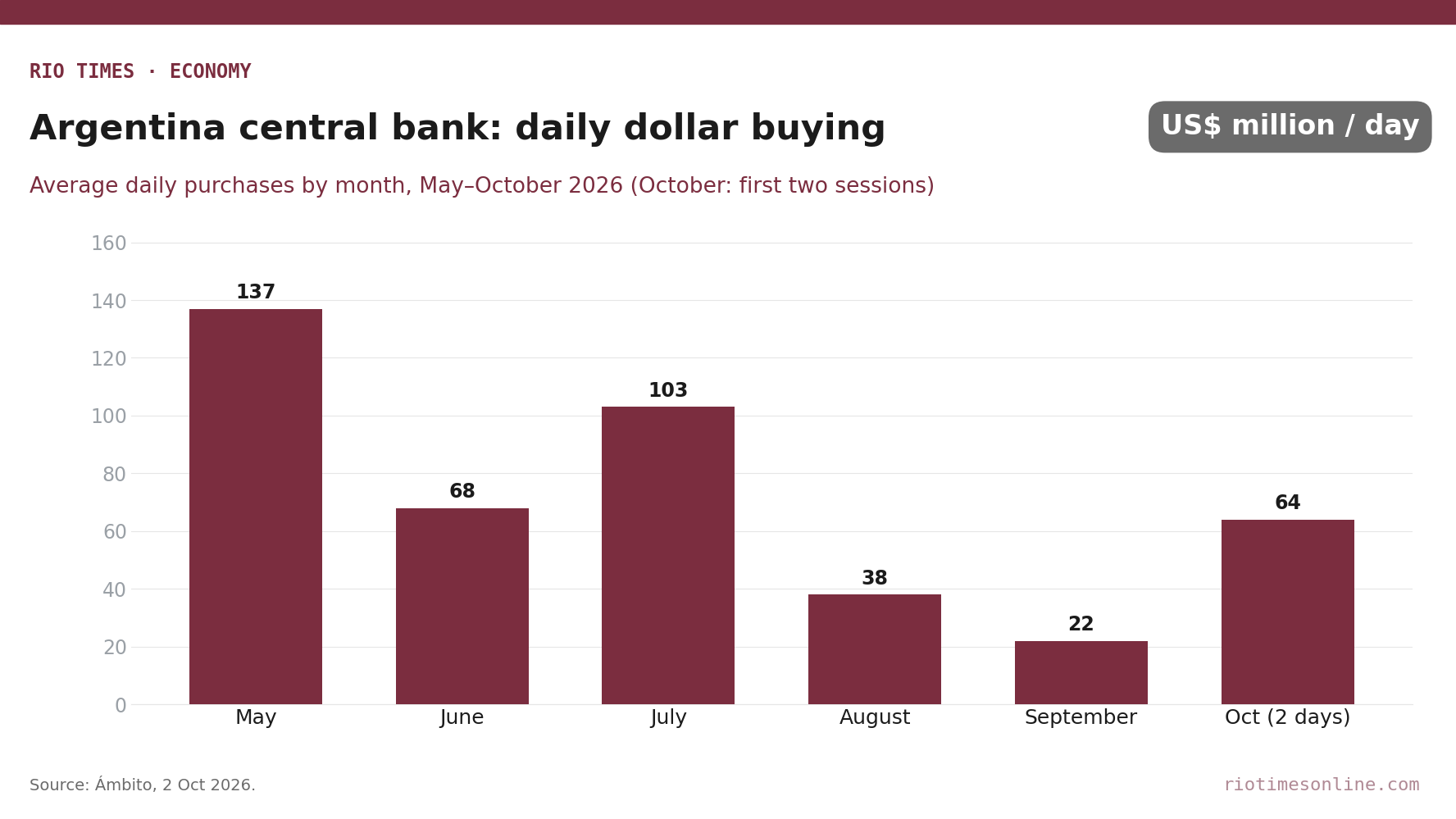
September was the weakest month since the buying programme began early this year. Daily purchases averaged US$22 million, against US$38 million in August and US$137 million in May.
Where the new dollars came from
Traders do not agree on the source. Some pointed to San Juan province, which raised US$600 million in New York days earlier, iProfesional reported.
Gabriel Caamaño of the consultancy Outlier estimated that much of Wednesday’s purchase was agreed directly, as a block outside the market. Companies and provinces placed almost US$3.2 billion of dollar debt in September, so analysts expect more such deals.
Economy Minister Luis Caputo has projected US$19.4 billion of purchases for 2026. Reaching it needs about US$5 billion more in three months, which the market sees as demanding, iProfesional said.
Savers keep buying billions a month
Households bought US$2.853 billion in banks in August, according to the central bank’s exchange balance cited by iProfesional and Infobae. Net of sales, the figure was US$2.463 billion, from about 1.7 million buyers.
About US$1.1 billion of that stayed on deposit in local banks, iProfesional reported from the same report. Three banks told the outlet that net September sales probably topped US$2.7 billion, a preliminary estimate.
From April 2025 to August 2026, individuals bought US$47.29 billion gross and US$40.34 billion net, Infobae reported from central bank data. Many of those dollars end up outside the system, part of the US$268.8 billion in mattress dollars estimated in June.
Twice as much, on a different count
Di Stéfano put purchases by individuals since December 2023 at US$72.9 billion, against US$36.5 billion bought by the central bank. His breakdown gives US$63.8 billion since April 2025, more than the official US$47.29 billion gross figure.
His column did not say which data series it used. Even the lower official figure exceeds what he says the central bank bought over the whole period.
He sees the trend as benign, citing a US$26.8 billion rise in private dollar deposits and US$21.7 billion more dollar loans. He called a tax on dollar purchases, which economist Santángelo floated this week, “a delusion”.
Others are less relaxed. Former central bank chief Martín Redrado told iProfesional the open question is whether dollars will cover both debt payments and rising dollarisation.
Investors share some of that doubt. Country risk hit a 2026 high of 655 points on Friday, El Economista reported.
What Is Not Yet Known
The central bank has not yet published its September exchange balance, so the US$2.7 billion figure for savers remains a bank estimate. The source of Wednesday’s large purchase has not been confirmed.
It is also unclear whether October buying will hold near the pace of its first two sessions. Analysts quoted by iProfesional were split on whether this week’s purchases were a one-off.
Sources: Ámbito (2 October 2026); iProfesional, 1 October, 2 October, 2 October and 3 October (column by Salvador Di Stéfano); El Economista, 1 October and 3 October; Infobae (28 September), citing the central bank’s exchange balance for August 2026.
This article was produced by The Rio Times’ automated newsroom system. How we use AI · Report an error · Editorial responsibility: Matthias Camenzind, Editor-in-Chief
In depth
LatAm Markets: Live Signals → — real-time movers, turnover leaders and FX across Latin America.