Amazon Cargo Plane Was Too Fast Before Deadly Miami Crash, NTSB Data Shows
CARIBBEAN · AVIATION
Key Facts
- —The warning Cockpit recordings show a pilot warned of “excessive speed” one minute and 42 seconds before Amazon Air Flight 7598 crashed in Miami, and called for a go-around seconds before impact.
- —The flight The Boeing 767-300 freighter, operated by 21 Air for Amazon, was arriving from San Juan, Puerto Rico, on Sunday 6 September when it overran runway 30 at 1:53 p.m.
- —The victims Five people were killed, all of them workers in a cleaning-crew van the jet struck after leaving the runway. Five more were injured; both pilots survived.
- —The data Flight recorders show the throttles were advanced to go-around thrust and the brakes reapplied, but the speed brakes and thrust reversers were never deployed.
- —What next The NTSB interviewed both pilots this week and expects to publish a preliminary report within weeks.
One minute and 42 seconds before an Amazon cargo jet from Puerto Rico crashed at Miami International Airport, one of its pilots began warning that they were going too fast. He never stopped. Newly released recorder data now frames the central question of the investigation: why a crew that saw the problem coming could not stop the outcome.
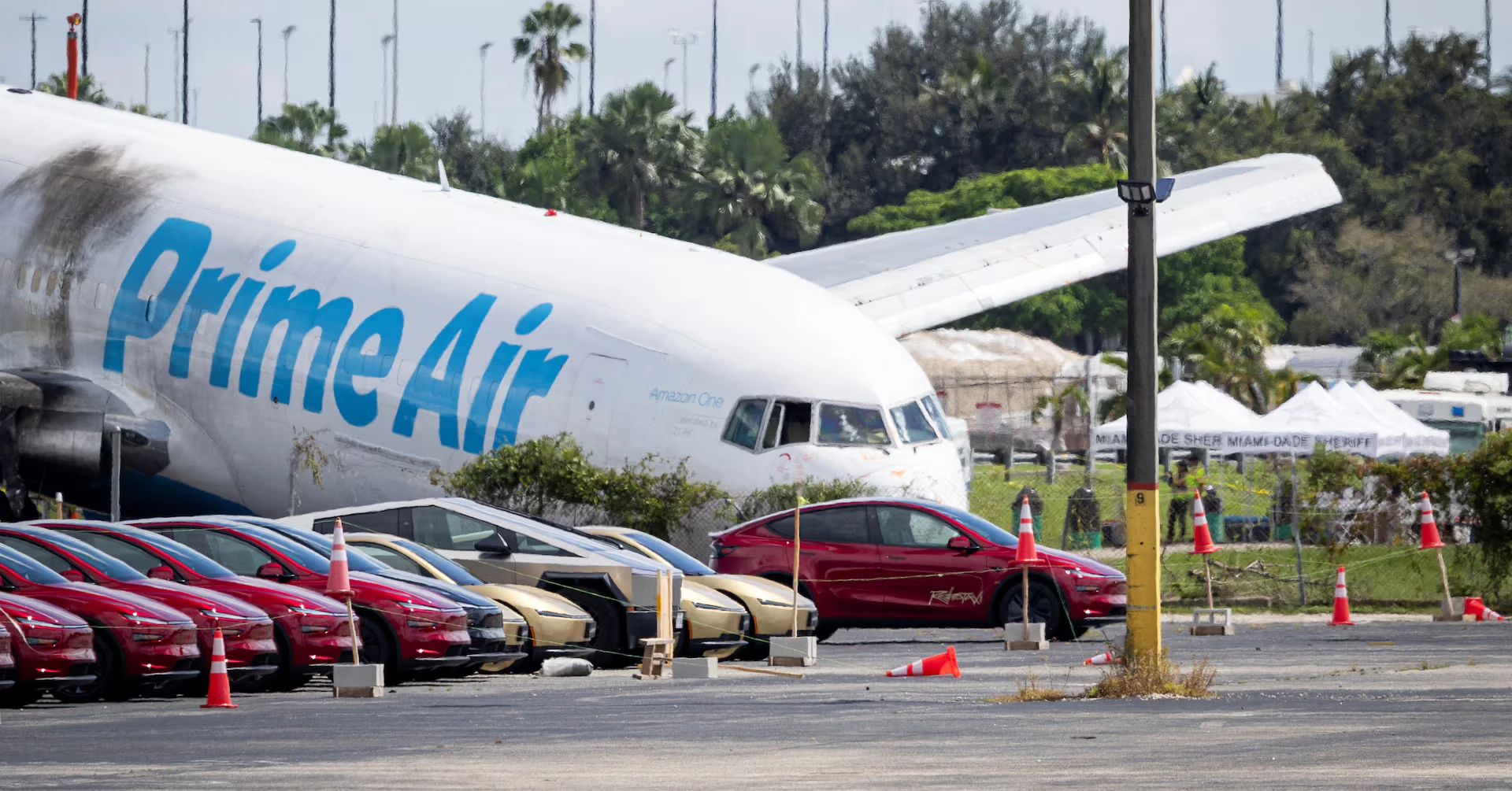
A pilot aboard Amazon Air Flight 7598 repeatedly warned of the aircraft’s “excessive speed” in the final minutes before the Boeing 767 freighter overran a runway at Miami International Airport on Sunday 6 September 2026, killing five people on the ground, according to a cockpit voice recorder summary released by the US National Transportation Safety Board.
The NTSB readout, released on Wednesday 9 September, reconstructs the last moments of the flight from San Juan. About 30 seconds before the crash, sounds consistent with the jet touching down on runway 30 are heard. Roughly 15 seconds later, one pilot called for a “go-around” — an aborted landing. Five seconds after that call, the aircraft had already veered off the runway.
What the Recorders Show
The cockpit voice recorder captured more than two hours of audio. One minute and 42 seconds before the crash, one pilot warned the other that the aircraft was going too fast, and he “continued to make comments about the plane’s excessive speed throughout the remainder of the recording,” the NTSB summary says. Flight data cited in the investigation put the landing speed at 158 knots — about 292 kilometers per hour.
The flight data recorder tells the mechanical side of the story. Seconds before the recording ends, the throttles were advanced to a setting consistent with go-around thrust, NTSB investigator Chihoon Shin told reporters. The brakes were then reapplied and stayed applied until the end of the data. But there was no indication that the speed brakes or the thrust reversers — the two systems that slow a jet most effectively on the ground — were ever deployed.
Tracking service Flightradar24 recorded the aircraft still moving at roughly 128 miles per hour when it left the usable runway surface.
Five Workers Killed on the Ground
After leaving the runway, the freighter struck a 2012 Ford Econoline van inside the airport perimeter, then a small Toyota SUV on a road just outside the fence. The van belonged to Professional Ocean Service Corp., a contractor that cleans aircraft, and was carrying a seven-person cleaning crew. All five people killed were in that van, the Miami-Dade County Sheriff’s Office said; the victims, identified by name this week, were men aged 47 to 75.
Five more people were injured. As of Tuesday, three remained hospitalized — two in critical condition and one stable — Sheriff Rosie Cordero-Stutz said. The aircraft’s two pilots were treated and released, and both sat for interviews with NTSB investigators on Wednesday.
Both crew members survived a crash that NTSB Chairwoman Jennifer Homendy described after walking the site as “utter devastation.” A 32-person NTSB team has spent the week documenting tire marks, debris and the aircraft’s engines. The cargo was about 32,000 lb (14.5 tonnes) of freight, mostly contact lenses; nothing hazardous was aboard.
A Routine Caribbean Rotation
Flight 7598 was on the last leg of an ordinary working day: Cincinnati to Miami, Miami to San Juan, and back. The aircraft was a 32-year-old Boeing 767-300 built in 1994 and converted from passenger service to freight. It was flown by 21 Air, a Miami-based charter carrier operating the jet for Amazon’s air network — part of an outsourced cargo model in which Amazon owns the freight but contracts the flying.
That model, built around contractors such as 21 Air and Atlas Air, is now likely to face renewed scrutiny. 21 Air said it was “devastated by the accident” and offered condolences to the families. Amazon said its priority was the safety and care of everyone affected and that it was working closely with investigators. The FAA and the NTSB will examine weather, aircraft performance, crew actions and air-traffic communications; a preliminary report is expected within weeks.
The crash shut down Miami International for roughly three hours on one of the year’s busiest travel weekends; two of the airport’s four runways remained closed into the week, rippling delays across the US air system — as The Rio Times reported on Sunday. For the San Juan–Miami corridor — one of the Caribbean’s busiest freight routes — the question investigators now carry is a narrow and haunting one: a crew recognized the speed, called the go-around, and ran out of runway anyway.
Sources: ABC News, NTSB cockpit recorder readout · Guyana Chronicle · ABC News, NTSB investigation · Flightradar24
More: Caribbean news in English, every day from The Rio Times.
This article was produced by The Rio Times’ automated newsroom system. How we use AI · Report an error · Editorial responsibility: Matthias Camenzind, Editor-in-Chief