Venezuela Hate Law Reform: Unions and NGOs Demand All Open Cases Be Annulled
POLITICS · VENEZUELA
Key Facts
- —The country Venezuela is run by acting president Delcy Rodríguez since Nicolás Maduro’s capture in January. Its 2017 hate law carries prison terms of ten to 20 years.
- —What happened On 29 September Rodríguez asked the National Assembly to partially reform the law and decriminalise its offences. On 30 September unions and NGOs demanded that all open cases be annulled.
- —The numbers Foro Penal, a legal-aid NGO, counts 927 people charged under the law since 2017. As of 30 September, six remain detained and 638 face court restrictions.
- —What it means for you Journalists, activists and social-media users have been prosecuted for posts and messages. Decriminalisation would ease that risk, but other censorship powers in the law may remain.
- —Still open No draft text or timetable has been published. It is unclear whether pending cases would close automatically once the reform passes.
Venezuela’s government has opened a hate law reform, and the people prosecuted under it want more than new wording. Press unions and human rights groups demanded on Wednesday 30 September that every open case be annulled.
Acting president Delcy Rodríguez asked the National Assembly a day earlier to reform the 2017 law “with urgency”. She said its goal was to decriminalise the offences it created.

What the Government Has Proposed
Rodríguez sent the request in a letter dated 28 September to her brother, Jorge Rodríguez, who presides over the assembly. Efecto Cocuyo reported the letter, which framed the reform as part of a wider overhaul of criminal justice.
The law was passed in November 2017 by the National Constituent Assembly, a body loyal to Maduro. It punishes anyone who “promotes or incites hatred, discrimination or violence” with ten to 20 years in prison.
Rodríguez said on Tuesday she still believed in its principles but that it had been “badly applied” and used abusively, EFE reported. Jorge Rodríguez had admitted misuse in February.
On 29 September the assembly created an 11-member special commission to draft the text, El Nacional reported. It is chaired by Pedro Infante and includes Maduro’s son, Nicolás Maduro Guerra.
Why Groups Want the Cases Closed
The press workers’ union SNTP said on Wednesday that seven in ten jailed or prosecuted press workers, as of January 2026, faced hate charges. It wants all open cases annulled and court restrictions lifted.
The union also warned that ending prison terms is not enough. The law lets authorities revoke broadcast licences, block websites, impose fines and order content removed.
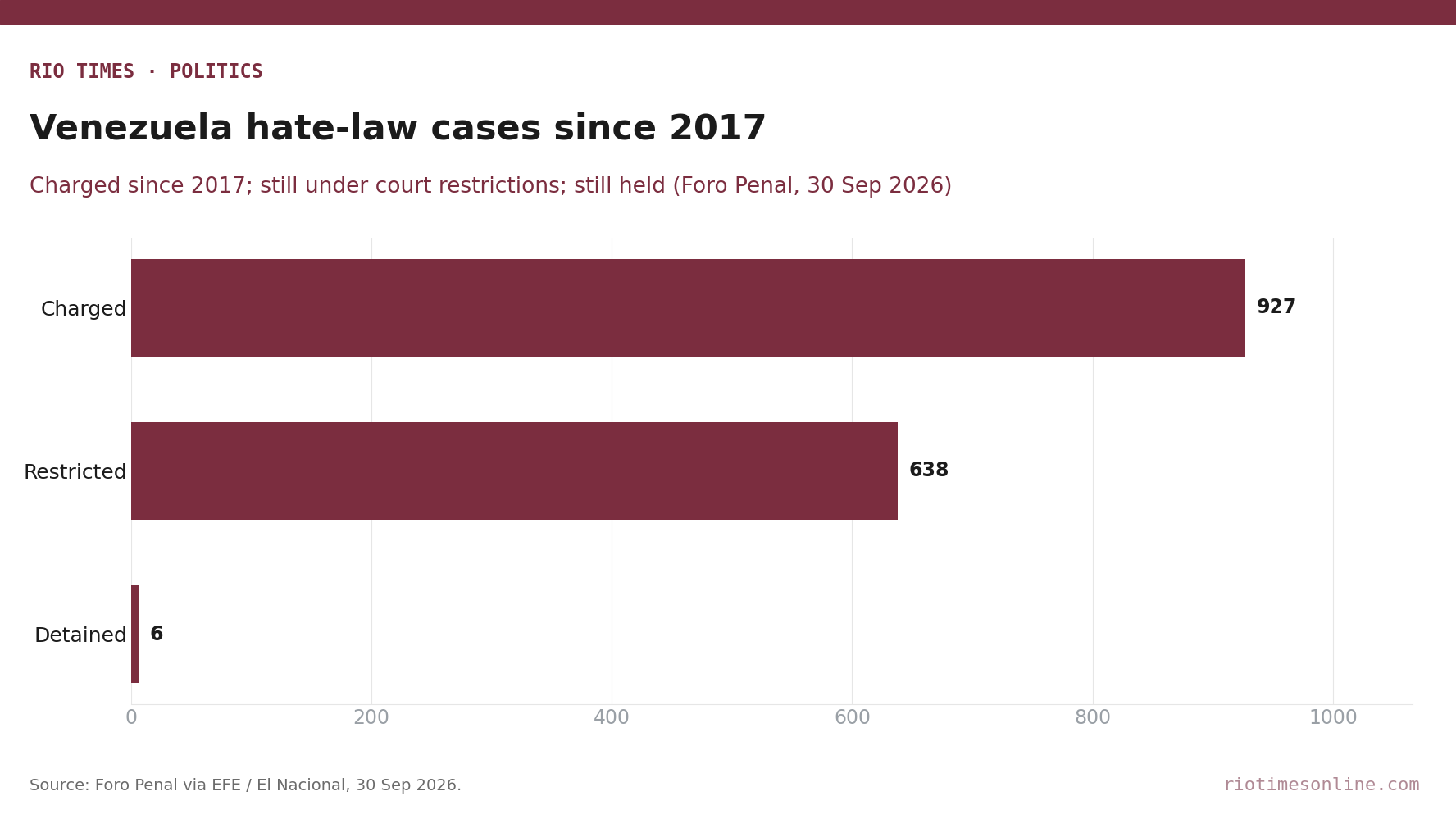
Foro Penal, which defends political prisoners, gave the widest count on Wednesday. Its vice-president, Gonzalo Himiob, told EFE that 927 people had been charged since 2017, often alongside terrorism or criminal association charges.
Six of them remain in detention and 638 are still under court-imposed restrictions. That second figure is the one a reform could change fastest.
Repeal, Not Reform
The National College of Journalists and the free-speech group Espacio Público want the law repealed outright. Espacio Público documented more than 120 cases from 2017 to 2024, including at least 33 arrests after the 2024 election.
It also wants Conatel, the telecoms regulator, to stop blocking websites and return seized broadcast licences and equipment. “We demand genuine and credible changes,” said Óscar Murillo of the rights group Provea.
The push follows weeks of pressure over detentions. Relatives have already demanded an inquiry into the judges, covered in Venezuela Protesters Demand Inquiry Into Judges in Political Prisoner Cases.
A UN fact-finding mission said in September that the repressive laws remain in force. That report is examined in Venezuela Still Runs Maduro’s Repression System, UN Mission Says.
A Step That Cuts Both Ways
The request is the clearest official admission yet that the law was misused. It follows US-backed talks between the government and members of the opposition-led assembly elected in 2015.
Yet the drafting commission is made up of government loyalists, and no draft has been shown to the public. Critics fear a narrow reform could keep the law’s censorship tools intact.
What Is Not Yet Known
The draft text, its timetable and any public consultation have not been announced. Espacio Público asks how the principle of applying the more lenient law would close pending cases.
Jorge Rodríguez also sent the request to the Supreme Tribunal of Justice, the top court, citing the law’s article 3. What role the court will play remains unclear.
Sources: Efecto Cocuyo (30 September 2026) and Efecto Cocuyo (29 September 2026); EFE via El Nacional (30 September 2026); El Nacional on the assembly commission and NGO reactions (29 September 2026); Espacio Público statement (29 September 2026).
This article was produced by The Rio Times’ automated newsroom system. How we use AI · Report an error
Read More from The Rio Times