
Rio Times Markets · United States
Key Facts
—Who. The US Labor Department counts new claims for unemployment benefits every week.
—What. New claims fell to 194,000 in the week to 17 October, a three-month low, against 200,000 forecast.
—The other side. Continuing claims rose 25,000 to 1.728 million, which may mean some jobless workers are slow to find work.
—Why it matters. Few layoffs keep the Fed firm on rates, which tends to support the dollar against Latin American and African currencies.
—What to watch. The Fed decides on Wednesday 28 October, and the October jobs report is due Friday 6 November.
—Prediction markets. Polymarket prices no Fed change on 28 October at 91.5% and a quarter-point hike at 8.5% (10:26 a.m. ET, 22 October 2026).
Fewer Americans filed for unemployment benefits last week, which is one more reason for the Federal Reserve to keep interest rates where they are.
The number of Americans filing new claims for unemployment benefits fell to 194,000 in the week ended 17 October, the US Labor Department reported on Thursday 22 October 2026. That is the lowest since the week ended 18 July, according to the RT economic calendar, and below the 200,000 that forecasters expected.
The data matter beyond the United States because American job conditions steer the Federal Reserve, the dollar and the money that migrant workers send home. All three show up in Latin American and African markets.
What the Labor Department Reported
Initial claims, the first requests for benefits, fell by 6,000 from 200,000 in the previous week, a figure revised up from 199,000. The four-week average, which smooths out weekly noise, eased to 197,750 from 198,750.
Continuing claims, which count people who are still receiving benefits, rose by 25,000 to 1.728 million in the week ended 10 October. Forecasters had expected 1.72 million.
The two numbers point in different directions. Employers are letting few people go, but those who lose a job may be taking longer to find a new one.
In Plain English
Initial claims. The number of people who ask for jobless benefits for the first time in a week.
Continuing claims. The number of people who are still receiving those benefits.
The Fed. The Federal Reserve, the central bank of the United States.
Seasonally adjusted. Smoothed for regular calendar swings such as holidays.
Low Layoffs, Slow Hiring
The latest monthly jobs report, from the Bureau of Labor Statistics on 2 October, showed employers adding only 29,000 jobs in September. The unemployment rate was 4.2%, and the bureau said both numbers changed little.
Low claims fit that picture of a labour market that is not shedding workers but is not hiring much either. One weekly reading can be noisy, and the next one is due on Thursday 29 October at 12:30 UTC.
What It Means for the Fed
The Federal Reserve raised its target range for interest rates by 0.25 percentage points to 3.75% to 4.00% on Wednesday 16 September 2026, in a 12 to 0 vote. It said inflation remains elevated and that the move would support a timelier return to its 2% goal.
Its next decision is due on Wednesday 28 October at 18:00 UTC (2:00 p.m. New York time). Few layoffs give policymakers little reason to ease, and the prediction market below shows traders expect no change.
What to Watch
Wednesday 28 October, 18:00 UTC. The Federal Reserve’s interest-rate decision.
Thursday 29 October, 12:30 UTC. The first estimate of US third-quarter growth, and the weekly jobless claims.
Friday 6 November, 13:30 UTC. The US jobs report for October.
Dollar, Real, Peso and Rand on the Day
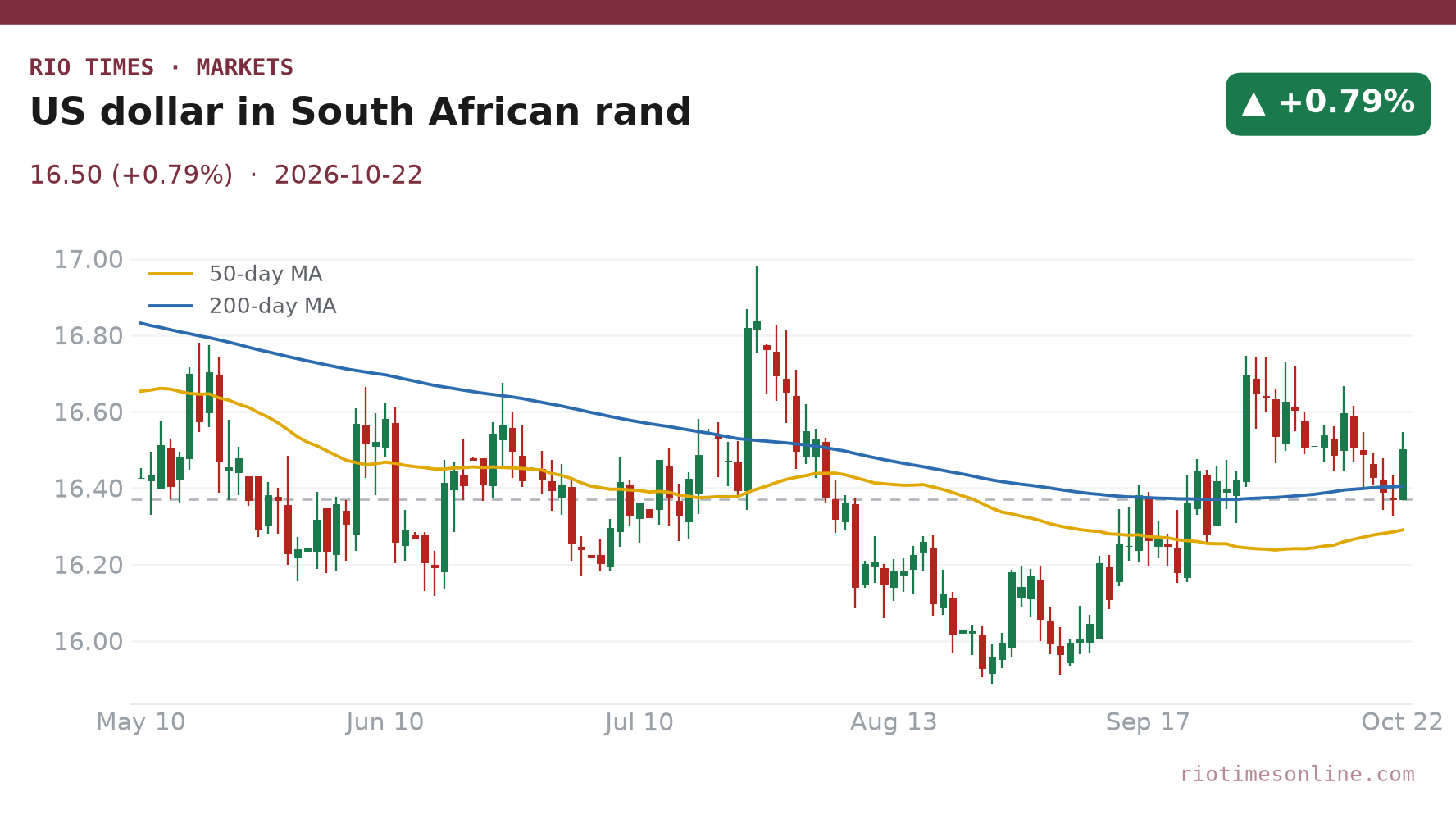
At about 14:10 UTC on Thursday, the dollar bought about 5.03 Brazilian reais (up 0.1% on the day), 18.70 Mexican pesos (up 0.1%) and 16.51 South African rand (up 0.8%), according to RT market data. The rand moved most of the three.
The claims data came out at 12:30 UTC, and it is not possible to separate their effect from other news on the day. Moves of this size are small, and they can reverse within a week.
Why Latin America and Africa Watch US Jobs
Mexico received US$5,452 million in remittances in August 2026, down 3.6% from a year earlier, according to Banxico, the central bank. In the first eight months of the year the total was US$41,802 million, up 2.2%.
Remittances are money sent home mostly by Mexican workers in the United States, so a healthy US job market supports them. For African economies, a firm dollar tends to raise the local cost of dollar debt and imported fuel.
What Prediction Markets Say
Polymarket is a platform where users trade contracts on real events, and its market on the Federal Reserve’s October decision has US$55,805,796 traded. As of 10:26 a.m. ET on 22 October 2026, traders price no change at 91.5% and a 25-basis-point (0.25 percentage point) increase at 8.5%.
All five outcomes together add up to slightly more than 100%. They are bets by traders, not polls, and a decision at 91.5% is a probability, not a certainty.
Why we show this: prediction markets turn real-money bets into a live probability that moves within minutes of the news, which is why investors, campaigns and newsrooms in the United States now follow them closely. We show them next to polls and official results, never instead of them.
What It Means for You
For US investors in emerging-market stocks, bonds or currencies, the data point to a Fed in no hurry to ease, which tends to keep the dollar firm. For US employers and families tied to Latin America, a steady job market supports the money that workers send home.
For travellers and people who send money abroad, a firm dollar stretches further. At today’s rates, US$100 buys about 503 Brazilian reais, 1,870 Mexican pesos or 1,650 South African rand.
What Is Not Known
It is not yet clear whether claims will stay near 200,000 or drift back up. Weekly figures are revised, and the October jobs report on 6 November will give a fuller view.
What supports the labour market is a low pace of layoffs and an unemployment rate of 4.2%. What could reverse it is slow hiring, which shows in the rise of continuing claims.
Frequently Asked Questions
How many Americans filed for jobless benefits in mid-October 2026?
New claims fell by 6,000 to 194,000 in the week ended 17 October 2026, the US Labor Department reported. Forecasters had expected 200,000.
What are continuing jobless claims?
Continuing claims count people who are still receiving unemployment benefits. They rose by 25,000 to 1.728 million in the week ended 10 October.
Will the Federal Reserve raise interest rates on 28 October?
The Fed raised its range to 3.75% to 4.00% on 16 September. On Polymarket, traders price no change on 28 October at 91.5% and a hike at 8.5%; these are bets, not polls.
How do US jobless claims affect Latin American currencies?
Low layoffs let the Fed keep rates firm, which tends to support the dollar. On Thursday the dollar was up 0.1% against the Brazilian real and Mexican peso and 0.8% against the South African rand.
Why do US jobs matter for remittances?
Remittances are money that migrant workers send home, mostly from the United States in Mexico’s case. Mexico received US$5,452 million in August 2026, down 3.6% from a year earlier.
Sources
US Department of Labor, weekly claims report · Bureau of Labor Statistics, employment situation · Federal Reserve, 16 September statement · Diario de Yucatán on Banxico remittances · Polymarket. Forecasts and earlier values from the RT economic calendar; currency rates from RT market data. This is news, not investment advice.
Connected Coverage
US Inflation Hits 3.7% as Gold, Silver Fall
Mexico inflation rises to 3.62% in mid-October
This article was produced by The Rio Times’ automated newsroom system. How we use AI · Report an error · Editorial responsibility: Matthias Camenzind, Editor-in-Chief
Part of our ongoing coverage
Africa: The New Scramble — the great-power contest over the continent.
LatAm Markets: Live Signals → — real-time movers, turnover leaders and FX across Latin America.