IMF Mission Chief Says Uruguay Has Room to Be More Ambitious on Growth

ECONOMY · URUGUAY
Key Facts
- —The country Uruguay has had no IMF lending programme for more than 20 years, Finance Minister Gabriel Oddone said on 28 September. Like every member, it is still reviewed annually.
- —What happened IMF mission chief Raphael Espinoza told El País on 4 October 2026 that growth averaging 1.2% since 2016 is too slow, and that “stability alone” cannot fix it.
- —The numbers IMF forecasts of 24 September: growth of 1.3% in 2026 and 2.4% in 2027; inflation at the 4.5% target; a primary surplus of 0.5% of GDP urged for 2029.
- —What it means for you Investors get a stable, low-risk Uruguay with slow growth. The IMF wants cheaper energy, logistics and licences, plus a review of decades-old tax incentives.
- —Still open Whether the central bank raises its 5.75% policy rate at its meeting this week, as some market pricing suggested on 29 September.
The IMF mission chief for Uruguay, Raphael Espinoza, says the country has room to be more ambitious. In written answers published by the Montevideo daily El País on Sunday 4 October, he argued that stability alone will not deliver the growth Uruguay needs.
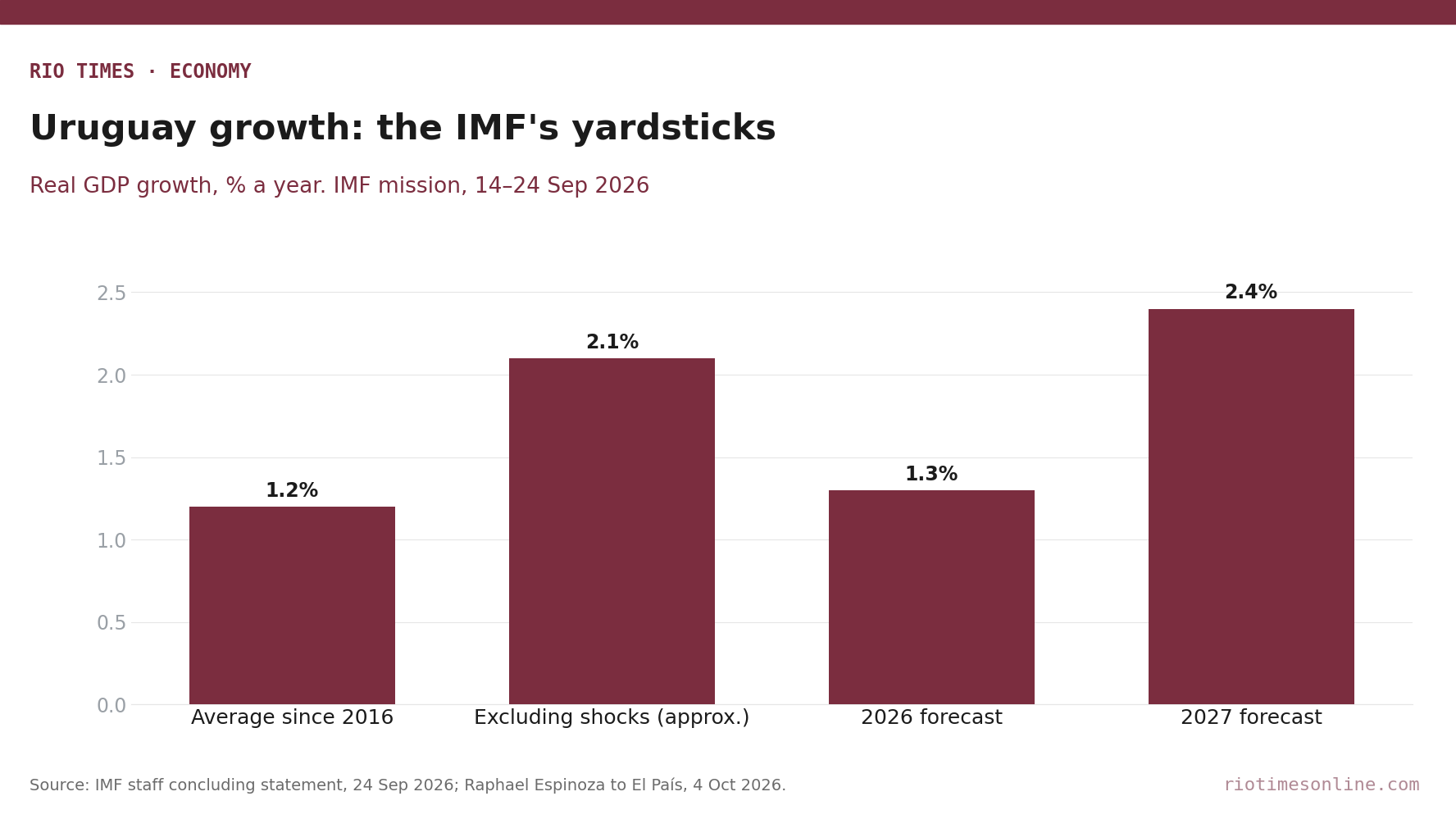
The interview follows the International Monetary Fund’s annual review, which ended on 24 September. Its staff noted that growth has averaged only 1.2% since 2016, too little to converge with rich-country incomes.
Why the Fund Expects a Rebound
The Fund’s mission, in Montevideo from 14 to 24 September, cut its 2026 growth forecast to 1.3% because last year’s drought hit farm output. It expects 2.4% in 2027.
Espinoza explained that optimism to El País. Leaving aside the pandemic of 2020–2021 and the historic 2023 drought, he said, the economy has grown about 2.1% a year.
He pointed to consumption, about 80% of GDP, growing at 2.5%. Fixed investment rose 9.5% year on year in real terms in the second quarter of 2026.
He also called monetary policy “accommodative”, which should help output reach its potential. Finance Minister Gabriel Oddone called the IMF’s reading “adequate” on 28 September, Subrayado reported.
A Tighter Fiscal Target Than the Government’s
The government aims for a primary deficit of 0.1% of GDP in 2029, covering central government and the BPS, the state social-security agency. The IMF urges a surplus of 0.5% instead.
Espinoza said debt to GDP stays broadly stable in the Fund’s baseline, so the aim is a falling path. The extra effort could be phased in gradually, he added.
His options are reviewing tax incentives, many set decades ago, moderating the public wage bill and spending reviews in health and education. He said such reviews should be gradual and evidence-based.
On the pending pension bill restoring retirement at 60, he cited BPS actuarial work showing a negligible effect. A full judgement needs the final text, he said.
Where Uruguay Could Be More Ambitious
Espinoza welcomed the competitiveness bill, saying licences to operate or import take far longer in Uruguay than elsewhere in the region. About one firm in five cites access to finance as a major obstacle.
Logistics and energy costs are not in the bill, he acknowledged, though the government has them on its agenda. He also urged state-company reform, with wages tied to productivity and cost-based pricing.
He defended Uruguay’s consensus politics as a source of durable policy. “Stability by itself cannot generate the increase in growth” the country’s social model needs, he said, urging “calculated risks” with discipline.
The Rate Decision Ahead
The IMF expects inflation to settle at the 4.5% target, with a gradual rise in the policy rate to a neutral level. The central bank (BCU) rate committee meets this week, Ámbito reported on 29 September.
On 28 September, 28-day BCU bills cleared at 5.94%, above the 5.75% policy rate, hinting at a 25 basis-point rise. Analysts polled by the BCU see one such increase within six months.
What Is Not Yet Known
The IMF board has not yet discussed the staff report, and the full document is not public. The final shape of the pension bill is also still open.
It is unclear whether the BCU moves this week or holds. Earlier coverage of the IMF’s 1.3% forecast set out the government’s more upbeat view.
Sources: El País (Uruguay), written interview with IMF mission chief Raphael Espinoza, 4 October 2026; El País, report on the IMF mission, 25 September 2026; IMF, Uruguay: Staff Concluding Statement of the 2026 Article IV Mission, 24 September 2026; Infobae, 29 September 2026; Uypress, 25 September 2026; Subrayado, 28 September 2026; Ámbito, 29 September 2026.
This article was produced by The Rio Times’ automated newsroom system. How we use AI · Report an error · Editorial responsibility: Matthias Camenzind, Editor-in-Chief
LatAm Markets: Live Signals → — real-time movers, turnover leaders and FX across Latin America.