Up to Half of São Paulo Students Could Be Infected in Class, Covid Study Says
RIO DE JANEIRO, BRAZIL – Worldwide, the return to school is one of the most sensitive issues in the process of restarting activities during the novel coronavirus pandemic.
While Brazil is discussing the best time for a return, a new study released on Friday, August 21st, shows that between 11 and 46 percent of students and staff in public schools could be infected with Covid-19 two months after returning to school.

The study was conducted by experts from the Ação Covid group, who have been simulating Covid-19 contagion throughout Brazil, in partnership with educational researchers from the Public School Network and the University (REPU).
The simulation estimates the probability that, if an infected person enters the environment, others will be infected attending in-person classes.
The figure considers two scenarios: a large and well-ventilated school (what the researchers called a dispersed school) and a smaller and cramped school (called a compressed school). Contagion would be high in both cases even if hygiene and distancing protocols were met by most people.
Thus, in the dispersed schools, on average 11 percent of students and teachers would be infected, according to the simulation. In the compressed school, it would be 46 percent.
The project includes a simulator, which citizens can use to simulate the risks of contagion in their schools.
The simulation model assumes that only 35 percent of students would be in school on a rotating schedule, which is established in the São Paulo government’s back-to-school plan introduced by Governor João Doria. Under the plan, classes are scheduled to start again on October 7th. The calculation also considers the staff who would be at the school according to the government’s plan.
Three potential interactions between people are estimated per day (entry, exit, and a recess break). The denser the school and the less government protocols are respected, the faster contagion will occur.
In practice, the result shows that students would only be safe if, in a smaller school, between 3.5 and seven percent of the students would attend school. And even in terms of the school with the largest space, it would only be able to hold between 20 and 11 percent of the students at a time.
Both percentages are below the 35 percent plan established by the São Paulo government.
“In other words, it is unlikely to return with this percentage, students would go to school twice a month. Our assessment is that it’s not possible to go back to school at this time,” says economist José Paulo Guedes Pinto, one of the study’s organizers and a member of Ação Covid, as well as Professor at ABC’s Federal University. “A less dense school will have a lower contamination dynamic than a smaller and more crowded school. Yet, even in the best scenario, there is no safety.”
The researchers used as a reference to design the simulator two state schools in São Paulo, elementary II, and high school. One school, in Pinheiros, has the best density and is wider, and the other, in Brasilândia, is classified as compressed.
“You can’t predict the future, but the simulation model is a potential scenario for different types of schools,” Guedes says.
In the calculation model, the study simulates an infected person entering the school every ten days. Other than that, the simulation does not consider the route students take between school and their homes, which may also lead to further contagion than expected.
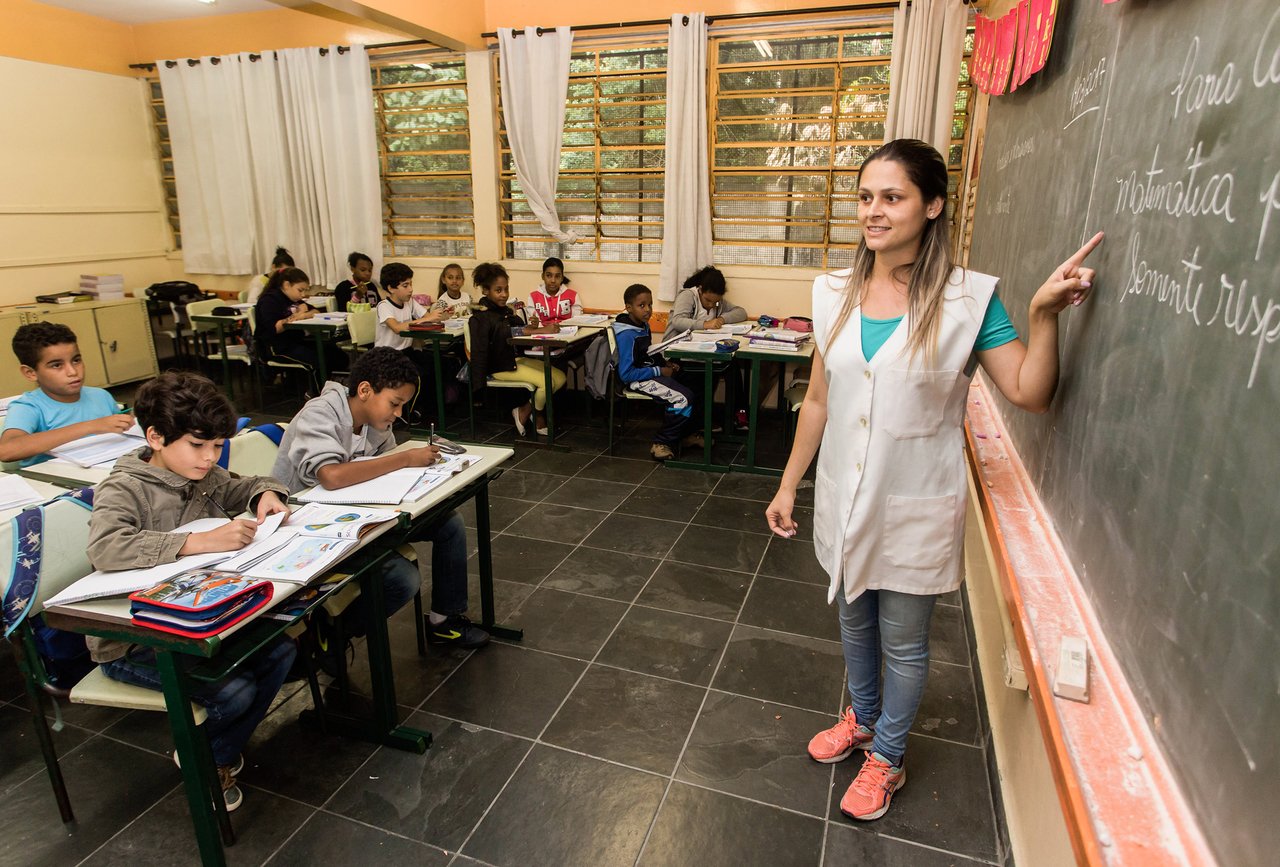
The state of São Paulo currently has some 7.7 million students in the public school system, from kindergarten to high school. In the state government’s system, used as a reference, there are 3.6 million students (most in primary and secondary education, older students, while younger ones traditionally attend municipal schools).
Researchers state that it is impossible to estimate the average number of contagion rates for the whole state or for the whole of Brazil, because the model is based on simulations for each type of school, and schools differ.
But the study shows that a high percentage of pupils could be at risk of infection, particularly in denser schools. “The model shows that there is great inequality in the probability of contagion within the public network,” Guedes says.
How to simulate
The simulator developed by the researchers can be found at this link. It is necessary to choose the number of students in the school, the level of hygiene and safety protocols, and whether people are expected to respect the safety guidelines. Researchers also recommend that each simulation be performed three times to ensure greater accuracy.
The probabilities used by the researchers in the calculation base are in line with the scientific literature now available: a person spreading the virus for about 14 days, and the chances of contagion in each location, as already estimated by the studies of Ação Covid in Brazil and other researchers in the world.
The chances of contagion in the event of contact with an infected person vary, depending on the socioeconomic situation and density of the location where the students come from, says Guedes.
“If the majority respect distancing and hygiene and one person accidentally stumbles upon another, the lowest chance of infection is 39 percent, the same as in a wealthy neighborhood in São Paulo, Switzerland, in New York,” he says.
The worst probability would be in a very poor community, at 48 percent. The researchers preferred not to use the worst rate because the trend at school is for students to try to maintain some distance, and teachers to encourage constant hand washing, Guedes says.
Thus, the three best rates were used to estimate the probability of contagion in schools.
More: Brazil news in English, every day from The Rio Times.
Living in or visiting São Paulo? See this month's events and our São Paulo city guide with rents, safety and upcoming concerts.
Source: Exame
This article was produced by The Rio Times’ automated AI newsroom. Editorial responsibility: Matthias Camenzind, Publisher and Editor-in-Chief. The Rio Times also runs Ask Rio Times, which answers from 100,000+ of our own articles, the daily Latin America Power Map, and prediction-market odds on elections and markets.. How we use AI · Report an error