Serbia Final Polls Split Before Sunday Vote

Key Facts
- Election date: Serbia's snap parliamentary election is set for Sunday, 25 October 2026, with polling stations closing at 20:00 local time (CET, UTC+1).
- What is at stake: All 250 seats in Serbia's National Assembly are being contested; 126 seats are required for a majority.
- Main contest: The ruling Serbian Progressive Party (SNS), led by former president Aleksandar Vučić, who is now its candidate for prime minister, faces the student-backed 'Student List – Students Win'.
- Latest poll: An Ipsos poll published 22 October, based on 3,624 respondents, put SNS at 47.4% and the Student List at 40.0%; the ruling list commissioned it.
- Final rally: Tens of thousands of people attended the Student List's final campaign rally in Belgrade on Thursday evening, 22 October; the independent Archive of Public Gatherings estimated about 150,000.
- Prediction markets: Polymarket gives Vučić’s list a 69.5% chance of finishing first (US$3.2 million traded), as of 23 October, 7:22 a.m. ET.
- US Eastern time: Polls close at 3:00 p.m. ET on Sunday, 25 October 2026; independent projections usually come first.
Election Set for Sunday
Serbia will hold a snap parliamentary election on Sunday, 25 October 2026, with polling stations closing at 20:00 local time (CET, UTC+1), or 3:00 p.m. ET. Independent projections usually come first, and the commission's own preliminary figures follow later that night.
This story is part of our coverage of the Serbia Election 2026. Dates, times and how to follow it are in our guide.
Our Serbia Election 2026 hub tracks every update.
The vote will fill all 250 seats in Serbia's National Assembly, with 126 seats required for a majority. The main contest is between the ruling Serbian Progressive Party (SNS), led by former president Aleksandar Vučić (now its candidate for prime minister), and the student-backed 'Student List – Students Win'.
Polls Show Tight Race
The freshest named-institute poll available is from Ipsos, published 22 October and based on 3,624 respondents. It was commissioned by the ruling list and put SNS at 47.4% and the Student List at 40.0%.
The Socialist Party-led list had 3.2%.
A separate NSPM poll published 20 October, surveying 1,050 people by telephone between 25 September and 5 October, showed a different picture among decided voters. It put the Student List at 44.5% and Vučić's United Serbia list at 42.7%, with 18.3% of respondents undecided.
The PolitPro aggregate as of 23 October gives SNS 45.0% and the Student List 42.5%. The poll gap is narrower than the Ipsos figures suggest.
What Prediction Markets Say
- Polymarket, winner of the election: Vučić’s United Serbia list 69.5% (US$3.2 million traded).
- Polymarket, Student List vote share: 40–45% at 29.5%, 35–40% at 28.0%, 45–50% at 23.0%.
- Polymarket, United Serbia vote share: 45–50% at 37.0%, 40–45% at 32.5%.
Prices are bets, not polls, and are as of 23 October, 7:22 a.m. ET. Why we show this: prediction markets turn real-money bets into a live probability that moves within minutes of the news, which is why investors, campaigns and newsrooms in the United States now follow them closely.
We show them next to polls and official results, never instead of them.
Final Rally and Arrests
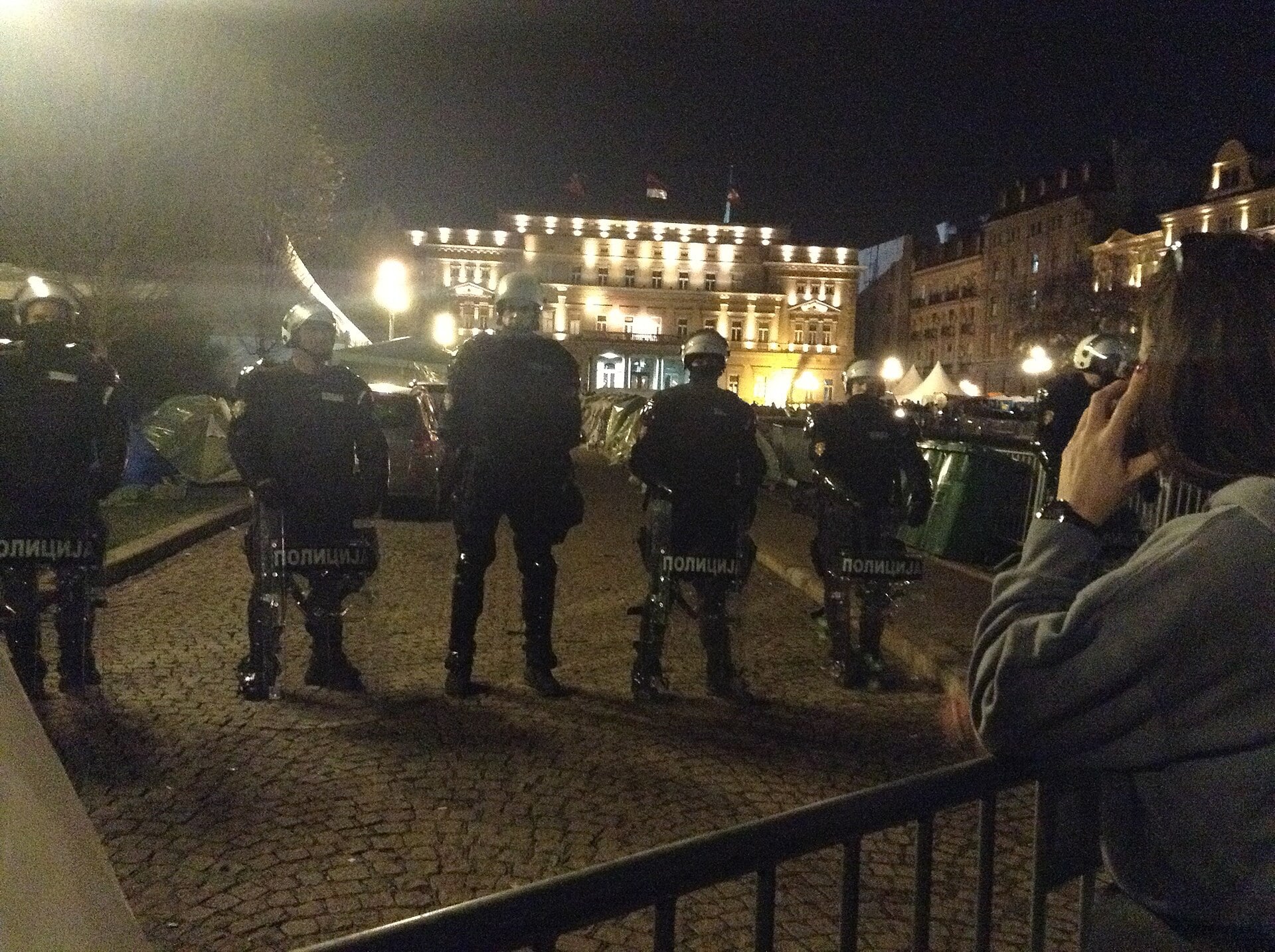
On Thursday evening, 22 October, tens of thousands of people attended the Student List's final campaign rally in Belgrade, and the independent Archive of Public Gatherings estimated about 150,000. The movement grew out of student protests following the November 2024 Novi Sad railway-station canopy collapse, which killed 16 people.
On Wednesday, 21 October, police arrested six people on suspicion of plotting violence and attacks on election day, according to the Higher Public Prosecutor's Office. The available reports do not establish whether prosecutors filed indictments, whether the suspects remain detained, or whether authorities linked the alleged plot to a particular political organization.
What Analysts Are Watching
Political scientist Dušan Vučićević of the University of Belgrade said the result was difficult to predict but expected the student movement to exceed 40%, which would be unusually strong for an opposition list under SNS rule. SNS and the Student List both claim to be ahead.
The Republic Election Commission (RIK) registered the Student List with 250 candidates, one for each parliamentary seat. Serbia's electoral system uses a single nationwide constituency and proportional allocation; most lists must obtain at least 3% of the vote, while recognized minority lists are exempt.
What It Means for US Readers
For US readers, the election is a test of whether a grassroots student movement can unseat a dominant ruling party in a European democracy. The contest has drawn comparisons to broader global debates about youth mobilization and institutional trust.
Traders on Polymarket put the odds of Vučić’s list finishing first at about 70%. Polling averages and the official count remain the primary measures of the contest.
What Is Not Known
Whether the Student List's apparent polling surge will translate into enough seats to form a government remains unknown. The final seat distribution and coalition arithmetic cannot be determined from vote-share polls alone.
How undecided voters will break, particularly the 18.3% recorded by NSPM, is not known. Whether smaller lists below the 3% threshold will win representation is also unclear.
Whether the arrests over alleged election-day violence will produce charges or affect the vote has not been established. Whether allegations of intimidation, media imbalance, surveillance, and cyberattacks will be substantiated through official investigations or independent observation is also unknown.
Related Reading
Serbia Votes Sunday After Student Protests
Sources
Republic Electoral Commission (RIK) · RTS, Ipsos poll · N1 Serbia · PolitPro · Polymarket. Prediction-market prices read on 23 October 2026, 7:22 a.m. ET.
This article was produced by The Rio Times’ automated newsroom system. How we use AI · Report an error · Editorial responsibility: Matthias Camenzind, Editor-in-Chief
Frequently Asked Questions
When do polls close in Serbia's election?
Polling stations close at 20:00 local time (CET, UTC+1) on Sunday, 25 October 2026. That is 3:00 p.m. ET in the United States.
Who are the main contenders?
The ruling Serbian Progressive Party (SNS), led by former president Aleksandar Vučić, who is now its candidate for prime minister, faces the student-backed 'Student List – Students Win'. The SNS has been in government since 2012.
What do the latest polls show?
An Ipsos poll published 22 October put SNS at 47.4% and the Student List at 40.0%. A separate NSPM poll among decided voters showed the Student List at 44.5% and Vučić's United Serbia list at 42.7%.
What do prediction markets say about Serbia's election?
Polymarket gives Vučić's United Serbia list a 69.5% chance of finishing first, as of 23 October. Prices are bets, not polls.
How many votes does a list need to win seats?
Most lists need at least 3% of the vote to win seats, while recognised minority lists are exempt.