Puerto Vallarta Travel Guide for Expats and Nomads 2026

MEXICO · PUERTO VALLARTA · EXPATS & NOMADS
Key Facts
- •The place Puerto Vallarta is a beach city on Banderas Bay, on Mexico’s Pacific coast in the state of Jalisco. Together with the resort towns across the state line in Nayarit, it draws visitors and long-stay residents from the United States and Canada through its international airport.
- •Why it matters Mexico lets US citizens visit without a visa for up to 180 days, so remote workers and snowbirds can try the city as tourists before committing.
- •Why now On 22 February 2026 the Mexican army and National Guard killed the leader of the Jalisco New Generation Cartel, CJNG. Blockades followed across Jalisco, international flights at Puerto Vallarta were cancelled and the US Embassy told Americans in the city to shelter in place.
- •Where things stand The State Department’s advisory of 29 May 2026 rates Jalisco Level 3, Reconsider Travel, but places no restrictions on its own staff in Puerto Vallarta or neighbouring Riviera Nayarit.
- •The numbers Mexico’s tourist entry fee is MXN 983 (about US$55), usually built into the air fare. Temporary residence through a US consulate requires, for example, US$4,049 a month in income at the San Diego consulate in 2026.
- •What it means for you Check the days stamped at entry, plan for the hurricane season from 15 May to 30 November, and apply for residence at a Mexican consulate at home if you want to stay beyond six months.
- •Still open Whether the city’s own fee on foreign visitors is being collected in 2026, after Mexico’s Supreme Court struck down the first version, is not clear.
Puerto Vallarta is a Pacific beach city in Mexico’s Jalisco state that draws American retirees, remote workers and families for stays of weeks to years. A US passport gets you up to 180 days as a visitor, and anything longer means applying for temporary residence at a Mexican consulate before you move.
Safety is the first question most Americans ask in 2026. A cartel crisis in February briefly shut the city down, and the State Department now rates Jalisco as a whole Level 3 while placing no restrictions on Puerto Vallarta itself.
This guide covers entry, residence, safety, neighbourhoods, the weather calendar and a first-month checklist. Peso amounts are converted at the Tuesday 6 October 2026 close of MXN 17.98 per US dollar.
Entering Mexico as a Visitor
US citizens need a passport valid at entry and no visa for visits of up to 180 days, according to the State Department. Mexican immigration officials decide on arrival how long you may stay, so check the number of days granted before you leave the immigration hall. All travellers need an entry permit, the FMM, from the National Migration Institute, INM.
The visitor status carries a federal fee, the Derecho de No Inmigrante, of MXN 983 (about US$55) in 2026, under Mexico’s Federal Duties Law as amended in the Official Gazette on 7 November 2025. For air passengers it is usually included in the ticket price; travellers arriving by land or sea pay it on entry.
The fee is charged to visitors entering without permission to do paid work, so visitor status does not allow a job with a Mexican employer. People who plan to stay longer and work remotely from Puerto Vallarta usually apply for temporary residence, a route the Mexican consulate in San Diego spells out for remote workers.
Staying Longer With Temporary Residence
Temporary residence is applied for at a Mexican consulate outside Mexico, before you move. Each consulate publishes its own requirements; the Consulate General of Mexico in San Diego lists these for 2026:
- Income of at least US$4,049 a month from employment or a pension over the previous six months, or
- Savings or investments with an average monthly balance of at least US$68,241 over the previous 12 months.
- Applicants who qualify through a job must add a letter from their supervisor stating their salary and explicitly agreeing to their plan to live in Mexico and work remotely.
- A non-refundable processing fee of US$56, in cash, and an appointment booked through the MiConsulado system.
The San Diego consulate says it may take up to ten business days to decide and advises against buying plane tickets before the visa is issued. Even with a visa, entry is still decided by the immigration officer at the border, the consulate notes.
Safety After the February Crisis
On Sunday 22 February 2026, the Mexican army and National Guard killed Nemesio Oseguera Cervantes, known as El Mencho, the founder and leader of the Jalisco New Generation Cartel, in Tapalpa, Jalisco, the Tijuana weekly Zeta reported. Mexico’s Defence Ministry said US authorities had supplied complementary intelligence for the operation.
President Claudia Sheinbaum, of the governing Morena party, appealed for calm as road blockades spread. The airport operator, Grupo Aeroportuario del Pacífico, said airlines had cancelled all international and most domestic flights at Puerto Vallarta that day, Peru’s state newspaper El Peruano reported.
The US Mission in Mexico told Americans in Puerto Vallarta, Guadalajara and other cities to shelter in place in a security alert on 23 February. By 24 February, Mexico’s federal Security Cabinet reported a gradual reopening of business and schools, while crews in Jalisco were still removing vehicles that blocked roads. The US Embassy had stopped urging Americans to shelter in place but kept a night curfew for its own staff in Puerto Vallarta, and said the road between Guadalajara and Puerto Vallarta had not fully reopened, according to Zeta.
The State Department’s current advisory, issued on 29 May 2026, rates Mexico overall Level 2, Exercise Increased Caution, over terrorism, crime and kidnapping. Jalisco is Level 3, Reconsider Travel, but the advisory states that there are no restrictions on travel by its staff in Puerto Vallarta, including neighbouring Riviera Nayarit; Nayarit state is Level 2. Across Mexico, US government staff may not travel between cities after dark and must use dispatched taxis or apps rather than hailing cabs in the street, and the department advises all US citizens to follow the same rules.

The City’s Fee on Foreign Visitors
Puerto Vallarta has tried to charge its own fee to foreign tourists arriving by air or cruise ship. The Jalisco state Congress approved a fee of MXN 141 (about US$7.85) in February 2025, payable once a year, with children under 14 exempt, according to TV Azteca Jalisco.
Mexico’s Supreme Court annulled that version on 1 December 2025 for vague wording. The city then rewrote it as a fee of MXN 160 (about US$8.90) to fund public works and tourism infrastructure, which the state Congress approved for 2026, Mexico News Daily reported. Ask your airline or cruise line whether it is being charged.
Choosing a Neighbourhood
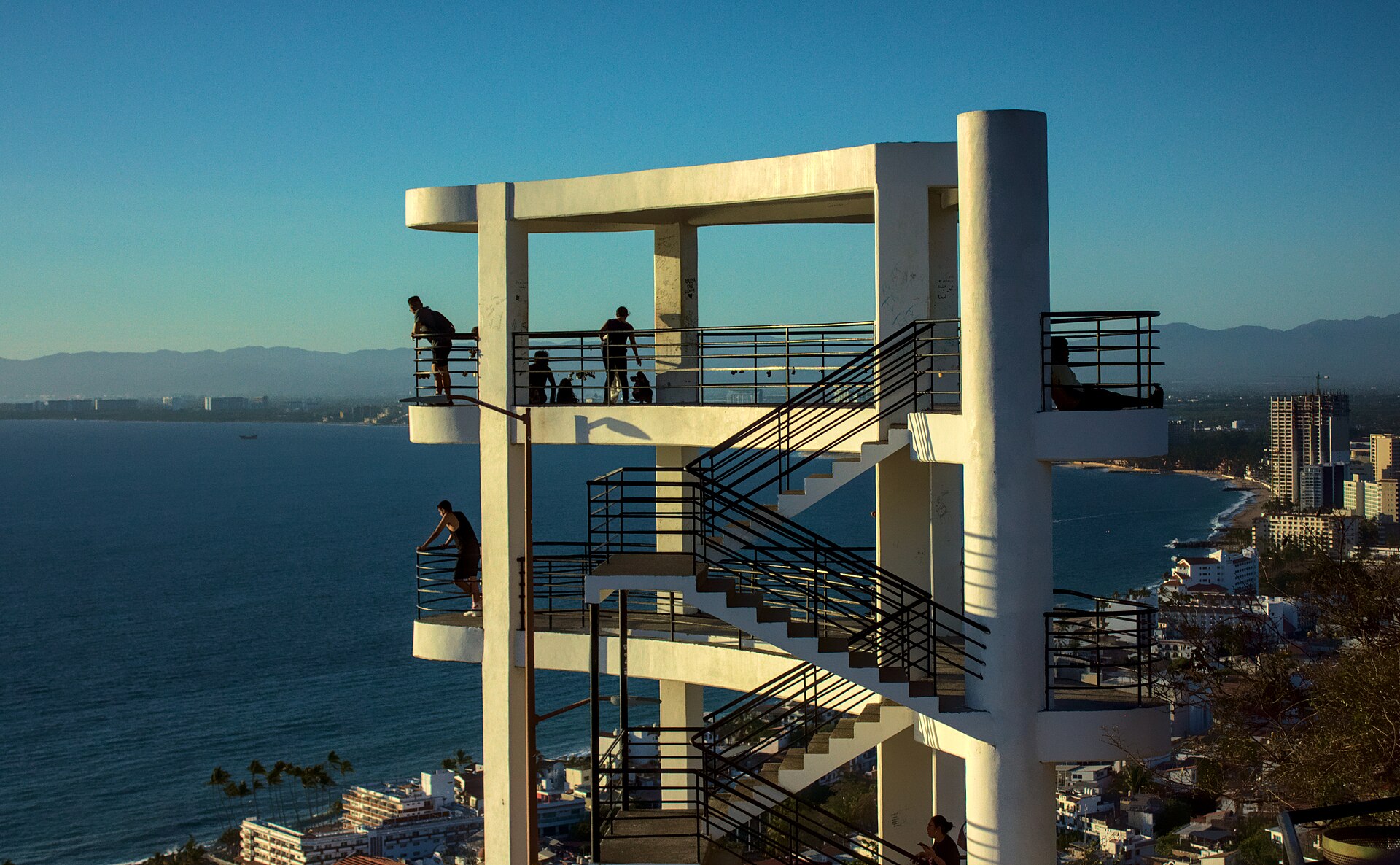
Puerto Vallarta runs along the bay from the airport in the north to the jungle coast in the south. The main areas, north to south:
- Nuevo Vallarta and Bucerías: across the Ameca River in Nayarit state, with resort developments and quieter beach towns.
- Marina Vallarta: the yacht marina beside the airport, with condos and a golf course.
- Hotel Zone: the strip of large beach hotels between the marina and downtown.
- Centro: the old centre around the Malecón seafront promenade and the Our Lady of Guadalupe church.
- Zona Romántica: south of the Cuale River, around Playa de los Muertos, a compact area many people manage without a car.
- Conchas Chinas and the south shore: steep hillside homes and smaller coves toward Mismaloya, with longer drives into town.
Before signing a lease, test the internet at the time of day you work, ask about water pressure and storage, and check how the street drains in heavy rain.
Weather and the Hurricane Season
The eastern Pacific hurricane season, which includes Mexico’s Pacific coast, runs from 15 May to 30 November, according to the US National Hurricane Center. An average season brings 15 named storms, eight hurricanes and four major hurricanes, based on 1991 to 2020 data.
If you stay through the summer and autumn, buy insurance that covers storm damage and evacuation, keep a power bank and mobile data backup, and follow Mexico’s civil protection agency for warnings.
Your First Month: A Checklist
- Check the days granted at entry and keep a photo of your entry record with your passport.
- Rent short-term for the first month before committing to a lease.
- Use dispatched taxis or ride apps, and avoid driving between cities after dark.
- Find the nearest private hospital and pharmacy, and confirm your insurance pays claims in Mexico.
- Sign up for US Embassy alerts through the State Department’s Smart Traveler Enrollment Program.
- If you will stay beyond 180 days, start the consulate appointment for temporary residence well before you leave home.
What It Means for You
For a US reader the city is open and easy to reach, but it sits inside a state where cartel violence can spill into daily life, as February showed. Follow the State Department’s rules for its own staff, keep travel plans flexible, and enrol for embassy alerts.
On paperwork, the decision is simple: under six months, come as a visitor; longer, or if you want legal clarity for remote work, apply for temporary residence at a consulate before you go. Consulates publish their own income figures, which can differ, so check the one where you will apply.
What Is Not Known
It is not clear whether Puerto Vallarta’s foreign visitor fee is being collected in 2026, or how. Consulate income thresholds differ from one consulate to another and change each year, so the San Diego figures are an example, not a national rule. Nor can anyone say whether the violence seen in Jalisco in February will return.
Frequently Asked Questions
Is Puerto Vallarta safe for Americans in 2026?
The State Department rates Jalisco Level 3, Reconsider Travel, but places no restrictions on its staff in Puerto Vallarta or Riviera Nayarit. The city was disrupted by cartel blockades in February 2026 after the army killed the CJNG leader.
How long can a US citizen stay in Puerto Vallarta?
Up to 180 days as a visitor, without a visa. Mexican immigration officials decide the number of days on arrival, so check it before leaving the immigration hall.
Can I work remotely from Puerto Vallarta?
Visitor status does not allow paid work in Mexico. For longer stays, apply for temporary residence at a Mexican consulate; the San Diego consulate asks remote workers for an employer letter approving the move.
How much income do I need for Mexican temporary residence?
It depends on the consulate. In 2026 the San Diego consulate asks for US$4,049 a month in income over six months, or an average balance of US$68,241 over 12 months.
Sources: US State Department, Mexico Travel Advisory, 29 May 2026, US Mission Mexico, security alert on shelter in place, 23 February 2026, Consulate General of Mexico in San Diego, temporary resident visa (economic solvency), 2026, US National Hurricane Center, tropical cyclone climatology, Diario Oficial de la Federación, Federal Duties Law reform, 7 November 2025, Zeta Tijuana, El Mencho killed in Tapalpa, 22 February 2026, El Peruano, Sheinbaum calls for calm, February 2026, Zeta Tijuana, Security Cabinet on return to normal, 24 February 2026, TV Azteca Jalisco, Puerto Vallarta visitor fee, Mexico News Daily, Puerto Vallarta foreign tourist tax after court ruling. Exchange rate: Tuesday 6 October 2026 close, MXN 17.983 per US dollar. All retrieved 7 October 2026.
This article was produced by The Rio Times’ automated newsroom system. How we use AI · Report an error · Editorial responsibility: Matthias Camenzind, Editor-in-Chief