
POLITICS · PERU
Key Facts
- —The country Peru, a leading copper exporter and US free-trade partner, has been governed since July 2026 by President Keiko Fujimori. Its Congress again has two chambers, Deputies and a Senate.
- —Why it matters Decree powers let a Peruvian government legislate by decree for a fixed period. Their scope decides how fast rules on crime, El Niño and investment can change.
- —Why now The Chamber of Deputies debates the request in plenary on Tuesday 6 October from 10 a.m. Lima time, with three hours allotted (El Comercio, 3 Oct).
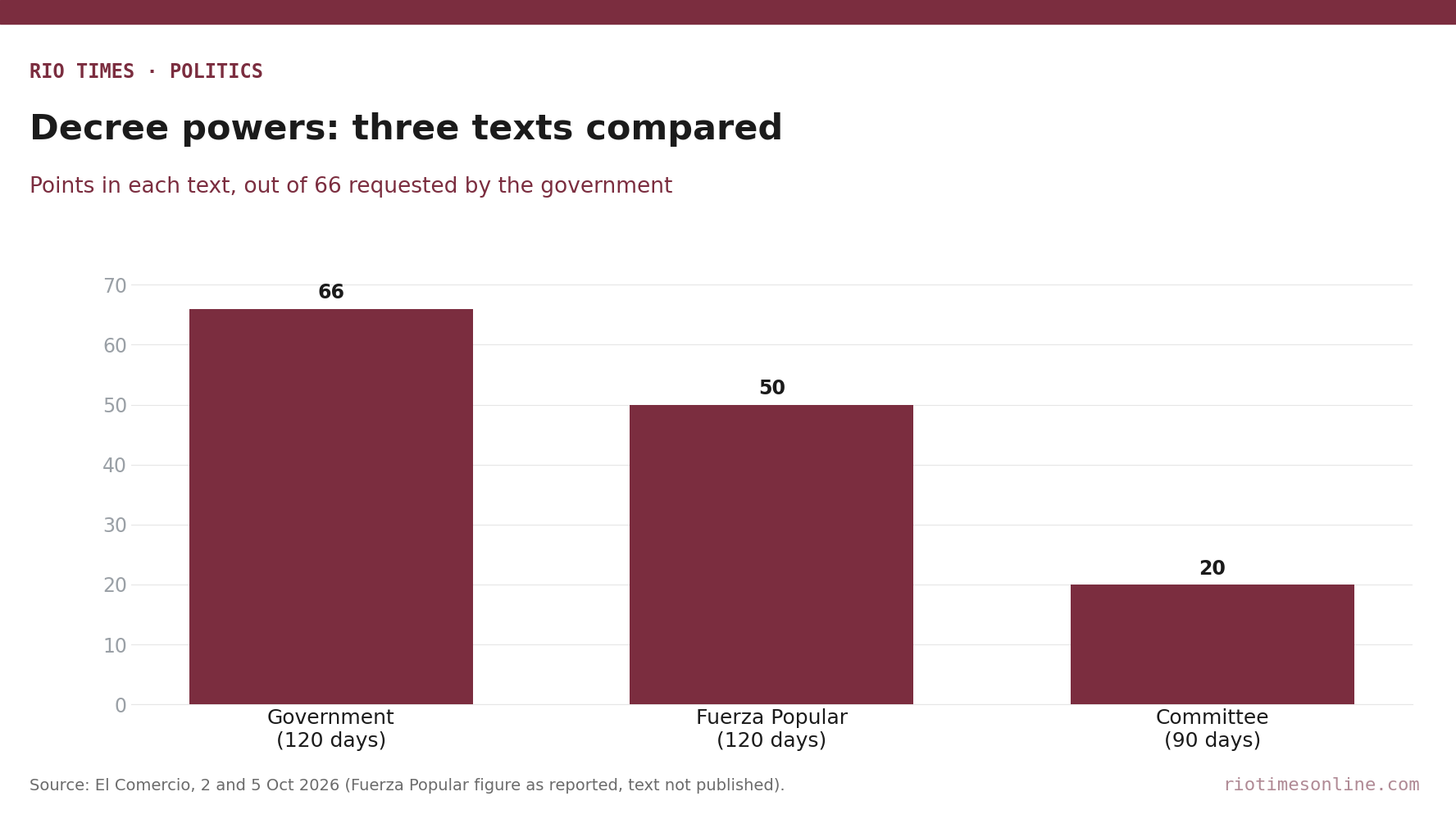
- —What happened Fuerza Popular, the conservative party Fujimori leads, has finished a 513-page minority text keeping 50 of the 66 requested points, El Comercio reported on 5 October.
- —The numbers The government sought 66 points in eight areas for 120 days. The committee text, approved 13 to 5 on 1 October, keeps 20 points in two areas for 90 days (El Comercio, 2 Oct).
- —What it means for you A hydrocarbon investment item is missing from both texts (El Comercio, 5 Oct), so it would need a slower ordinary bill. Faster security decrees look likely under either version.
- —Still open Whether any other bloc backs the Fuerza Popular text, whether the government accepts a narrow package, and when the Senate votes.
Peru decree powers sought by President Keiko Fujimori go to a vote in the Chamber of Deputies on Tuesday 6 October. For US firms in Peruvian mining and energy, the size of the package sets how quickly the rules can change.
Her conservative party, Fuerza Popular, which she leads, has finished a rival text keeping 50 of the 66 requested points, El Comercio reported on 5 October. The committee version on the agenda keeps only 20, limited to public security and the El Niño weather threat.
What Fuerza Popular Is Proposing
The text runs to 513 pages and argues for powers in all eight subject areas, for the full 120 days. El Comercio, which saw the document, said the party will present it to the plenary as an alternative.
It would still drop some of the government’s items. Three labour points would go, covering severance pay, a formalisation regime and changes to public holidays.
In productive development, eight of 19 points would be removed, the paper reported. One of them would have promoted private investment in hydrocarbon exploration, production and storage.
Another dropped item would have let children under 12 hold savings accounts. The text also abandons a plan to repeal the law creating a professional association for Peruvian artists.
That repeal is already moving separately. Culture Minister Alberto Beingolea told RPP on 2 October that the Education Committee had approved it.
Fuerza Popular deputy Jaime Abensur told El Comercio on 3 October that the aim was to restore most powers the committee rejected. These include an operational role for the national intelligence directorate and legal protection for soldiers acting against crime.
How Tuesday’s Vote Works
The plenary meets at 10 a.m. Lima time (11 a.m. ET) on Tuesday, with three hours of debate shared among six blocs. Party spokespeople picked the date because Thursday, the usual plenary day, is a national holiday.
The majority text is debated first, Abensur told reporters on 2 October, according to Gestión. Only if it fails does the minority text come up for debate.
The committee text passed with 13 votes in favour, five against and two abstentions, El Comercio reported. Three Fuerza Popular members backed it with reservations, while Juntos por el Perú, the left-wing party of former presidential candidate Roberto Sánchez, voted against.
Whatever the Deputies approve then goes to the Senate. That second reading is new, part of the two-chamber system restored with this year’s general election.
Where the Other Blocs Stand
Renovación Popular is the conservative party of former Lima mayor Rafael López Aliaga. Its deputy Frank Krklec told El Comercio that Fuerza Popular was within its rights to file a minority text. The paper quoted him as saying his bloc would “most likely” back the committee’s consensus text.
Obras, the party of former Lima mayor Ricardo Belmont, and Ahora Nación, the left-wing party of former university rector Alfonso López Chau, joined Juntos por el Perú in writing to Prime Minister Luis Galarreta. They asked for a new request limited to security and El Niño.
Their letter warned that the Senate could “distort” the two-chamber process by restoring rejected items. Panamericana reported the letter on 3 October.
Obras deputy Víctor Piñán urged the government on 2 October to respect the committee deal, Gestión reported. He warned that if the plenary added items, some blocs could reject even the agreed points.
The government wants more. On Monday, President Fujimori said she hoped deputies would “widen this first” committee text, state news agency Andina reported.
Galarreta told Canal N on 2 October that the committee text was “heavily cut” and lacked sufficient tools, El Comercio reported.
Beingolea told RPP the same day that excluding military logistics was “a barbarity”. He also said Congress was taking far too long.
The Investment Signal
On Monday, Senate President Miguel Torres pledged that Congress would back legal certainty and stable rules to attract foreign investment. He was opening a Peru–Italy business forum at the Lima Chamber of Commerce, Congress said.
Investors read the fight over Peru decree powers in that light. Items left out of any final package, including tax measures, can still advance as slower ordinary bills through both chambers.
Earlier stages are covered in Peru Legislative Powers: Committee Draft Urges Rejecting Fujimori’s 120-Day Request. The compromise is explained in Peru Decree Powers Cut to Security and El Niño.
Both texts on Tuesday’s table keep security and El Niño powers, so some delegation looks likely either way. How wide it will be remains the open question.
What It Means for You
For US companies in Peruvian mining and energy, the vote sets how much of the rulebook the executive can rewrite without Congress. The hydrocarbon investment item is out of both texts, so any change there needs a slower ordinary bill.
Holders of US-listed Peruvian shares, such as the lender Credicorp, are watching whether deputies back a broad 120-day package or a narrow 90-day one. A narrow package keeps most rule changes in Congress, where they move more slowly.
Travellers and firms with staff in Peru should expect faster security and El Niño decrees under either text. The Senate vote, which has no date yet, is the next step to watch.
What Is Not Known
El Comercio has not published the Fuerza Popular text, and the 50-point figure has not been independently confirmed. It is also unclear whether the party will formally file it before Tuesday’s session.
No other bloc has publicly endorsed the minority text so far. The Senate has not announced when it will take up whatever the Deputies pass.
It is not known whether the government would accept narrower Peru decree powers or keep pressing for more. Labour Minister Juan Sheput ruled out a confidence vote over the request on 28 September, El Comercio reported.
What are decree powers in Peru?
Under Article 104 of Peru’s Constitution, Congress can let the executive issue legislative decrees on set matters for a fixed period. The government must report each decree to Congress.
When do Peru’s deputies vote on the decree powers?
The Chamber of Deputies debates the request in plenary on Tuesday 6 October from 10 a.m. Lima time, 11 a.m. ET, with three hours allotted. If approved, the bill then goes to the Senate.
What would the Fuerza Popular text change?
According to El Comercio, it would grant 50 of the 66 requested points in eight areas for 120 days. The committee text grants 20 points in two areas, security and El Niño, for 90 days.
Sources: El Comercio, 5 Oct; El Comercio, 3 Oct; El Comercio, 2 Oct; Gestión, 2 Oct; RPP, 2 Oct; Panamericana; Andina, 5 Oct; El Comercio live, 5 Oct; Congress of Peru, 5 Oct.
Editorial responsibility: Matthias Camenzind, Editor-in-Chief · Editorial standards · Report an error