El Niño Puts 756 Latin American Hospitals at Risk as Dengue Cases Top 624,000
Health: Latin America
Key Facts
—Dengue surge. In epidemiological week 12 of 2026, the Americas reported 624,085 suspected dengue cases, a cumulative incidence of 62 per 100,000 population — a 64% decrease from the same period in 2025 but still elevated.
—El Niño threat. PAHO’s July 2026 analysis warns that the 2026–2027 El Niño event could expose 756 emergency hospitals in the Americas to coastal-flooding risks and disrupt supply chains for medicines and medical supplies.
—2025 baseline. The Americas recorded 4.46 million suspected dengue cases in 2025, down 66% from the record 13 million in 2024 but still above the pre-pandemic average. All four serotypes circulated simultaneously in Brazil, Colombia and Mexico.
—Brazil lead. Brazil reported 1.66 million probable dengue cases in 2025, with an incidence rate of 775.7 per 100,000. In early 2026, 62,707 suspected cases were reported through epidemiological week 5.
—Vaccine access. PAHO is advising member states on newly approved dengue vaccines and has expanded clinical-training networks, while warning that climate-related disruptions could delay immunization campaigns.
Latin America is entering the 2026–2027 El Niño cycle with dengue still circulating at scale and its health infrastructure — including hundreds of coastal hospitals — newly exposed to climate-driven flooding risks.
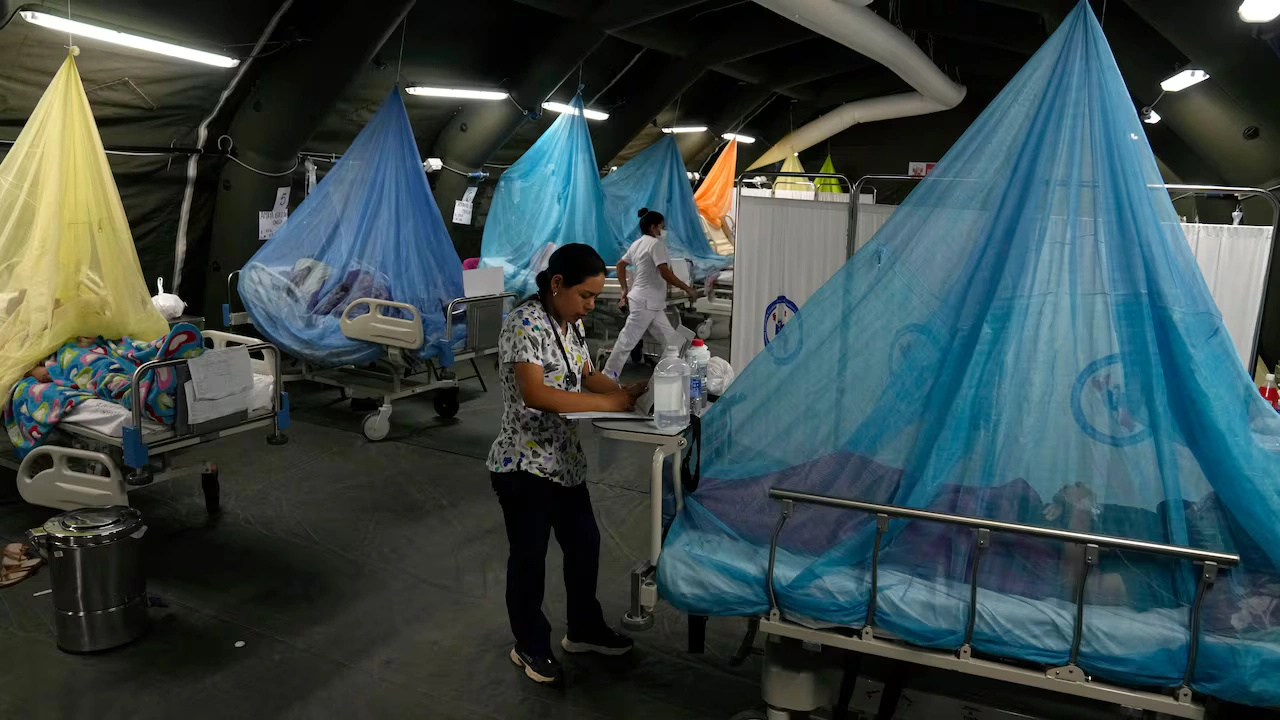
The Scale of the Dengue Burden in 2025–2026
The Americas experienced its largest dengue epidemic on record in 2024, with more than 13 million cases reported to the Pan American Health Organization. In 2025, the numbers fell but remained high: 4.46 million suspected cases and 1.68 million confirmed cases across the region, according to PAHO’s February 2026 epidemiological update. The decline of 66% from 2024 was partly seasonal, but the underlying transmission potential remains.
Brazil accounted for the largest share. In 2025, the country reported 1.66 million probable cases, 1.45 million of them confirmed, with 1,793 deaths. The incidence rate was 775.7 per 100,000 population. Colombia reported 125,119 suspected cases in 2025, including 86,881 confirmed and 124 deaths. All four dengue virus serotypes — DENV-1, DENV-2, DENV-3 and DENV-4 — circulated simultaneously in Brazil, Colombia, Costa Rica, El Salvador, Mexico, Panama and Puerto Rico.
In the first weeks of 2026, the pattern continued. Through epidemiological week 12, PAHO reported 624,085 suspected cases across the Americas. Brazil alone added 62,707 suspected cases in the first five weeks of the year. The figures represent a 64% decrease from the same period in 2025, but PAHO warned that the seasonal uptrend is consistent with expected behavior and that health systems should prepare for potential increases.
What El Niño Adds to the Health Risk
In July 2026, PAHO published a public-health situation analysis specifically on the El Niño climate event for 2026–2027. The document is not a forecast of certainty but a mapping of vulnerabilities. It identifies the same set of climate-sensitive diseases — dengue, Zika, chikungunya, malaria, cholera — and adds a new layer of infrastructure risk.
The analysis examined 756 emergency hospitals across the Americas and found them exposed to coastal flooding associated with sea-level rise, which El Niño can amplify through storm-surge and extreme-rainfall events. The risk is not theoretical: disruptions to supply chains for medicines, vaccines and medical equipment have already occurred during past climate emergencies in the region.
The report also notes that drought conditions can paradoxically increase dengue transmission. When water becomes scarce, households store it in open containers, creating breeding sites for the Aedes aegypti mosquito. The 2023–2024 El Niño contributed to severe drought in the Brazilian Amazon, disrupting healthcare access and increasing malaria incidence in states such as Rondônia. The same dynamics could recur.

How Countries Are Responding
PAHO’s response has three pillars: surveillance, vector control and clinical training. The organization has deployed expert teams to affected countries, expanded its online clinical-diagnosis course for dengue, and established national networks of clinical specialists in arboviral diseases. In August 2025, PAHO held a workshop to update its Integrated Management Strategy for Arboviral Disease Prevention and Control, setting a roadmap for 2026–2030.
On the vaccine front, PAHO is advising member states on newly approved dengue vaccines, though access remains uneven. The organization emphasizes that vaccination is a complement to, not a replacement for, vector control and early clinical management. It also warns that climate-related disruptions could delay routine immunization campaigns, widening existing immunity gaps.
The bottom line is that Latin America’s health systems are facing a converging threat: endemic arboviral diseases that never fully receded, a new El Niño cycle that amplifies both drought and flood risks, and infrastructure that was not designed for either. The 756 hospitals in the flood-risk zone are a concrete measure of that vulnerability.
Frequently Asked Questions
How many dengue cases were reported in the Americas in 2025?
The Americas reported 4.46 million suspected dengue cases in 2025, including 1.68 million confirmed cases, 8,966 severe cases and 2,207 deaths. This was a 66% decrease from the record 13 million cases in 2024.
What does El Niño mean for healthcare in Latin America?
PAHO’s July 2026 analysis warns that El Niño could expose 756 emergency hospitals to coastal-flooding risks, disrupt medicine supply chains, and increase transmission of dengue, malaria and waterborne diseases through both flooding and drought-driven water-storage practices.
Which countries are most affected by dengue?
Brazil leads in absolute numbers (1.66 million probable cases in 2025), followed by Colombia, Mexico, Guatemala and Panama. All four dengue serotypes circulated simultaneously in Brazil, Colombia, Mexico and several Central American countries in 2025.
Connected Coverage
Healthcare preparedness is part of Latin America’s broader resilience challenge.
Sources: PAHO; WHO.
This article was produced by The Rio Times’ automated newsroom system. How we use AI · Report an error
Read More from The Rio Times