Is there enough water in the Andean region of Bolivia for all of 2023?
Much of the country is affected by a severe drought due to a shortage of rainfall expected to start at the end of 2022.
The government of Luis Arce is developing strategies to prevent the population from suffering from the lack of water.
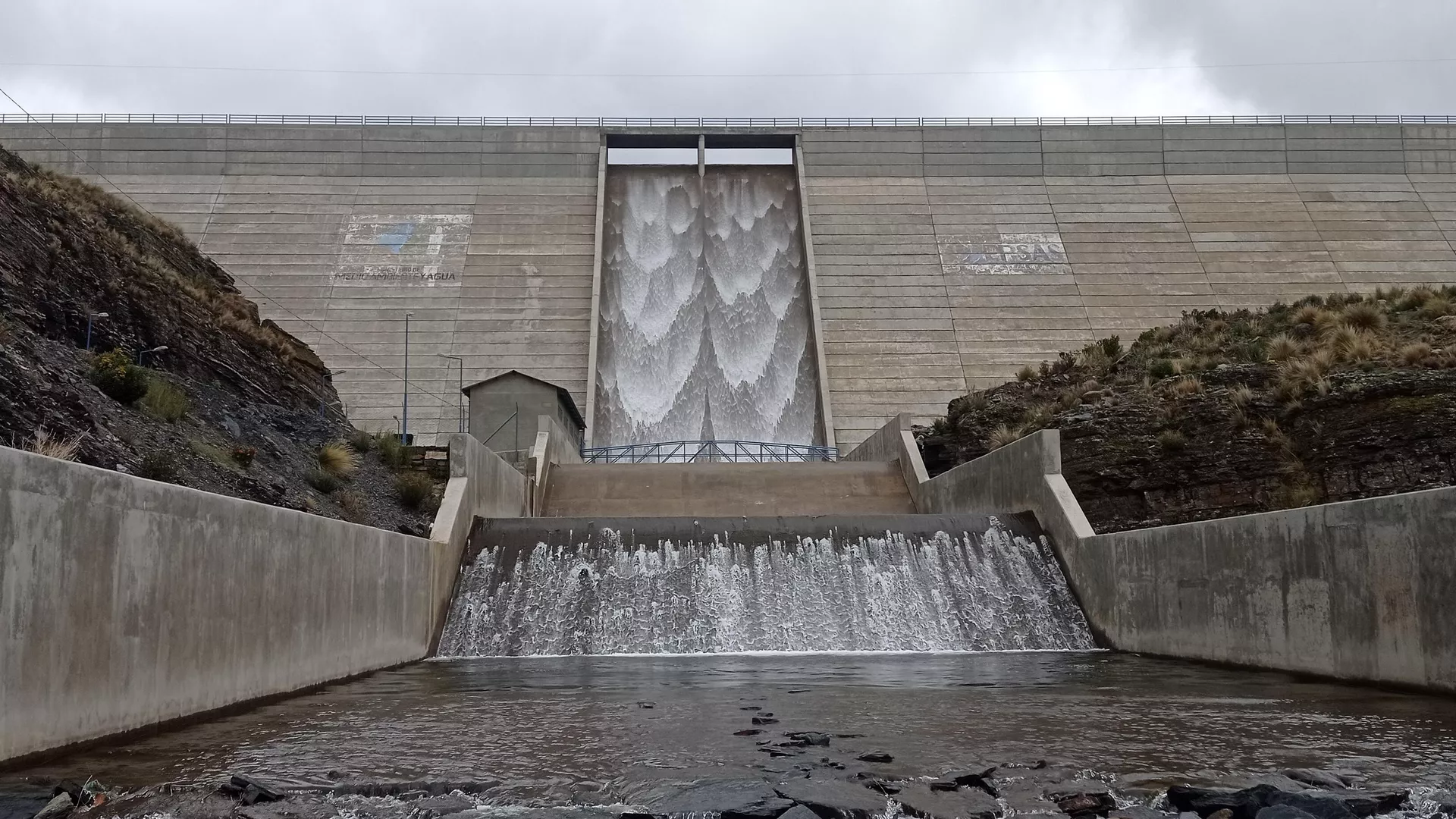
Sputnik visited the Hampaturi dam, one of the reservoirs providing water to La Paz.
In 2017, Bolivia suffered one of the worst droughts in its history in the face of a sluggish rainy season, which in this region takes place mainly during the summer.
The most affected department was La Paz, whose population depends primarily on dams that store water from melting glaciers and rainfall.
The 2022-2023 rainy season was also scarce.
In February of this year, heavy rainfall was only recorded throughout the country, when it usually begins in November and ends in April.
Therefore, special measures must be taken to avoid a further shortage of this resource in a few months.
The drought recorded in these rainy seasons is due to La Niña, a meteorological phenomenon that periodically affects this region of South America.
Bladimir Iraizos is the comptroller of the Empresa Pública Social de Agua y Saneamiento (EPSAS).
In a press conference, he guaranteed the water supply for this year in La Paz.
“Currently, we are at 74% of the storage capacity, which is 43 million cubic meters in our 10 dams”.
Sputnik visited the Hampaturi highlands in the rural area of the municipality of La Paz.
The dam, built between 1945 and 1993, is one of 10 dams that supply the approximately 2.5 million inhabitants of La Paz.
HAMPATURI
The Hampaturi dam is one of the most outstanding tourist areas in the vicinity of the capital of La Paz.
To get there, it is necessary to go to Pampahasi, the neighborhood on the hillside opposite the city of El Alto.
Buses leave from there to the native communities near the reservoir.
After walking uphill for an hour and a half, you reach the first dam at 4,000 meters above sea level.
A couple of kilometers further up is the imposing Ajuar Khota dam, whose construction dates back to 1993.
There are the crystalline waterfalls of Hampaturi, which join these dams.
Several travel agencies organize site visits, including a walk through an abandoned mine, which against all logic, is just a few meters from the dams.
Katherine Fernández coordinates the Polinizar Network, which organizes trips to agro-tourist communities.
Hampaturi was one of the 25 rural areas in La Paz that they visited, but the death of several native authorities during the COVID-19 pandemic cut off the main links.
In mid-2021, circulation in the country was reactivated and, consequently, tourism.
“Also, mining has intensified in this area, so it is unknown how contaminated the water is. Pipes are coming out of the mine from the old dam to carry the heavy water. But there is no certainty that they are well maintained because they border the dam,” she told Sputnik.
CYCLICAL DROUGHT
Through the network, Fernández recurrently visits rural communities in La Paz, which depend entirely on meltwater and rainfall.
She recalled that during the great drought of 2016-2017, “there were hydrologists who warned us that this phenomenon would be cyclical, that it would be five-yearly,” which would now be fulfilled.
Fernández says there’s a lack of “work in the social part of the communities that consume a large amount of water [such as the city of La Paz] so that they take precautions. They should use storage tanks again so that they do not waste water so that we have enough water until the rainy season returns, which hopefully will be abundant”.
The coordinator of the Polinizar Network considered that there is also a lack of coordination between the municipalities that share river basins.
“The Government [of La Paz] does not articulate the basin plans of the different municipalities either. This is another problem.”
Fernández insisted that the different levels of government should implement “aggressive tree planting”.
Planting trees helps to retain soil moisture and manage runoff, that is, rainwater that seeps into the soil.
The coordinator pointed out that, on the contrary, “more cementing is taking place, the construction of gigantic infrastructures is advancing in La Paz”.
She explained that the constructions in the Bolivian capital, in addition to cement, carry stones and materials found in the river basins, which are currently unprotected.
The current mayor of La Paz is Iván Arias, who was Minister of Public Works during the de facto government of Jeanine Áñez (2019-2020).
Based on her visits to rural communities in La Paz, Fernández calculated that “crop losses in each family range from US$725 to US$5,000, only in the campaign that began in August 2022, whose production should be harvested in February-March”.
In these regions, peasant families grow mainly potatoes, beans, onions, and corn.
RIGHT TO WATER
Bladimir Iraizos said that EPSAS is working on drilling three wells for water supply for a value of US$144,770.
“This injection is being made thanks to our president Luis Arce Catacora, who does not want to violate the right to the water.”
“We are guaranteeing this liquid element, which is not renewable,” he assured.
According to Iraizos, “we have the infrastructure capacity to store more water, but unfortunately, the rains have been short. So, we have to take care of the water; that is why we are carrying out large projects”.
With information from Sputnik
More: Bolivia news in English, every day from The Rio Times.
Read More from The Rio Times