Exxon Starts Fifth Oil Ship Off Guyana
Exxon’s fifth floating oil ship adds installed capacity off Guyana, but capacity is not the same as oil produced. The company has set a first target for early next year.

Energy: Guyana
ExxonMobil, the US oil major, started production on Monday 16 November 2026 from Errea Wittu, its fifth floating production, storage and offloading ship (FPSO), at the Uaru project off Guyana. An FPSO is a vessel that pumps, processes and stores oil at sea until a tanker collects it.
The start lifts installed capacity, the most the equipment can pump, in Guyana to 1.1 million barrels per day (bpd), ExxonMobil said on 16 November 2026. The company (NYSE: XOM) operates the offshore Stabroek block, the licence area where Guyana’s oil is produced, so the news bears on US investors as well as on Guyana.
Key Facts
- Who. ExxonMobil operates; MODEC, an offshore contractor, built it; Hess (now Chevron) and China’s CNOOC are partners.
- What. Errea Wittu, the fifth oil ship in the Stabroek block, started production on Monday 16 November 2026.
- Where. Uaru project in the Stabroek block off Guyana, in 1,690 metres of water.
- As of. 24 November 2026, 11:00 GMT.
Exxon’s fifth floating oil ship adds installed capacity off Guyana, but capacity is not the same as oil produced. The company has set a first target for early next year.
ExxonMobil’s release of 12 November 2026 says it produced approximately 900,000 bpd in Guyana from four projects before Uaru. The new ship therefore joins an already large base.
Dan Ammann, President of ExxonMobil Upstream Company, said on 16 November 2026: “The startup of Errea Wittu is another major milestone for Guyana and ExxonMobil.” Guyana’s Natural Resources Ministry, which oversees the sector, gave a slightly higher figure of 1.15 million bpd for the country’s capacity in its own announcement of the start-up.
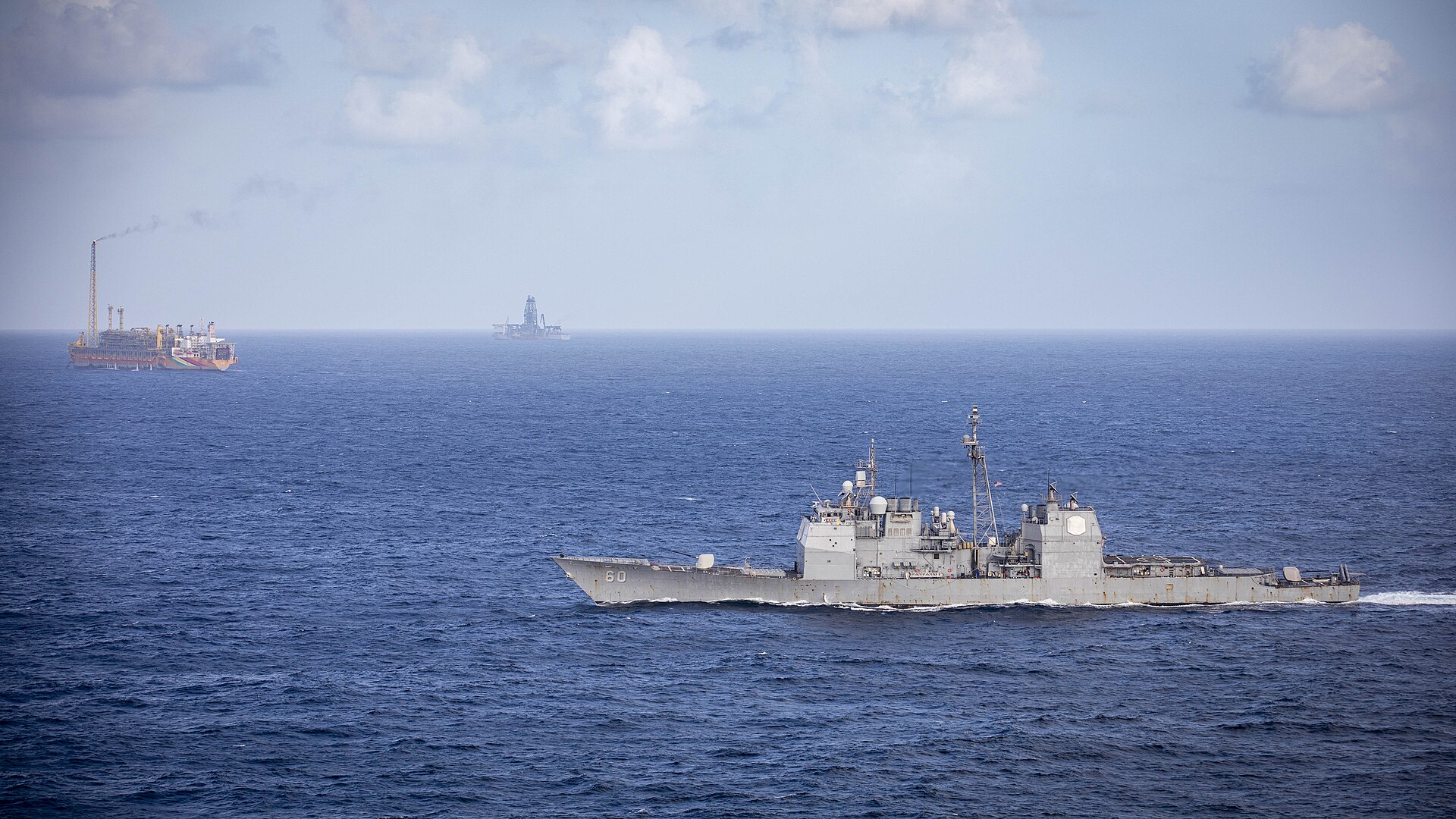
ExxonMobil’s schedule of 12 November 2026 expects Whiptail, the sixth approved project, to produce in 2027 and Hammerhead, the seventh, in 2029. On that timetable installed capacity keeps rising rather than levelling off.
ExxonMobil took the final investment decision, the formal go-ahead to spend, on Longtail, the eighth Stabroek development, on 12 November 2026 after the required government approvals. It expects start-up in 2030 and plans additional investment of US$12.5 billion.
The Longtail ship, ExxonMobil’s release of 12 November 2026 says, is designed for 1.2 billion cubic feet of gas a day and up to 250,000 bpd of condensate, a light oil that comes up with natural gas. It will draw on about 45 subsea wells.
MODEC said on 17 November 2026 that the vessel “achieved First Oil ahead of schedule on November 16, 2026”. It is MODEC’s first FPSO in Guyana, and the company will operate and maintain it for ExxonMobil.
The ship’s name, Errea Wittu, means “abundance” in Warrau, an indigenous language, according to ExxonMobil. MODEC, which will run the vessel for ExxonMobil, is a contractor that builds and operates floating production units.
The vessel can store about 2 million barrels of oil, according to ExxonMobil. MODEC said it sits in 1,690 metres of water.
The Uaru project is owned by ExxonMobil Guyana Limited with 45% as operator, Hess Guyana Exploration Limited with 30% and CNOOC Petroleum Guyana Limited with 25%. Chevron, a US oil major, completed its takeover of Hess, once a separate US oil company, in July 2025, so that 30% now belongs to a second US company.
CNOOC is a Chinese state-owned oil company and the third partner in the venture. For US investors, that means ExxonMobil runs the operation while a Chinese state-owned company shares it.
The two official figures differ by 50,000 bpd, with 1.1 million from ExxonMobil and 1.15 million from the ministry. ExxonMobil’s release of 12 November 2026 expected production to exceed 1 million bpd once Uaru starts.
Capacity is not output: ExxonMobil expects Errea Wittu’s initial capacity of 250,000 bpd in the first quarter of next year, and it has not said how quickly production will climb toward that level. The ExxonMobil and MODEC releases we read do not restate Uaru’s reserves or what the project cost.
If the ship reaches 250,000 bpd, it would add about 28% to the 900,000 bpd base, a simple division of the two company figures. The Whiptail, Hammerhead and Longtail projects then stack further capacity into 2027, 2029 and 2030.
The first-quarter target is the next dated step ExxonMobil has given. It will show how much of the new capacity turns into oil that reaches the market.
Frequently Asked Questions
What is Errea Wittu?
It is a floating ship that pumps, processes and stores oil from the seabed off Guyana. ExxonMobil operates it, and MODEC built it and will run it.
Does Guyana now produce that much oil?
Not yet, because the headline figure is installed capacity, not production. Actual output depends on how quickly the ship ramps up.
Who is behind the project?
ExxonMobil is the operator and largest owner, with Hess Guyana Exploration Limited and CNOOC Petroleum Guyana Limited as partners. Hess is now part of Chevron.
Read More from The Rio Times
Sources
Published Tuesday 24 November 2026 · Source: ExxonMobil releases of 12 and 16 November 2026; MODEC release of 17 November 2026; Government of Guyana statement of 16 November 2026; ExxonMobil · MODEC
This article was produced by The Rio Times’ automated AI newsroom. Editorial responsibility: Matthias Camenzind, Publisher and Editor-in-Chief. The Rio Times also runs Ask Rio Times, which answers from 100,000+ of our own articles, the daily Latin America Power Map, and prediction-market odds on elections and markets.. How we use AI · Report an error