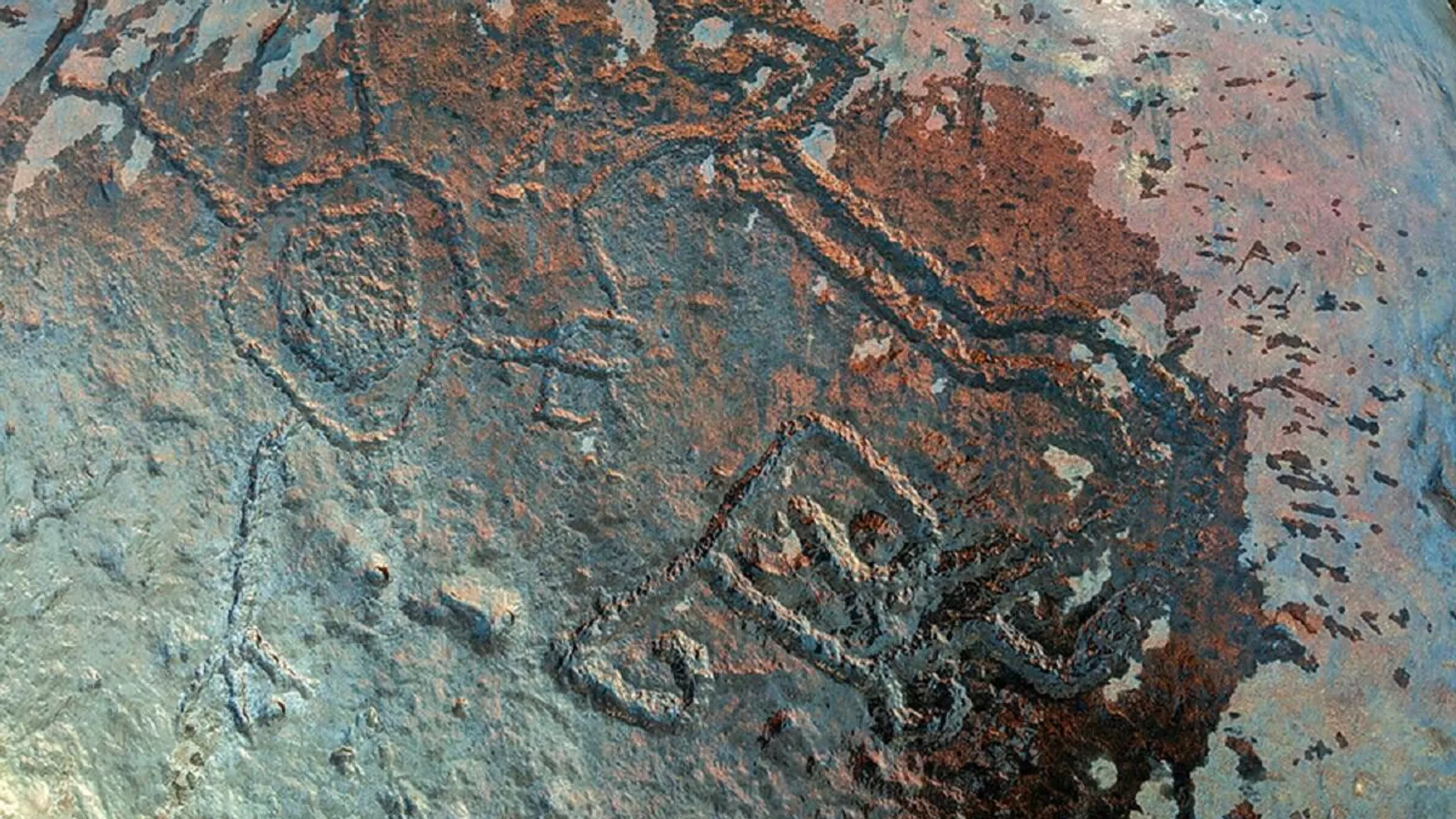
A significant drought in Bolivia has unveiled ancient carved stones in the Amazon’s Beni River.
These carvings, dating back about a thousand years, are now visible for the first time in ages. They raise questions about their meaning and the messages they might convey.
The lowering of the Beni River’s water level exposed these petroglyphs in Rurrenabaque, a municipality in the Amazonian department of Beni.
The ancient artworks made by ancestral civilizations have become a focus of study. This revelation comes as the region awaits its usual seasonal rains.
Cristian Agramont from the Autonomous Municipal Government of Rurrenabaque (GAMR) shared his experience with Sputnik.
He noted that this isn’t the first instance of discovering carved rocks in the region. “We have always known these pictographic stones,” he said.
One notable petroglyph is the seven-headed snake near Rurrenabaque’s urban center.
Agramont believes these carvings represent forest spirits, integral to the region’s indigenous cultures.
Severe Drought
Seven of Bolivia’s nine departments are currently experiencing a severe drought due to the El Niño weather pattern.
These regions include La Paz, Cochabamba, Santa Cruz, Oruro, Chuquisaca, Tarija, and Potosí.
Additionally, wildfires have ravaged 2.9 million hectares nationwide, with 56% in Beni.
Agramont views the stone emergence as potentially significant, perhaps even conveying a message.
He suggests looking at this situation positively. “It’s a chance to revalue our ancestors’ heritage and heed their messages,” he reflected.
The petroglyphs, located between Carmen Florida and Real Beni in the Pilón Lajas Biosphere Reserve, captivate with ancient craftsmanship.
Agramont, who oversees Protocol and Human Resources at GAMR, emphasized the creativity of our ancestors.
Millennium-old stones
The millennium-old stones now resurface, indicating a life once in harmony with nature.
These rocks depict pictographic figures, illustrating a deep bond with the jungle and its wildlife.
They resemble the symbols of the Tacana culture, one of 36 indigenous groups recognized in Bolivia.
Agramont highlighted the seven-headed snake symbol, sacred in indigenous culture, symbolizing a guardian of forest life.
The inscriptions prompt reflection on the environmental care practiced by ancient cultures.
Agramont explained that the Beni River used to be a stream, hence the name Rurrenabaque, meaning ‘stream of ducks’ in the native language.
The petroglyphs likely belong to the Tacana, Leco, and Mosetén peoples, ancient inhabitants of this region.
“We plan to study these rocks to identify their cultural origins,” Agramont revealed.
Rurrenabaque is a key tourist spot in the Bolivian Amazon. It offers access to Madidi National Park and the Pilón Lajas Reserve.
The COVID-19 pandemic hit this tourist-dependent community hard. However, efforts are underway to revive its economy, focusing on tourism.
The Rurrenabaque-Madidi-Pampas circuit was even recognized as a top green destination in 2022.
This area is rich in biodiversity, home to over 265 animal species and more than 5,000 plant types.
More: Bolivia news in English, every day from The Rio Times.
This article was produced by The Rio Times’ automated newsroom system. How we use AI · Report an error
Read More from The Rio Times