Costa Rica Poll Finds 89% Say Iron Fist Does No Harm

POLITICS · COSTA RICA
Key Facts
- —The country Costa Rica, a Central American democracy of about five million people that abolished its army in 1948. President Laura Fernández took office in May 2026.
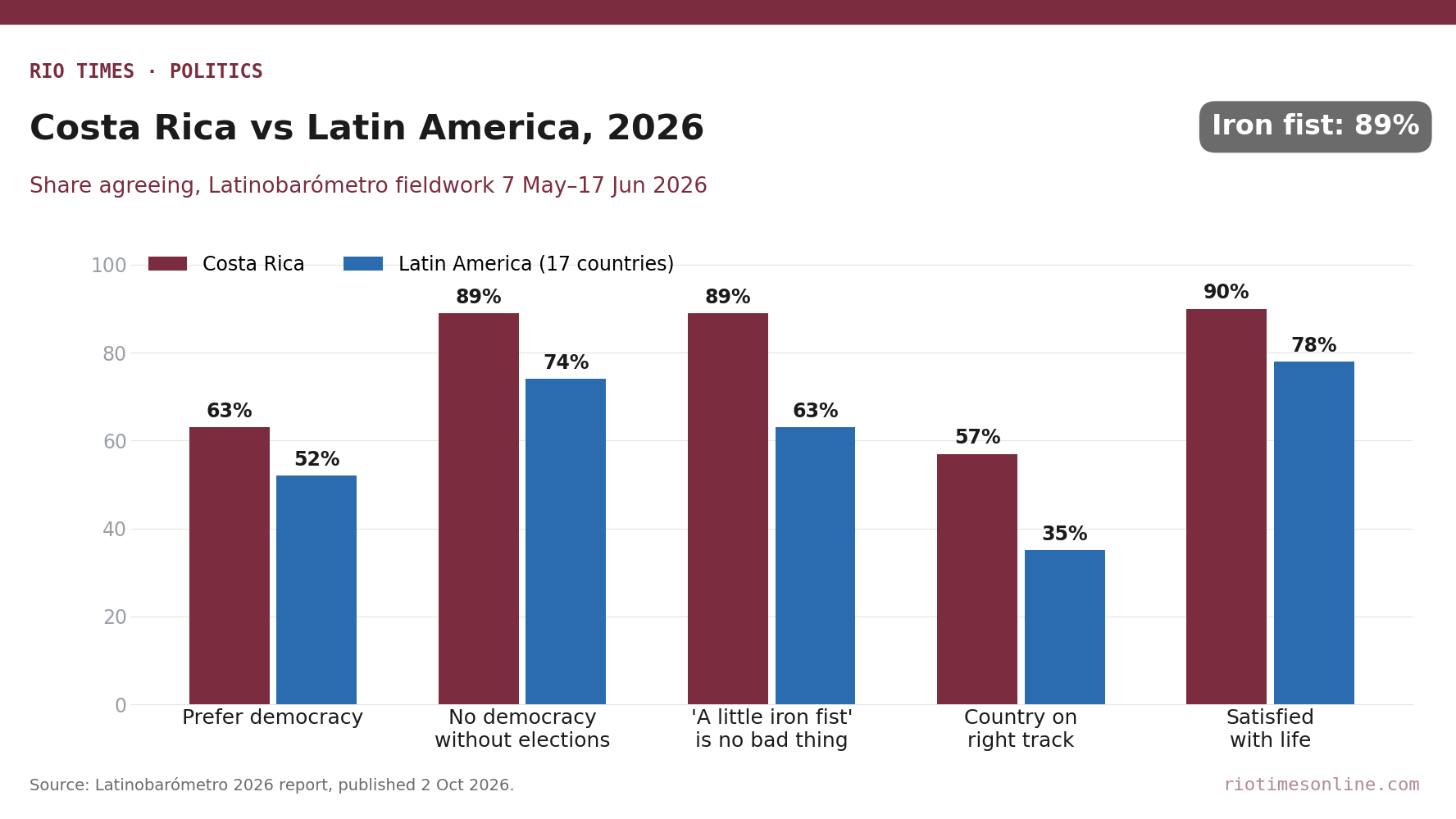
- —What happened The Latinobarómetro 2026 report, published on 2 October, found 89% of Costa Ricans say a little iron fist from government does no harm. The regional average is 63%.
- —The numbers Fieldwork ran from 7 May to 17 June 2026. In it, 63% prefer democracy and 89% say there is no democracy without elections, the regional high.
- —What it means for you Tough security talk will stay popular in Costa Rica. The poll does not show backing for any specific measure, such as states of exception.
- —Still open Which groups hold the view, and whether they would accept limits on rights. The 2026 report publishes no Costa Rican breakdown by age, income or vote.
Costa Rica has the highest share in Latin America of people who say a little iron fist from government does no harm. The Latinobarómetro 2026 survey, published on Friday 2 October, puts the figure at 89%.
The same survey ranks Costa Ricans first in the region for believing that democracy cannot exist without elections, also at 89%. The two findings sit side by side, and the report draws no line between them.
What the survey asked
Latinobarómetro is a Chile-based polling organisation that has tracked opinion across Latin America since 1995. This year it ran 19,207 face-to-face interviews in 17 countries between 7 May and 17 June.
Costa Rica’s sample was 1,000 adults, with a stated margin of error of three points. Nicaragua was left out because interviewers could not work there safely.
The question, asked in Spanish as mano dura, offers two statements. One says a little iron fist from the government does no harm; the other says no iron fist is needed.
Across the region 63% chose the first, against 59% when the question was first asked in 1995. Costa Rica sits at the top with 89%, and Argentina at the bottom with 33%.
Strong democrats, too
The stabiliser is in the same report. Some 63% of Costa Ricans say democracy is preferable to any other form of government, against a regional average of 52%.
Only Argentina (73%) and Uruguay (64%) score higher, while Chile also stands at 63%. Costa Ricans are also the most satisfied with their lives in the region, at 90%.
El Financiero, the San José business paper, stresses that the 89% figure does not show a turn away from democracy. Infobae also notes it is an opinion, not backing for a specific policy.
El Financiero adds that the question names no concrete measure. It does not ask about states of exception, military deployment or limits on civil liberties.
Crime fear behind the answer
The report links this attitude mainly to fear of organised crime. It calls the attitude a feature of Latin American political culture that has barely changed in three decades.
There is a counterweight in Costa Rica’s own figures. The share saying organised crime, gangs or drug groups operate where they live fell between 2020 and 2026, the report says.
It does not give the Costa Rican percentages for that measure. The Rio Times reported in July on Costa Rica’s falling killings and the president’s quarrel with the judges.
Some 57% of Costa Ricans also say their country is heading in the right direction. That is the second-highest score in Latin America, behind El Salvador at 79%.
The political backdrop
Fieldwork began after the February election that Laura Fernández won in the first round. The report describes her as continuing the course of her predecessor, Rodrigo Chaves.
El Financiero cautions that the data cannot show that this attitude decided the vote. It notes the survey does not cross the answer with voting intention. For wider context, see Costa Rica Explained.
What Is Not Yet Known
The published report gives no Costa Rican breakdown by age, sex, education, income, region or crime exposure. It is therefore unclear which groups drive the 89% figure.
It is also unknown whether respondents would accept measures that clash with rights or court oversight. The survey did not ask, and no follow-up question has been published.
What exactly did Latinobarómetro ask?
Respondents choose between two statements: that a little iron fist from government does no harm, or that none is needed. It measures a general attitude, not support for any specific policy.
Does the poll show Costa Ricans turning against democracy?
No. In the same survey 63% prefer democracy, well above the regional 52%. And 89% say there can be no democracy without elections, the highest share in Latin America.
How large was the Costa Rica sample?
Latinobarómetro interviewed 1,000 adults face to face in Costa Rica between 7 May and 17 June 2026. It states a margin of error of three percentage points for each country sample.
Sources: Corporación Latinobarómetro, Informe Latinobarómetro 2026, published 2 October 2026; El Financiero (Costa Rica), 2 October 2026; Infobae, 2 October 2026.
Editorial responsibility: Matthias Camenzind, Editor-in-Chief · Editorial standards · Report an error